
Short Answer: Fall aeration and overseeding is the single most important lawn event of the year in Knoxville, and the decisions that decide how well it works are made in July, not September. July decisions include identifying which areas of the yard need renovation, ordering the right seed mix early before regional supply tightens, scheduling the service window before the calendar fills, and managing the lawn through August so the September window is actually usable. Homeowners who treat July as a planning month see thicker, more uniform lawns by November. Homeowners who wait until September are choosing between the slots no one else wanted.
If you ask us what one service makes the biggest difference for a Knoxville lawn over a 12-month period, the answer is not a fertilizer round, a fungicide application, or a perfectly timed pre-emergent. It is fall aeration and overseeding. Done right, on the right yard, in the right week of September, it is the event that turns a thin, struggling Fescue lawn into a thick, deep-green property by November and a remarkable spring show by April.
Done wrong or done late, it is a waste of money. We have seen seed put down on compacted clay that the cores never penetrated, and renovations rushed in the second week of October when the cool window was already closing. Every one of those outcomes traces back to a missing July decision.
This is the planning blog. The work happens in September. The thinking happens now.
Why Aeration Matters More in East Tennessee Than Almost Anywhere
Three soil realities make aeration disproportionately important in our service area compared to other parts of Tennessee.
Rocky clay throughout Knox County. Our soil is dense, plate-like clay over limestone bedrock with rocky inclusions. It compacts quickly under foot traffic, mower wheels, and freeze-thaw cycles. Compacted clay drains poorly and holds little oxygen, which suffocates roots. Core aeration physically removes plugs of compacted material and creates channels for air, water, and seed to reach the root zone.
Limestone influence. The limestone bedrock under most of the metro creates pockets of alkaline soil and varying calcium levels across short distances. Aeration plugs let lime and other amendments actually reach the soil profile rather than sitting on the surface where they do nothing.
Transition zone biology. Tall Fescue, the dominant cool-season grass in East Tennessee, is a bunch-type grass that does not spread laterally the way Bermuda or Kentucky bluegrass does. Every empty spot in a Fescue lawn stays empty unless you put new seed into it. Aeration plus overseeding is the only reliable way to thicken a Fescue stand once it has thinned out, and most Knoxville Fescue lawns thin out somewhere between mid-July and late August.
Yards in Hardin Valley, parts of Farragut, the ridges around Bearden, and out toward Halls and Karns have particularly shallow soil over rock. The cores need moisture in the soil to pull cleanly. Dry compacted clay in early September shatters the plugs and produces a poor result.
July Decision One: Walk the Yard and Map It
The first July decision is a walkthrough with a notepad or phone camera. You are not treating anything. You are documenting.
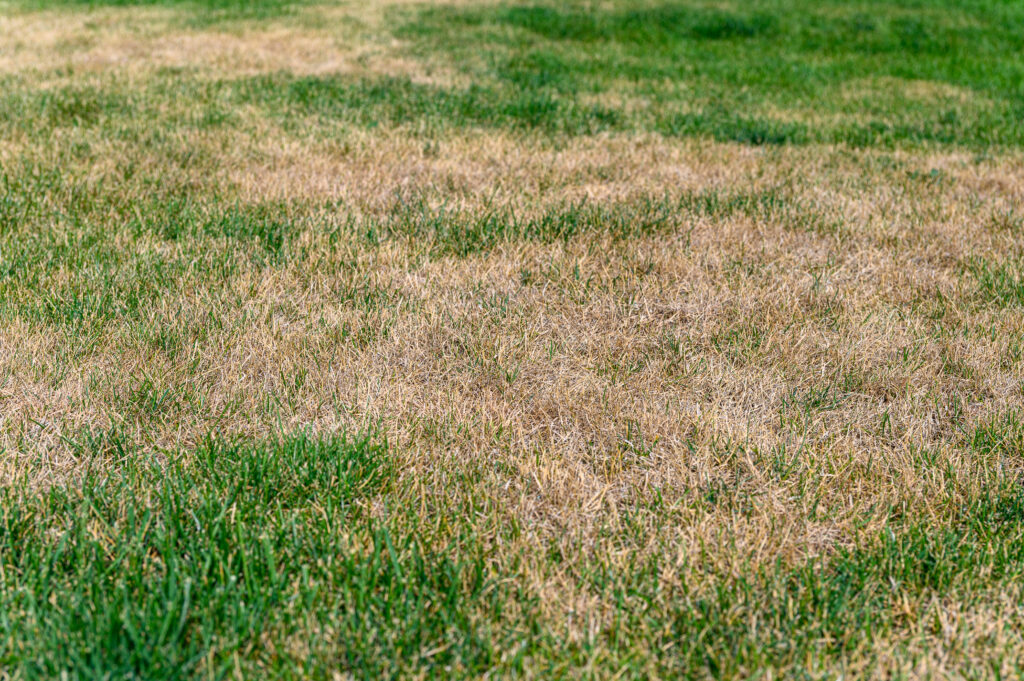
Take photos of every area that looks thin, off-color, or damaged. Pay particular attention to:
- Shaded zones under mature trees, where Fescue typically thins more than open lawn
- Slopes where runoff has carried away topsoil over the winter
- High-traffic paths from driveway to door, kid play areas, and dog runs
- The strip along driveways and roads where heat and reflected sun stress grass
- Any areas that suffered brown patch disease this past June or large patch on Zoysia
These photos become the renovation map. Some areas will need core aeration plus full overseeding. Some will need aeration alone (compacted but already thick enough). Some will need only spot overseeding without aeration. And some will need no work at all because they are already thriving.
Walking the yard now, before August dormancy obscures the picture, gives you a clean read on what August stress is going to look like. We tell every Knoxville homeowner the same thing: your yard tells you what it needs in July. By September, you are guessing.
July Decision Two: Order the Right Seed Now
Seed supply tightens every year as we move through August and into early September. Premium turf-type Tall Fescue blends, the ones that actually perform in the transition zone, get bought up by professional applicators and by homeowners who decided early. By the second week of September, the seed on local shelves is often what is left after the people who planned ahead took the best.
If you are renovating with us, we handle this. If you are doing it yourself, order in July and store the bag cool and dry. Look for turf-type Tall Fescue blends with three or more named cultivars proven for transition zone conditions. Avoid contractor-grade seed and Kentucky 31, which has been superseded by far better cultivars.
For shaded areas under heavy tree canopy, consider a shade-tolerant Tall Fescue blend. The seed bag matters. We see homeowners spend hundreds on professional aeration and then put down the cheapest seed at the home improvement store. The result is a thinner stand than they could have had.
July Decision Three: Lock the Schedule
Our service calendar for September aeration and overseeding starts filling up in July every year. By mid-August, the optimal week (typically the second or third week of September in Knoxville) is heavily booked. Homeowners who call in late September are scheduling into early October, which is functional but cuts the recovery window shorter than ideal.
The biology behind the timing: Tall Fescue seed germinates best when soil temperatures are between 60 and 75 degrees and the seedling has 8 to 10 weeks of cool-season growth ahead of it before the first hard frost. In Knoxville, that ideal planting window is mid-September through the first week of October. Earlier than that and soil temperatures are still too warm. Later and the seedlings do not develop enough root mass before winter to survive freeze-thaw cycles.
For multi-property owners with rental homes on the Sevierville and Pigeon Forge corridor, scheduling in July also lets us coordinate around your booking calendar so we hit properties between guest turnovers. That coordination is impossible if you call us the week you want it done.
July Decision Four: Manage August So September Is Usable
The fourth July decision is the one most homeowners skip. What you do in August determines whether the September window is actually usable. Three August management practices matter most.
Reduce stress in July and August. A Fescue lawn that is barely surviving August will not respond well to aeration in September no matter how perfectly timed. Keep mowing at 4 inches. Water deeply once or twice a week. Skip nitrogen until after the overseeding event. The goal is to bring the lawn into September with living crowns ready to respond to new growth.
For Zoysia areas that suffered large patch this past spring or are at risk this fall, July is when we plan a preventive fungicide application for late August or early September to protect the warm-season turf as it begins to slow down.
Stop summer herbicide on areas you plan to overseed. Most pre-emergent and post-emergent herbicides have residual activity that will prevent or damage new seed germination. The cutoff varies by product but is typically 6 to 12 weeks before seeding. If you plan to overseed in mid-September, your last herbicide window for those areas is mid-July at the latest, and often earlier. Read the label or call us.
Plan the irrigation strategy. Newly seeded Fescue needs consistent moisture for the first 21 days. If you do not have irrigation, you need a plan: a hose-end sprinkler schedule, multiple short cycles per day, someone to manage the watering if you travel. Rental property owners need a contractor or a smart controller in place before seed goes down. Failing the water plan in week one means losing the entire renovation investment.
What a Knoxville Fall Renovation Actually Includes
For homeowners new to fall renovation, here is what we do in the September service window and why each step matters.
- Core aeration with a heavy walk-behind machine that pulls plugs 2 to 3 inches deep, with hole spacing tight enough to create true soil channels (typically 20 to 40 holes per square foot on Knoxville clay)
- Spreading the seed at the right rate (typically 6 to 8 pounds per 1,000 square feet for full overseeding) immediately after aeration so seed falls into the open holes
- A starter fertilizer application targeted to support seedling root development, not push leaf growth
- A clear watering plan and follow-up guidance for the homeowner
- For Zoysia areas, separate timing (late spring is the better aeration window for warm-season grasses, so July is also when we map next May’s Zoysia work)
Leave the aeration plugs on the surface to dissolve back into the soil over the next several weeks. Do not rake them up. They are returning organic matter and microbial life to the root zone.
Why Some Yards Should Not Be Aerated
Not every Knoxville lawn needs annual aeration. Yards on sandier soil, yards that already have good thatch management, and yards that were aerated last year on a 12-month cycle may not benefit from another round. We will tell you that honestly. Aerating soil that does not need it is a way to spend money without improving the lawn.
The diagnostic we use is a screwdriver. If a 6-inch screwdriver pushes into moist Knoxville soil with hand pressure alone, your soil is fine. If you need a hammer to drive it past 2 inches, that yard needs aeration, sometimes two years in a row before single-year-cycle maintenance is enough.
What to Do Next
If you would rather have somebody who plans fall renovations every July across the Knoxville metro walk your yard, map the areas that need work, and put you on the calendar before the prime window fills, that is what we do.
Lawn Squad of Knoxville serves homeowners across Knoxville Metro and East Tennessee.
Call us at 865-564-9525 or request a free quote at lawnsquad.com. Our VitaminLawn program is built around the fall renovation as the cornerstone event of the year, with the seed quality, timing, and follow-through that turn a single September service into a 12-month improvement in your East Tennessee lawn.