
Short Answer: Frederick County lawns get their best fall recovery when core aeration and overseeding happen in a tight window between late August and early October, with the seed going down on the same day as the aeration. The work itself is fast, but the conditions that make it succeed (the right soil moisture, the right cultivar choice, the right seedbed contact, the right post-seeding water) are set up in July. Booking the aeration date, soil testing, irrigation tune-up, and seed sourcing now is what separates the lawns that look transformed in October from the lawns that show a thin, patchy result. Frederick clay soils especially benefit from annual or every-other-year aeration because of the compaction and thatch issues common in newer subdivisions.
Most people in Frederick County think of fall lawn renovation as a September project. The trucks roll, the cores come up, the seed goes down, and six weeks later the lawn looks different. That is the visible part. What we have learned across thousands of Frederick County properties is that the difference between an outstanding fall result and a mediocre one almost always tracks back to choices made in July.
That is not because July is the right month to aerate. It is not. Pulling cores during heat stress or mid-disease is the worst thing you can do. July is the month to set the table.
Here is the planning we do this month for the September and October work, and why each piece matters more in Frederick County than elsewhere.
Why Frederick Lawns Need Aeration More Than Most
Two things make aeration unusually important in our service area. The first is the soil. Frederick County clay is dense and slow to drain, with limestone-influenced subsoil under much of the valley making it slower still. Tall fescue wants to push roots down six to twelve inches when given the chance. Compacted clay locks those roots into the top two or three inches, which is why so many Frederick lawns suffer in July.
The second is new construction. Frederick is one of the fastest-growing counties in Maryland, and most subdivisions built in the last decade sit on aggressively graded sites where topsoil was scraped and fill brought in. Homeowners three to five years into one of those lawns are fighting that legacy. Core aeration is the most effective tool for opening up that compacted profile without ripping the lawn apart.
Older Frederick neighborhoods, downtown Frederick, established sections of Walkersville, country roads outside Middletown and Myersville, often have better native soil but more accumulated thatch from decades of clippings and mature root systems. Aeration there is more about thatch and gas exchange than compaction, but the value is just as real.
The Right Window for Frederick County
Cool-season grasses do their best growing when soil temperatures are between 50 and 65 degrees and air temperatures are mild enough that the new seedlings do not desiccate. In Frederick County, that window opens in the last ten days of August in most years and closes in mid-October. The sweet spot is the first three weeks of September.
Aerating and seeding too early, in mid-August, puts seed down into soil that is still too warm and too dry. Germination is uneven, and brown patch pressure is often still active. Aerating and seeding too late, after the first week of October, leaves new seedlings without enough time to put down meaningful root before the first hard frost in early November. Those plants survive but barely, and they often thin out the following spring.
The narrow window is part of why booking now matters. By August, calendars for the good operators fill up. Properties that get scheduled in July tend to land their preferred week. Properties that wait until late August get whatever slot is left, which is often outside the ideal window.
What Cultivar Choice Does to Your Result
Seed selection is the most ignored piece of the renovation puzzle, and the most expensive to get wrong. The tall fescue bag at the big box store is not the seed we use on Frederick County lawns, and the difference shows.
For most Frederick properties, we use a blend of three to five turf-type tall fescue cultivars bred for transition-zone climates. The traits we care about are brown patch tolerance, drought tolerance, heat tolerance, and dark green color genetics. The National Turfgrass Evaluation Program publishes annual rankings, and the top performers for Maryland are a moving target. Our 2026 mix is not what we recommended in 2022.
For older properties with established KBG, especially the historic neighborhoods around downtown Frederick, we may include a small percentage of bluegrass to maintain the expected look. KBG germinates slower (14 to 21 days versus 7 to 14 for fescue) but offers self-repair through rhizomes.
For shaded properties, typically older streets with mature canopy, a fine fescue component (creeping red fescue, hard fescue, chewings fescue) added to the blend dramatically improves performance. Standard tall fescue does not handle dense shade well.
Sorting out the right blend takes a conversation about sun, traffic, irrigation, and what the existing lawn is mostly made of. That conversation is much easier in July than in late August.
Soil Testing in July Pays Off in September
A soil test costs roughly 20 dollars and gives you information that affects every dollar you spend on fertilizer and seed for the next two to three years. We push for soil tests on every property considering aeration and overseed, and we push hardest in the spots where the limestone bedrock affects pH.
Most Frederick County soils run between 6.5 and 7.5, which is a touch high for ideal turf nutrition. Tall fescue prefers something closer to 6.0 to 6.8. At higher pH, iron and certain micronutrients become less available, which is the reason so many Frederick lawns turn pale yellow in mid-summer even when they have adequate nitrogen. The fix is not always lowering pH. Sometimes it is a sulfur application, sometimes it is supplemental chelated iron, and the right answer depends on the test result.
July is the right month to pull the test. The lab needs two to three weeks to return results. Getting that information back in early August gives you time to apply lime or sulfur ahead of the aeration so the amendments can work into the soil. Doing the soil test in September delays the corrective treatments and stretches the timeline by another full year.
Irrigation Tune-Up in July
New grass seed germinates and establishes only when the surface stays consistently moist for the first three to four weeks. On a Frederick lawn in September, that means short, frequent watering cycles (two to four times per day in the first ten days, tapering down). If your irrigation system has dry zones, broken heads, blocked nozzles, or poor coverage, you find out the hard way in the form of patchy germination.
The fix is to audit your irrigation now. Run each zone in daylight, walk the coverage, watch for dry corners and overlapping wet spots, and get repairs scheduled. Irrigation contractors are also booking up by August. A July call is much easier than a September emergency call.
For properties without irrigation, the planning is different but just as important. You need to map out hose, sprinkler, and timer placement before the seed goes down. A failed germination on a non-irrigated lawn during a dry September stretch is the most painful renovation outcome we see, and it is almost always preventable with planning.
Pre-Aeration Cultural Work
The work that happens between now and the aeration date matters too. Lawns that go into late August in good shape produce better aeration cores and better seed-to-soil contact than lawns that are limping in.
- Hold nitrogen until early September. Pushing growth in July just feeds brown patch pressure and burns through reserves you want for the fall recovery.
- Stay on top of disease. A lawn that loses 20 percent of its canopy to brown patch in late July still recovers with aeration, but the renovation is more about recovery and less about improvement.
- Mow at the full 3.5 to 4 inches. Taller turf has deeper roots and a healthier crown going into the aeration.
- Spot-spray broadleaf weeds in early August, not later. Most broadleaf herbicides have a four-week wait before seeding. Hit those weeds in early August so the chemical clears before mid-September.
- Schedule the aeration date now. The first two weeks of September fill up first. Booking by mid-July typically gets the slot you want.
What the Aeration Day Actually Looks Like
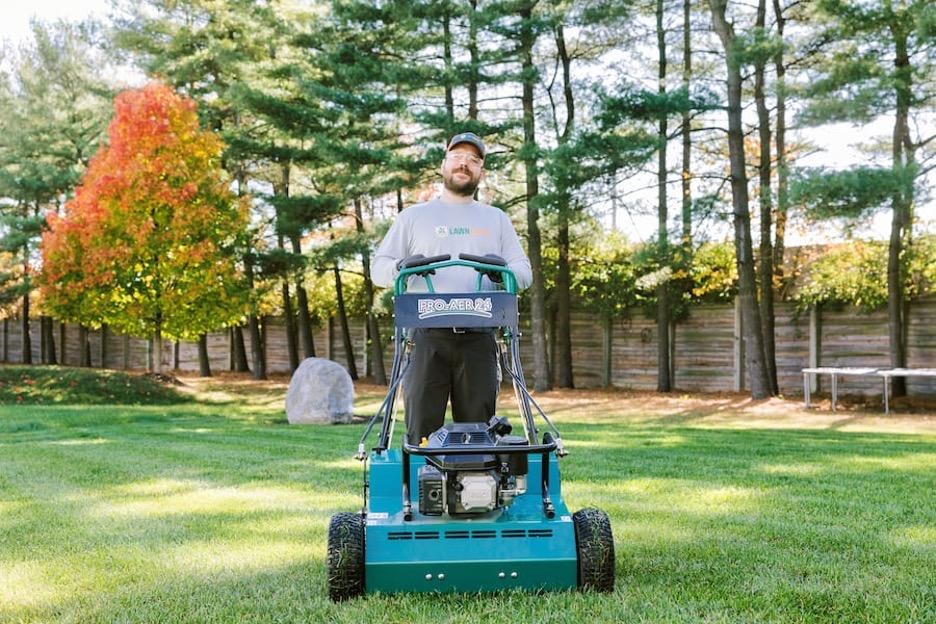
On the day, the crew runs a core aerator over the lawn in two passes, perpendicular to each other, pulling soil plugs about three inches deep. Those plugs stay on the surface and break down naturally over the next two weeks. The holes left behind are the receiving channels for the seed, for water, and for air exchange.
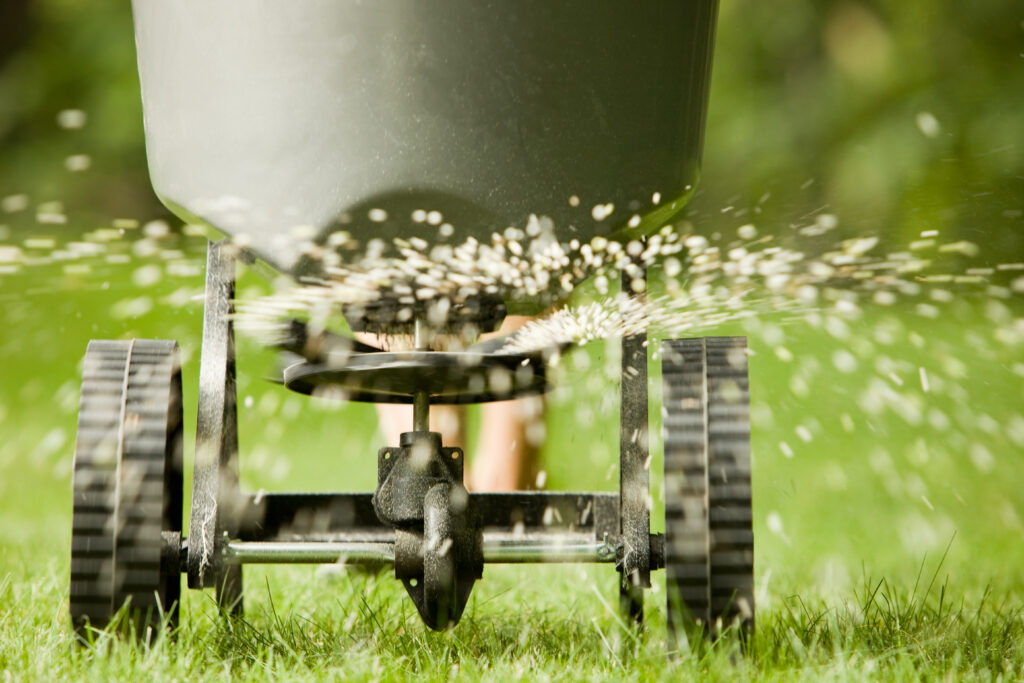
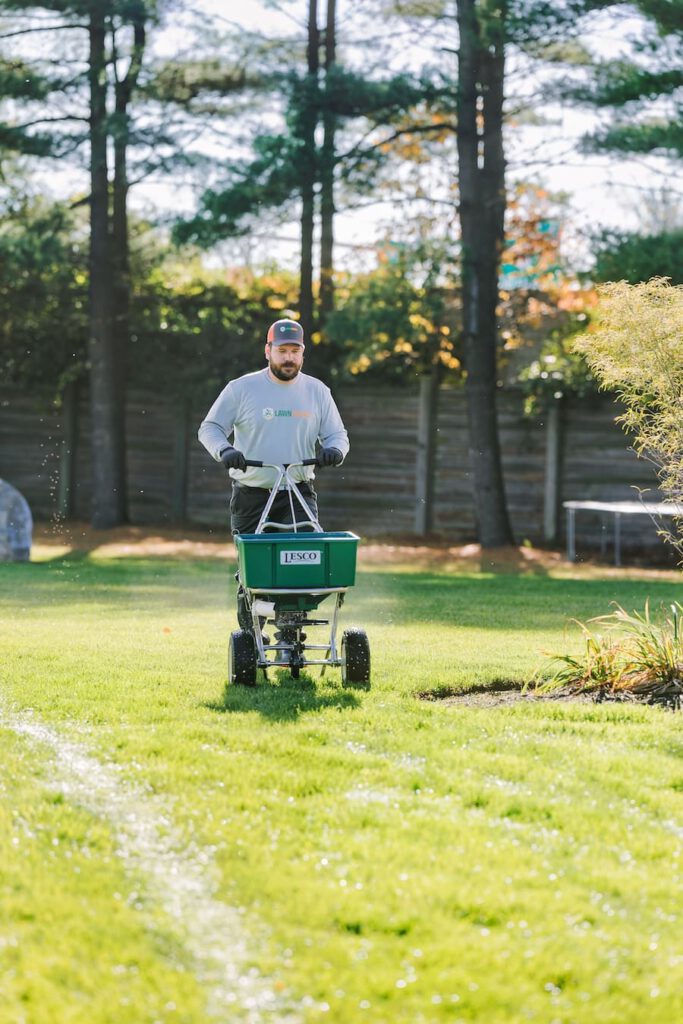
Seed goes down the same day, ideally within an hour or two of the aeration. The fresh holes catch the seed and create perfect seed-to-soil contact. Topdressing with compost is optional but valuable on properties with poor soil quality, common in newer Urbana, Lake Linganore, and Mount Airy developments.
The first week of watering is the most important. Light, frequent cycles, three or four times a day for five to ten minutes, keep the seedbed moist without flooding it. Around day ten, when most of the seed has germinated, you taper to longer cycles less frequently. By day thirty, you are back on a normal one inch per week schedule.
What to Do Next
The aeration and overseeding work itself is straightforward. What separates the great results from the disappointing ones is the planning that happens now. Soil testing, seed selection, irrigation work, scheduling, and the cultural management between now and late August all stack on top of each other. Lawns that get those right come out of October looking like a different property.
Lawn Squad of Frederick serves homeowners across Frederick, Walkersville, Mount Airy, Urbana, New Market, Middletown, and Myersville.
Call us at 301-637-4412 or request a free quote at lawnsquad.com. Our VitaminLawn program is designed around the Frederick County calendar, with fall aeration and overseed treated as the most important single touchpoint of the year for tall fescue lawns on clay soils. We will walk your property in July, build the plan, get the date on the calendar, and make sure September goes the way you want it to.