Short Answer: In Huntsville the trigger is soil temperature, not a date on the calendar. Apply fall pre emergent when soil temperature at the two inch depth has fallen to about seventy degrees and is still dropping, which in the Tennessee Valley usually lands between the third week of September and the middle of October. Annual bluegrass, henbit, chickweed, and hairy bittercress all germinate in that window. Once they have sprouted, a pre emergent will not touch them, and you are left with slower post emergent control on a lawn that is heading into dormancy.
Why Winter Weeds Are Really a Fall Problem
Almost nobody calls a lawn company about winter weeds in the fall. The calls come in February, when a dormant tan bermuda or zoysia lawn is suddenly carpeted in bright green annual bluegrass and low purple henbit, and the contrast makes the property look abandoned.
By February the decision that caused it is four months old. Winter annual weeds germinate in the fall, when soil temperatures fall into a range that breaks their seed dormancy. They spend October through December small, low, and largely invisible in a lawn that is still holding some color. Then as the turf goes fully dormant and daylight lengthens in late winter, they grow rapidly and flower.
The window to prevent all of that is right now, in the fall, before anything visible has happened.
What Actually Germinates Here in the Fall
The Huntsville winter weed roster is fairly consistent year to year across Madison County and the surrounding valley.
- Annual bluegrass, usually called poa annua, is the most common and most complained about. It is a light green bunching grass that produces seed heads at low mowing heights and dies off in late spring, leaving bare spots.
- Henbit and purple deadnettle are the square stemmed weeds with purple flowers that turn fields and lawns purple in March.
- Common chickweed forms dense low mats, particularly in shaded and moist areas.
- Hairy bittercress is the one that fires seed pods at you when you pull it, which is exactly why it spreads so effectively.
- Wild garlic and wild onion push up in clumps and are not controlled by pre emergent at all, since they come from bulbs rather than seed.
Every one of those except the bulb weeds is preventable with a correctly timed fall barrier.
Soil Temperature Is the Trigger, Not the Calendar
The rule that matters is this. Apply when the average soil temperature at two inches has fallen to roughly seventy degrees and is continuing to drop. That is the threshold at which most winter annual seed begins to germinate.
In the Tennessee Valley that generally occurs between the third week of September and the middle of October, but the spread across years is substantial. A warm dry September can push it into the third week of October. An early cool front can bring it forward to the second week of September. Huntsville sits far enough north in Alabama that our soil temperatures fall earlier than Birmingham or Montgomery, which is why advice written for the rest of the state runs late here.
Air temperature is not a substitute. Soil holds heat and lags behind air by a considerable margin, especially under a dense turf canopy. A cool week does not mean the soil has cooled.
How to Actually Measure It
You have two practical options and neither is difficult.
The direct method is a soil thermometer, which costs very little at any garden center. Push it two inches into the turf, in a spot that gets typical sun exposure for the property, and read it mid morning for a reasonable daily average. Take the reading in the same place several days running. You are watching for a trend, not a single number, because one warm afternoon does not mean anything.
The remote method is the network of agricultural weather stations across north Alabama that publish soil temperature data continuously. Those readings are usually taken in bare or minimally covered soil, so they tend to run slightly warmer than what you will find under a thick lawn, but the trend line is accurate and it is free.
Either way, start watching in early September rather than waiting until the number sounds right.
What Happens If You Are Two Weeks Late
Pre emergent herbicides work by creating a chemical barrier in the top layer of soil that interrupts root and shoot development in germinating seedlings. The critical detail is that the barrier has to be in place before the seed germinates.
Applied two weeks after germination has begun, the product does essentially nothing to the plants already up. It will still catch later germinating seed, so a late application is better than none, but you will have a partial weed problem all winter and a homeowner who paid for prevention and got half of it.
The alternative at that point is post emergent control on winter weeds in a dormant or semi dormant lawn. That works, but it is slower, less complete, sometimes requires repeat applications, and leaves dead brown weed skeletons in the turf until they break down.
What Happens If You Go Too Early
Early application is a real error too, not a safe hedge. Pre emergent products have a finite residual life in the soil, generally somewhere in the range of eight to twelve weeks depending on the active ingredient, the rate, and the weather.
Put it down in late August in Huntsville and a meaningful part of that residual is spent before the germination window even opens. The barrier then begins breaking down in November, right when a warm stretch can trigger a second flush of germination. You end up paying full price for partial coverage on the other end.
Heavy rainfall shortens residual life as well, and fall in north Alabama can deliver several inches in a week.
The Case for Splitting the Application
On properties with a heavy history of winter weeds, particularly annual bluegrass, a single application often does not carry the whole window. Annual bluegrass in particular does not germinate all at once. It comes in flushes through the fall and into early winter whenever conditions are right.
The stronger approach on those lawns is an application at the seventy degree trigger and a second application roughly six to eight weeks later, which extends the barrier through the tail of the germination period. That is a judgment call based on what the property did last year rather than a default.
Watering It In
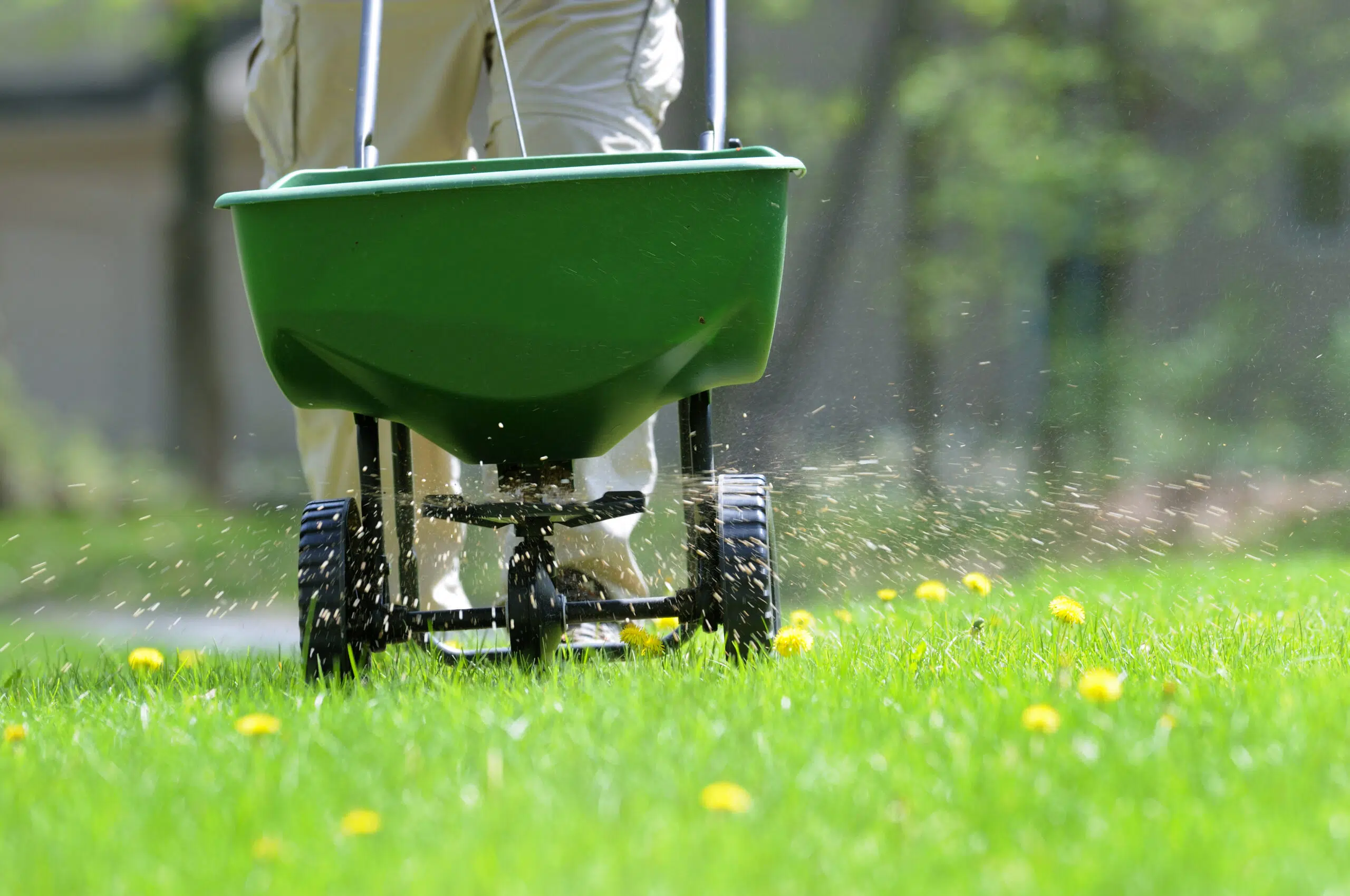
Most granular pre emergent products need roughly a half inch of water within a few days of application to move the active ingredient off the granule and into the top layer of soil where the barrier forms.
Until that happens the product is sitting on the surface doing nothing, and it can be blown or swept off. If rain is not in the forecast, run the irrigation. This is the most common reason a properly timed application underperforms, and it is entirely avoidable.
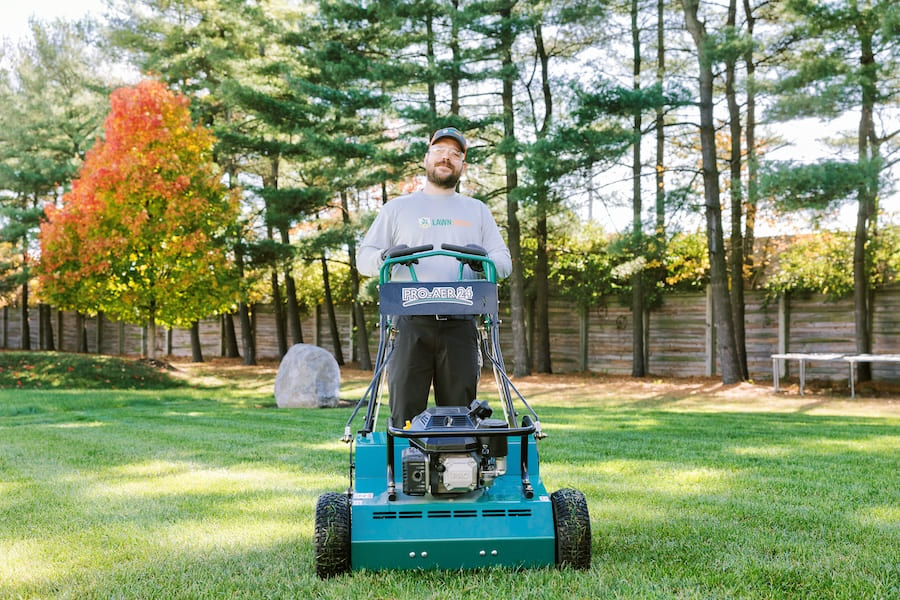
Just as important, do not disturb the barrier afterward. Aerating, dethatching, or heavy raking through treated turf punches holes in the chemical layer and weeds come up through those openings. Any of that work needs to happen before the application, not after.
The Fescue Conflict That Is Specific to Huntsville
This is where Huntsville differs from markets farther south, and it catches people every year.
We sit in the transition zone. Plenty of properties in Madison County have bermuda or zoysia in the sun and tall fescue in the shade, and a fair number are fescue throughout. Fescue is a cool season grass and fall is the correct time to seed it, generally September into early October, which is the exact same window as the pre emergent application.
Pre emergent cannot tell fescue seed from annual bluegrass seed. Apply one and you have prevented the other. On a mixed property that means treating different areas differently on different dates, and on a fescue property that means choosing between seeding and pre emergent for that season, or using a product specifically labeled to allow seeding, applied according to the interval on its label.
Trying to do both on the same turf on the same weekend produces a lawn with neither the seedlings nor the weed control.
Limestone Soil in the Tennessee Valley
Soils in and around Huntsville are largely derived from limestone, which is unusual for Alabama and gives us pH values that often run neutral to alkaline rather than the acidic readings common through most of the state.
That matters for two reasons. First, homeowners here who apply lime by habit because they read that southern soils are acidic can push pH further out of range and create nutrient availability problems. Second, soil pH influences how some herbicides behave and how long they persist. A soil test in the fall costs very little and tells you what your property actually is rather than what the region is assumed to be.
What Pre Emergent Will Not Do
Set expectations correctly so you are not disappointed in March.
- It does not control weeds that are already growing. It only prevents germination.
- It does not control perennial weeds that return from roots, rhizomes, or bulbs, which is why wild garlic and wild onion push straight through it.
- It is not permanent. The barrier degrades and it has to be reapplied on schedule every season.
- It does not fix a thin lawn. Bare ground grows weeds, and the most durable weed control in Huntsville is turf density.
What to Do Next
Walk the lawn this week and write down the two or three things that actually bother you about it, then work backward from the window rather than forward from today. Almost every fall mistake we see in Huntsville comes from starting with the calendar instead of with the lawn.
If you would rather have someone look at it with you, Lawn Squad of Huntsville offers a free quote. Call 833-816-7508 or find us at lawnsquad.com. Every Lawn Squad location is independently owned and operated, and our VitaminLawn fertilization and weed control program is built around the grass, soil, and conditions here rather than a national average.
A first visit is a walk of the property, a look at the thin areas, a check of mowing height and irrigation, and a straight conversation about what is realistic in the weeks left this season. At 30 days you should see color and density improve. At 90 days the lawn should be visibly thicker, with the root growth that carries it through winter.