

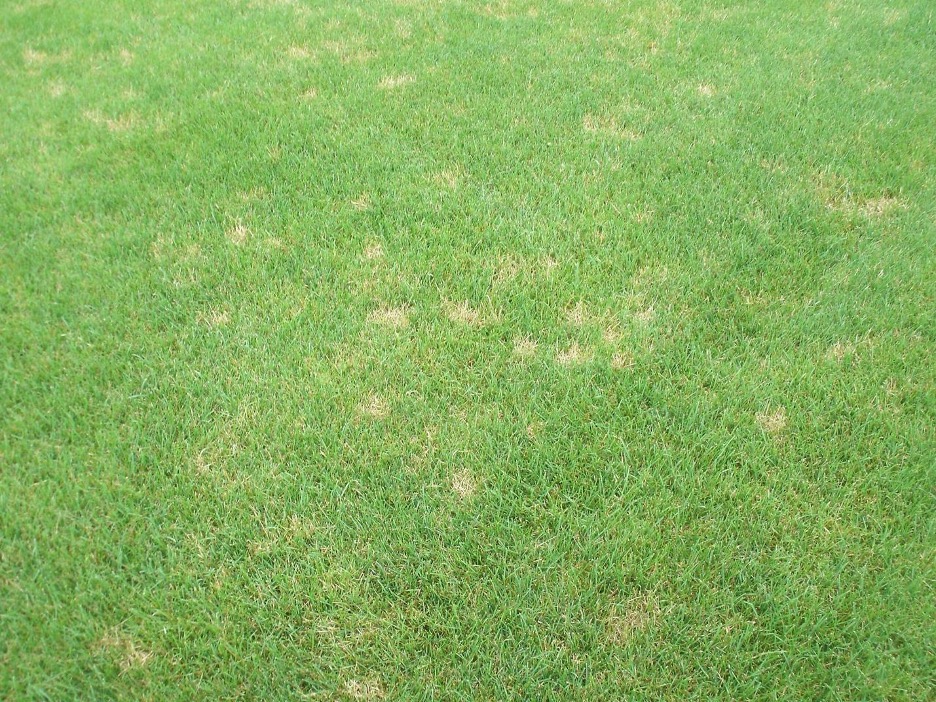
Short Answer: In Cherry Hill the most likely cause is brown patch, a fungal disease of tall fescue driven by nights above 68 degrees, long periods of leaf wetness, and available nitrogen. South Jersey supplies all three from mid July through August. It shows up as irregular tan patches with a smoky gray advancing edge on dewy mornings, and individual blades carry tan lesions with dark borders. It rarely kills the crown, so most lawns recover in fall, but it leaves the stand thin enough that weeds claim the space first.
Start by Ruling Out Drought Dormancy
Before assuming disease, check whether the lawn was simply dry. Cool season grass responds to prolonged heat and moisture stress by going dormant, which is a survival mechanism rather than damage. On the sandy coastal plain soils under Cherry Hill, that happens quickly, sometimes within a week or ten days of the last meaningful rain.
Drought dormancy has a recognizable pattern. It is fairly uniform rather than patchy, it appears first on the sunniest ground, on south facing slopes, over shallow soil, and along driveways and sidewalks that radiate heat. The color is even straw, not blotchy. Crowns stay alive, and the lawn greens back up within a week or two of good rain or irrigation. If your brown areas look like that and recovered after the weather broke, you had dormancy and not a disease.
Brown Patch Is the Most Likely Answer
If the browning was patchy, appeared quickly in mid to late summer, and did not recover with water, brown patch is the leading candidate. It is caused by the fungus Rhizoctonia solani, and it is the dominant summer disease on tall fescue throughout South Jersey.
It requires three conditions, and this area reliably delivers all three from mid July through August. Nighttime temperatures above about 68 degrees, which we have for weeks at a stretch. Extended leaf wetness, ten hours or more, which our humidity and heavy dew produce even without irrigation. And available nitrogen, which pushes the soft lush growth the fungus prefers. Tall fescue is the most susceptible common lawn grass, which is an awkward fact given that tall fescue is also the best fit for this region’s soil and heat.
How to Confirm Brown Patch
Go out at first light on a morning with heavy dew, before the sun burns it off. Active brown patch shows a distinct smoky gray or purplish band at the leading edge of the patch, where the fungal growth is advancing into healthy turf. That ring is the clearest field diagnostic there is, and it disappears within an hour or two of sunlight.
Then look at individual blades with reading glasses or a phone camera zoomed in. Brown patch produces irregular tan lesions running across the leaf blade, each with a distinctly darker brown border. The patches themselves are usually irregular in shape, anywhere from a few inches to several feet across, and on a badly affected lawn they run together into large blighted areas. Critically, pull on the turf. It should stay firmly rooted. Brown patch attacks leaf tissue, not roots, so if the sod lifts freely you are looking at an insect problem instead.
Gray Leaf Spot Hits Ryegrass Hard Here
Gray leaf spot is worth knowing about specifically because New Jersey is one of the regions where it does the most damage, and because it is far more destructive than brown patch. It devastates perennial ryegrass, and it can also affect tall fescue.
The disease is most active from August into September, exactly when nights are warm and humidity is high. Early symptoms look like small tan spots with dark borders and a slightly fuzzy gray appearance in humid conditions, and affected blades often twist and shrivel at the tip in a way people describe as looking scorched or fishhooked. Unlike brown patch, gray leaf spot can kill plants outright, and a stand of perennial ryegrass can collapse in a matter of days. If your lawn contains a lot of ryegrass and it disappeared rather than just browning, this is the likely reason, and it argues for shifting the seed mix toward tall fescue.
Dollar Spot Looks Different Up Close
Dollar spot is common here and easy to distinguish once you know what to look for. Instead of large irregular patches, it produces small, sharply defined, round bleached spots roughly the size of a silver dollar, sometimes merging into larger areas on a badly affected lawn.
On individual blades it creates a distinctive hourglass shaped lesion, a tan band running across the width of the blade with reddish brown borders on either side. In early morning dew you can often see fine white cottony webbing on the affected spots. Dollar spot is strongly associated with low nitrogen, which makes it the opposite of brown patch in that respect. A lawn showing both diseases in the same summer usually has an inconsistent fertility program rather than too much or too little of anything.
Pythium Blight in the Low Spots
Pythium blight is less common on home lawns but genuinely dangerous when it appears, and it favors specific conditions found on some properties in this area. It needs extreme heat and humidity along with standing water or saturated soil, so it shows up in low areas, along drainage swales, and in spots where a downspout or irrigation head keeps the ground wet.
It moves fast, often overnight, and it typically appears as greasy, dark, water soaked streaks that follow drainage patterns or mower tracks, sometimes with a cottony white growth visible in the early morning. Affected grass collapses and dies rather than just discoloring. If you see that pattern, stay off the area while it is wet, since foot traffic and mowing spread it directly. Improving drainage in the affected spot matters more than any spray.
Chinch Bugs and Sod Webworm
Two insects produce damage frequently mistaken for disease or drought in this region. Chinch bugs feed by inserting mouthparts at the base of the plant and withdrawing sap, and they favor hot dry sunny areas, particularly the strips along driveways, sidewalks, and south facing foundation beds. The damage looks exactly like drought stress, and the giveaway is that it does not respond to watering. Part the grass at the soil line in an affected area on a hot afternoon and look for small dark insects with a white marking across the back moving quickly.
Sod webworm larvae chew grass blades off near the crown, producing small ragged brown patches and a lawn that looks closely and unevenly scalped. Look for pencil lead sized green pellets of frass in the thatch, and for small buff colored moths flying in a zigzag pattern just above the turf at dusk. Neither insect causes the turf to lift like carpet, which remains the signature of white grub feeding.
The Three Habits That Feed Summer Disease
Most of the disease pressure on a Cherry Hill lawn traces back to three controllable practices.
- Watering in the evening or at night. This extends leaf wetness through the entire overnight period, which is precisely what brown patch, dollar spot, and gray leaf spot require. Water between 4 a.m. and 9 a.m. instead.
- Applying nitrogen in June and July. Summer nitrogen produces soft growth that is highly susceptible, and it does so at the moment the plant can least afford it. Feed in spring and fall, and leave midsummer alone.
- Mowing too short. Every inch of blade height supports root depth. Set the deck at three and a half to four inches from June through September, keep the blade sharp, and never remove more than a third of the height in one cut. Torn leaf tips from a dull blade are open wounds that pathogens enter.
What Fungicides Can and Cannot Do
Fungicides are preventive tools, not repair tools. Applied before or at the very beginning of a disease cycle, they protect healthy tissue. Applied to a lawn that is already blighted, they stop further spread but do nothing to bring back what is already dead, and they cannot regrow grass.
For most home lawns in this area, the honest answer is that cultural practices and better cultivar selection deliver more value per dollar than a fungicide program. A preventive program makes sense on a high value lawn where appearance through August genuinely matters, and it needs to start in early July before symptoms appear, with applications on a repeating interval through the disease period. Spot spraying in late August after the damage is done is the most common way homeowners waste money on fungicide.
Why It Happens Again Every Year
Brown patch does not arrive from somewhere. Rhizoctonia lives in the soil and thatch of essentially every lawn in this region year round, waiting for conditions. That means eradication is not the goal and is not possible. Management is.
The lawns that come through August looking acceptable in Cherry Hill share a short list of traits. They are planted with improved tall fescue cultivars carrying good brown patch resistance ratings. They are mowed high. They are watered early in the morning, deeply enough to matter but not so often that the surface never dries. They are not fed nitrogen in midsummer. And they have soil with enough organic matter to hold water through a dry stretch. None of those are quick fixes, which is why September is the useful month.
Fall Recovery and Cultivar Selection
Because brown patch spares the crown, most affected lawns recover a good deal of density on their own once nights cool into the 50s and 60s. Give it two to three weeks before deciding what is actually dead. Where the stand is genuinely thin, overseed now, since September into the first week of October is the best establishment window of the year in South Jersey.
Use that overseeding to change the genetics of the lawn rather than replacing what failed. Buy an improved turf type tall fescue blend and look for cultivars with strong brown patch resistance ratings from independent turf trials. Keep perennial ryegrass to a small percentage given the gray leaf spot pressure here. Core aerate first so seed reaches soil, apply starter fertilizer, and keep the surface damp for two to three weeks. Then get the fall fertilizer applications done before New Jersey’s seasonal application blackout begins in mid November, since that feeding is what builds the root reserves that carry the lawn into next summer.
What to Do Next
Walk the lawn this week and write down the two or three things that actually bother you about it, then work backward from the window rather than forward from today. Almost every fall mistake we see in Cherry Hill comes from starting with the calendar instead of with the lawn.
If you would rather have someone look at it with you, Lawn Squad of Cherry Hill offers a free quote. Call 833-816-7508 or find us at lawnsquad.com. Every Lawn Squad location is independently owned and operated, and our VitaminLawn fertilization and weed control program is built around the grass, soil, and conditions here rather than a national average.
A first visit is a walk of the property, a look at the thin areas, a check of mowing height and irrigation, and a straight conversation about what is realistic in the weeks left this season. At 30 days you should see color and density improve. At 90 days the lawn should be visibly thicker, with the root growth that carries it through winter.


