
Short Answer: Some of it does, and that is why how you feed matters more here than how much. The coastal sands around Jacksonville and St. Augustine hold very little water and very few nutrients, so soluble nitrogen applied at a heavy rate can move below the root zone with the next hard rain. The fix is not more fertilizer. It is slow release nitrogen at lighter rates applied more often, irrigation that does not push water past the roots, and building organic matter over time so the soil can actually hold what you give it.
What Coastal Sand Actually Is
Dig a hole anywhere in Duval or St. Johns county and in most locations you will find sand within a few inches. Much of this coastline is former beach and dune deposit, and the soil is dominated by relatively large, rounded quartz particles with very little clay and very little organic matter mixed in.
That structure has one genuine advantage. Water moves through it freely, so these lawns drain fast and rarely stay waterlogged after a storm. Everything else about it works against you. Large particles mean large pore spaces, and large pore spaces do not hold water. Quartz sand is also chemically close to inert, which means it does very little to grip nutrients and keep them where the roots are.
A soil like this is closer to a container than to a field. It supports the plant physically and it delivers whatever you put into it, but it stores almost nothing on its own.
Cation Exchange Capacity, in Plain Terms
The technical measure of a soil’s ability to hold nutrients is cation exchange capacity. The concept is simpler than the name. Clay particles and organic matter carry negative electrical charges on their surfaces, and many plant nutrients carry positive charges. Those opposite charges attract, so the soil physically holds nutrients on those surfaces until roots take them up.
Sand has very little charged surface area. A heavy clay soil might have a cation exchange capacity in the twenties or higher. Coastal Florida sand frequently tests in the low single digits. The practical translation is that a clay soil can be handed a large amount of nutrition and hold onto it for weeks, while a sandy soil holds a small amount briefly and lets the rest pass.
This is why the same bag of fertilizer, applied at the same rate, produces different results in Jacksonville than it does in Atlanta. The product is not the variable. The soil is.
Where the Nitrogen Goes
Nitrate, which is the form of nitrogen plants take up most readily, carries a negative charge. That means even a soil with decent cation exchange capacity does not hold it well, and sand holds it essentially not at all.
Apply a heavy dose of quick release nitrogen to a sandy lawn, get two inches of rain that night, and a substantial portion of it moves straight down past the root zone. The grass never sees it. You paid for it, the lawn greened up for ten days on the part it caught, and the rest is gone.
It does not vanish from the world, which is the part that matters beyond your yard. Leached nitrate moves into groundwater and eventually into the St. Johns River, the Intracoastal Waterway, and the coastal estuaries, where excess nutrients feed algae blooms. That connection is the direct reason fertilizer ordinances exist across this part of Florida.
Why More Fertilizer Is the Wrong Response
The intuitive reaction to a lawn that fades quickly after feeding is to feed heavier next time. On sand, that makes the problem worse in three separate ways.
It increases the amount available to leach, so a larger share of what you buy leaves the root zone. It creates a boom and bust growth pattern, where the lawn surges, produces soft tissue, and then runs out, which is stressful for the plant and attractive to chinch bugs and disease. And on St. Augustine grass, heavy nitrogen builds thatch faster, and thatch is exactly where sod webworm larvae and chinch bugs shelter.
The goal on sandy soil is a steady low supply, not a large periodic one. That single shift in thinking solves most of what homeowners here complain about.
Slow Release Versus Quick Release
Read the guaranteed analysis on the bag rather than just the three numbers on the front. What you are looking for is how much of the nitrogen is in a controlled or slow release form.
- Quick release sources such as ammonium nitrate and urea dissolve immediately and are fully available at once. They produce fast color and they are the most vulnerable to leaching on sand.
- Slow and controlled release sources, including polymer coated and sulfur coated products and various nitrogen forms that break down gradually, release over weeks. Far less is sitting in solution at any moment, so far less is available to wash out.
- Organic and natural sources release as soil microbes break them down, which is inherently gradual and also contributes organic matter.
On coastal sand, a product with a high percentage of its nitrogen in slow release form is worth paying more for. It is one of the few places in lawn care where the premium product genuinely outperforms in proportion to the price difference.
Lighter Rates, More Often
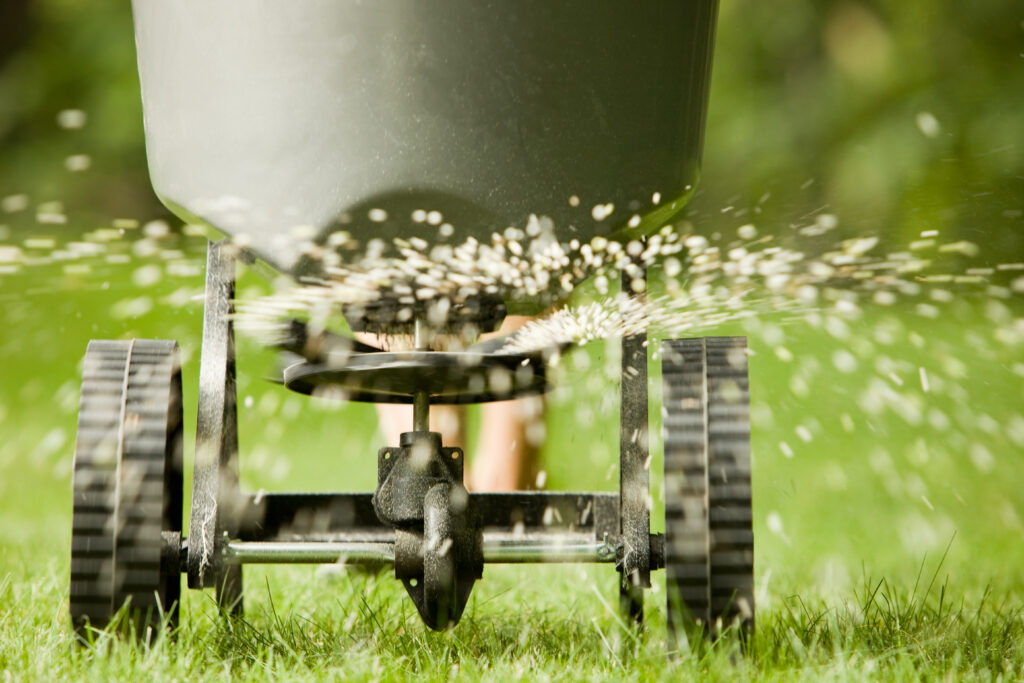
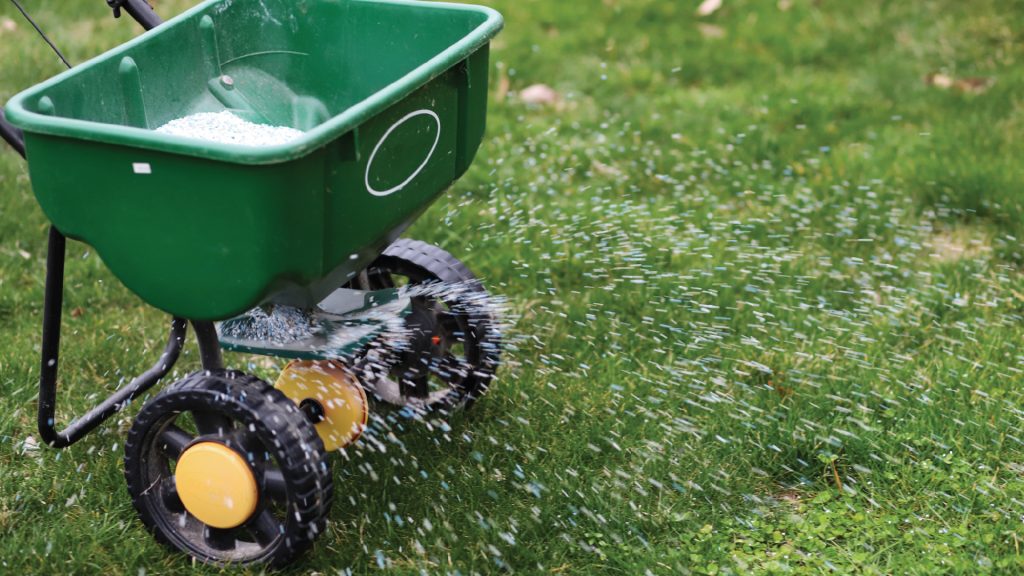
The professional approach on sandy soil is sometimes called spoon feeding. Rather than a single heavy application every couple of months, you apply smaller amounts on a shorter interval so supply roughly matches uptake.
The practical version for a homeowner is to cut the rate meaningfully and increase the frequency, keeping total seasonal nitrogen within what the grass and the local ordinance allow. Less sits in the soil unclaimed at any given time, growth is steadier, color is more consistent, and the flush of soft growth that follows a heavy feeding never happens.
Calibration matters more than usual here, because on sand the difference between the correct rate and double the correct rate is not just wasted money, it is a real leaching event.
Irrigation Is Half of the Problem
You can do everything right with the fertilizer and undo it with the sprinklers. Water is the vehicle that moves nutrients down, and on sand it does not take much.
Sandy soil holds roughly half an inch of available water per foot of depth, sometimes less. Apply an inch in one cycle and a good portion of it, along with whatever is dissolved in it, moves below the root zone. That is why the standard advice to water deeply and infrequently needs adjusting on true coastal sand. Deep still applies in the sense of wetting the root zone thoroughly, but the total volume per event has to respect how little the profile can actually hold.
In the fall the volume should be coming down anyway. Cut back as temperatures drop and daylight shortens, shift the schedule so cycles finish around sunrise, and use a functioning rain sensor. Watering the day after a fertilizer application should be a light irrigation to move the product off the leaf and into the soil, not a soaking.
What Sand Loses Besides Nitrogen
Nitrogen gets the attention but it is not the only nutrient walking out of a sandy profile.
- Potassium leaches readily on sand and it is the nutrient most tied to stress tolerance, root function, and cold hardiness. Sandy coastal lawns are frequently potassium deficient, and it is a common reason a lawn looks generally weak with no obvious single symptom.
- Magnesium leaches similarly, and deficiency shows up as yellowing between the veins on older leaves.
- Iron and manganese availability is heavily influenced by pH, and many properties in this area have soil pH pushed upward by shell fragments in the sand or by irrigation water drawn from limestone aquifers. High pH can leave iron present but unavailable, producing a pale lawn that does not respond to nitrogen.
That last point is worth emphasizing. A pale St. Augustine lawn is not automatically short on nitrogen. If pH is high, a chelated iron application will green it up in days without adding growth, and adding more nitrogen instead just produces thatch. A soil test distinguishes the two and costs very little.
Fall Timing in North Florida
North Florida gets a longer season than the rest of the Southeast, and that changes the fall calendar meaningfully.
The general warm season rule is to stop nitrogen about six weeks before the average first frost so new growth can harden off. Along this stretch of coast the first frost typically arrives in December, and some winters barely deliver one at all in the immediate coastal zone. That gives Jacksonville and St. Augustine lawns a genuinely longer feeding window than Birmingham or Atlanta.
Longer does not mean open ended. Push nitrogen through November and you get soft growth going into whatever cold events do arrive, plus higher large patch pressure as soil temperatures fall through the seventies. A better use of late fall on sandy soil is potassium for stress tolerance, a properly timed pre emergent for winter annual weeds, and iron for color without growth.
Local Fertilizer Ordinances
Many counties and municipalities across north Florida have adopted fertilizer ordinances, and they carry real requirements. Provisions commonly include restricted application periods during the summer rainy season, limits on nitrogen and phosphorus rates, minimum slow release percentages, buffer zones near water bodies, and prohibitions on applying before heavy rain or on impervious surfaces.
The specifics differ by jurisdiction and they get amended, so confirm the current rules for your address with your county or municipal government rather than relying on general guidance. A licensed professional operating in your area is required to know and follow them.
Worth noting is that these rules are largely aligned with what actually works on sand. Slow release requirements and rate limits exist because leaching is real, and following them tends to produce better results, not worse ones.
Building Soil That Holds What You Give It
You cannot replace coastal sand, but you can improve its holding capacity over time, and this is the only permanent fix available.
Organic matter is the lever. It carries charged surfaces just as clay does, it holds many times its weight in water, and it feeds the microbial life that cycles nutrients. Return clippings when you mow rather than bagging them, since they carry a meaningful share of the nitrogen you applied straight back to the soil. Topdress thin areas with a quality compost. Use natural and organic nitrogen sources as part of the program. Avoid unnecessary soil disturbance, which burns organic matter off.
Progress is slow and measured in years rather than months, but it compounds. A sandy lawn that has had clippings returned and organic inputs applied for five seasons behaves noticeably differently from one next door that has been bagged and fed synthetically the whole time.
Salt and Wind on the Coastal Edge
Properties near the Atlantic and along the Intracoastal have an additional variable. Salt spray carried inland on the wind deposits on leaf tissue and accumulates in soil, and sodium competes with calcium, magnesium, and potassium for the little exchange capacity that sandy soil has.
St. Augustine grass tolerates salt better than most lawn grasses, which is a substantial part of why it dominates here. Centipede is considerably less tolerant, and bermuda falls in between. On the most exposed properties, adequate irrigation to flush salts downward through the profile is part of routine management, and a soil test that reports sodium is worth requesting rather than assuming.
What to Do Next
Walk the lawn this week and write down the two or three things that actually bother you about it, then work backward from the window rather than forward from today. Almost every fall mistake we see in Jacksonville and St. Augustine comes from starting with the calendar instead of with the lawn.
If you would rather have someone look at it with you, Lawn Squad of Jacksonville-St. Augustine offers a free quote. Call 833-816-7508 or find us at lawnsquad.com. Every Lawn Squad location is independently owned and operated, and our VitaminLawn fertilization and weed control program is built around the grass, soil, and conditions here rather than a national average.
A first visit is a walk of the property, a look at the thin areas, a check of mowing height and irrigation, and a straight conversation about what is realistic in the weeks left this season. At 30 days you should see color and density improve. At 90 days the lawn should be visibly thicker, with the root growth that carries it through winter.