How Should I Change My Sprinkler Schedule From Summer to Fall?
Short Answer: Cut days, not minutes. As days shorten and temperatures drop, your lawn uses noticeably less water, so reduce how often you run each zone while keeping runtimes long enough to wet the root zone deeply. The easiest way is the seasonal adjust or water budget percentage on your controller, stepped down through September and October. Seeding is the one exception, and it reverses the rule completely: new seed needs short, frequent cycles until it germinates, then a deliberate taper back to deep and infrequent. Finish the season with a deep soaking before shutoff.
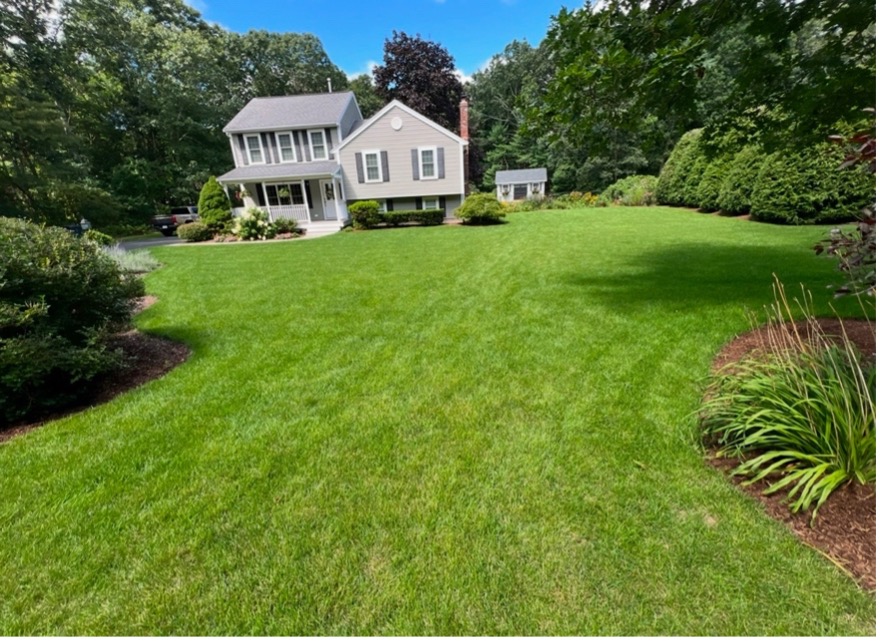
Here is a scene we walk into constantly in late August. The controller in the garage is still running the schedule somebody set in the third week of June, back when the lawn was losing water faster than anything could replace it. The lawn has soft spots now. There is moss creeping in along the north side of the house, mushrooms in the shady corner, and a low area near the downspout that squelches underfoot at eight in the morning. Nothing is broken. The schedule is just three months out of date.
Almost nobody enjoys reprogramming a sprinkler controller, and most people have been quietly hoping the lawn will sort itself out. It will not, and overwatering in fall causes as much damage as underwatering did in July.
Why the June Schedule Stops Making Sense
Grass loses water through its leaves and the soil loses it to evaporation. Together that is called evapotranspiration, and it is driven mostly by sunlight, temperature, humidity and wind. Every one of those inputs is changing right now. Days are getting shorter, the sun angle is dropping, and nights are cooling.
The practical result is that a lawn needing well over an inch of water a week in peak summer may need meaningfully less by late September and less still by late October. If your schedule does not follow that curve down, you are not being generous. You are creating a saturated root zone, and saturated soil has no oxygen in it, which is why roots get shallower in a wet fall rather than deeper.
Rainfall complicates it further. In much of the country the fall pattern shifts toward longer, slower, more soaking rain events instead of the fast convective storms of summer. An inch of gentle rain enters the soil profile in a way that an inch of thunderstorm running off a compacted clay lawn never does, so late season rain counts for more than the rain gauge suggests.
Cut Days, Not Minutes
This is the adjustment homeowners get backward most often. The instinct is to trim a few minutes off every zone and keep watering on the same days. That produces frequent shallow watering, which trains roots to live in the top inch of soil, exactly the opposite of what fall is for.
Keep the runtime that gets water down into the root zone and take away days. Three days a week becomes two, then one. If you have never measured what your system actually applies, put a few straight sided cans out on the lawn, run a zone, and see how long it takes to collect a half inch. That single measurement tells you more than any published schedule, because head spacing, pressure and nozzle type vary enormously between systems.
Most controllers made in the last twenty years have a seasonal adjust or water budget feature that scales every zone at once by a percentage. Stepping that number down through the fall is a two minute job instead of a twenty minute one, and it is the single most useful button on the box. On heavy clay or on slopes, split each runtime into two or three shorter cycles with a soak period between them so the water has time to move in rather than run to the curb.
Seeding Turns Every Rule Upside Down
If you are aerating and overseeding this fall, ignore everything above for a few weeks. A grass seed sitting in the top quarter inch of soil has no root system and no reserve. If that thin surface layer dries out once after the seed has begun to swell, the seed dies. Not stalls. Dies.
So during germination you water lightly and often, short cycles two to four times a day, enough to keep the surface consistently damp without creating puddles that float seed into low spots. Depending on species, germination runs from about five days for perennial rye to two or three weeks for Kentucky bluegrass, and a blend will come up in waves rather than all at once.
The part people miss is the taper. Once seedlings are up and mowed once or twice, that frequent schedule becomes actively harmful, encouraging shallow roots and disease in a canopy that stays wet. Over the following two to three weeks, work back toward fewer, deeper waterings. The lawns we see fail in November are usually not the ones that were watered too little at seeding. They are the ones left on the germination schedule until frost.
The Details That Cause Fall Problems
Water in the early morning. Finishing before the sun is fully up gives blades time to dry and dramatically reduces disease pressure, which matters more in fall than summer because the dew period lengthens as nights cool. Evening watering in a humid climate is close to a brown patch and large patch recipe.
Check your rain sensor. Many systems have one, plenty of them have failed quietly, and a number of states require a working rain shutoff device on automatic systems. A sensor that stopped working two summers ago is why a system runs through a rainstorm while the neighbors watch.
Also walk the zones with the system on at least once this month. Fall is when a misaligned head watering the driveway or a sunken head in a low spot finally shows up as a pattern in the turf, and those are cheap fixes compared with the seed you would otherwise spend replacing the damage.
One last habit worth breaking: watering by the day of the week because that is when the sign says you may. If it rained two inches on Tuesday, skipping the Thursday cycle is not neglect, it is the correct decision.
What Changes Where You Live
In the cool-season North, demand drops fast after Labor Day, and the season ends with a hard deadline. Systems get blown out with compressed air before the first sustained freeze, usually somewhere in October, and the important detail is that the lawn frequently still needs water after shutoff. If October runs warm and dry, hose and sprinkler once or twice. A deep soaking before the ground freezes measurably improves winter survival.
In the transition zone, the priority is disease avoidance during the long warm humid stretch of September, so morning watering and generous dry-down between cycles matter more than total volume. In the warm-season South, keep watering into fall while roots are still active, then continue occasional deep watering on dormant bermuda and zoysia through a dry winter, since winter desiccation is a real cause of spring thinning that gets blamed on cold.
In the arid West, the calendar is often set for you. Pressurized secondary irrigation systems shut off on a district schedule, commonly in mid October, and watering restrictions may still be in force. Plan a deep final soaking before that date rather than after. In tropical Florida and along the Gulf, the pattern reverses entirely. The rainy season winds down in the fall, so irrigation demand goes up as the dry season begins, and the systems that idled through August often need to come back to a real schedule in November.
What to Do Next
Do three things this week. Set your controller’s seasonal adjust down a step, move every start time into the early morning, and run one catch can test so you know what a half inch actually costs you in minutes. If you are seeding, build the germination schedule now and put a reminder on the calendar for the day you will start tapering it, because that is the step everyone forgets.
If you would rather have someone look at the whole picture, find your local Lawn Squad at lawnsquad.com or call 833-816-7508 for a free quote. Every Lawn Squad location is independently owned and operated, and each builds its VitaminLawn fertilization and weed control program around the grass type, soil and climate where you actually live, watering expectations included.
A first visit is a walk of the property, a look at the wet spots and the dry ones, a check of mowing height, and a straight conversation about what your schedule should look like between now and shutoff. At 30 days, a corrected schedule usually shows up as firmer footing, fewer mushrooms and better color in the areas that were staying wet. At 90 days, the real result is underground, in a deeper root system that makes next July considerably less stressful for both of us.