Short Answer: Almost all summer thinning along the Connecticut shoreline traces back to five causes: brown patch and dollar spot in our humid stretches, grub feeding on the roots, chinch bug damage in the hot strips beside pavement, drought stress on shallow or sandy soil, and simply mowing too short. Each one leaves a different signature, and the correct fix is different for each. Fall is when you diagnose it, because the evidence is still readable on the ground, and it is also the only good window to repair the damage before next summer arrives.
Diagnose First, Buy Product Second
The single most expensive mistake in a thinned lawn is treating the wrong cause. Grub control does nothing to a fungal problem. Fungicide does nothing to insect feeding. Watering more makes disease worse. So before anything else, get on your hands and knees in the worst area and look at what is actually there.
Along the New Haven and Fairfield shoreline we have a specific combination working against cool season grass: high summer humidity coming off Long Island Sound, warm nights that never let the turf dry out, a heavy grub complex, and a lot of properties with either thin sandy soil near the water or shallow soil over ledge inland. Those conditions point to a short list of suspects.
Brown Patch, the Big One on Tall Fescue
If your lawn is tall fescue and it fell apart in late July or August, brown patch is the first thing to check. It thrives when daytime temperatures are in the eighties, nighttime temperatures stay above about seventy, and the leaf surface stays wet for long stretches. That describes a coastal Connecticut August almost perfectly.
It shows as irregular tan or brown patches from a few inches to several feet across. Early in the morning while dew is still on the lawn, you can sometimes see a grayish smoke ring at the advancing edge. Look at individual blades: brown patch produces tan lesions with a darker border running across the leaf. The good news is that brown patch usually kills leaf tissue rather than the crown, so much of it recovers on its own once nights cool. The areas that do not recover are your overseeding targets.
Dollar Spot and Red Thread
Two other diseases show up constantly in this area and get confused with each other. Dollar spot produces small, sharply defined bleached spots roughly the size of a silver dollar that can merge into larger blighted areas. Individual blades show a straw-colored band with a reddish-brown edge. Dollar spot is strongly associated with low nitrogen, so a lawn that has been underfed is far more susceptible.
Red thread is the pink one. It hits perennial ryegrass and fine fescue hardest, appears in cool wet stretches in spring and again in fall, and produces patches with visible pinkish-red threads at the tips of the blades. It looks alarming and it is rarely serious. Both of these respond well to correcting fertility rather than to spraying.
Grubs: Pull, Do Not Guess
Coastal Connecticut has one of the more crowded grub situations in the Northeast. Japanese beetle, Oriental beetle, European chafer, and Asiatic garden beetle are all present, and Oriental beetle in particular is heavily established along the shoreline.
The test is simple and it takes five minutes. Grab a handful of turf at the edge of a brown area and pull. If it lifts away like a loose piece of carpet with no roots holding it, grubs have been eating the root system. Then cut a square foot of sod, fold it back, and count the C-shaped white larvae in the top few inches of soil. A healthy lawn tolerates a few. The common treatment threshold is somewhere around six to ten per square foot, and lower than that if the lawn is already stressed.
Skunks, raccoons, and crows tearing up the turf at night is a strong secondary signal. They are not damaging your lawn out of spite. They are digging because there is something worth eating under it.
Chinch Bugs Along the Hot Edges
Chinch bug damage looks a lot like drought and gets misdiagnosed constantly. The tell is location. Chinch bugs concentrate in the hottest, driest, sunniest strips of the lawn: along the driveway, beside the sidewalk, against a south-facing foundation, and in the sun-baked strip by the road.
If those specific areas went yellow then straw brown while the rest of the lawn held up, and watering them did not help at all, part the grass at the edge of the damage and look at the soil surface. The adults are small, dark, and white-winged, and they move when disturbed. Unlike grub damage, chinch bug turf does not pull up loose, because the roots are intact. The insect feeds on the stems above ground.
Drought Stress and What Our Soil Does
Properties in this area sit on two very different kinds of ground. Close to the Sound, soils are often sandy and drain fast, which means they hold very little water and a lawn there can go into visible stress within a week of no rain. Farther inland in Fairfield County, a lot of yards are shallow soil over glacial till or ledge, so roots hit an obstruction and stop.
Either way the result is the same: a limited water reservoir and a lawn that browns out quickly during a dry stretch. Drought dormancy is usually recoverable, but if it goes on long enough the plants actually die, and you get the same brown patches that never green back up. The tell for drought versus disease is the pattern. Drought damage follows topography and soil, so it shows up on the high spots, the slopes, and the sunny south side first, in that order.
Mowing Height and a Dull Blade
This is the cause nobody wants to hear and the one that costs nothing to fix. Cool season grass cut at two inches has a root system roughly proportional to what is above ground, which is not much. Cut at three and a half to four inches, the same lawn shades its own soil, holds moisture longer, and roots deeper.
A dull blade makes it worse. It tears the leaf tip instead of cutting it, and the frayed white tips you see the day after mowing are open wounds that lose water and give disease an entry point. Sharpen twice a season. During a July heat stretch, raise the deck and cut less often rather than more.
Shade Under the Fairfield County Canopy
A lot of yards in this area sit under mature oaks, maples, and beeches. Grass under that canopy is short on light all season and competing with tree roots for water in the top several inches of soil. It goes into summer already weak, and it is the first thing to disappear in August.
If the thin areas map neatly onto the tree canopy, no fertilizer program is going to solve it. The realistic answers are limbing up the lower branches to raise the canopy, selective thinning to let more light through, switching those areas to a fine fescue blend that tolerates shade, and mowing the shaded turf a half inch higher than the rest of the lawn.
What Repair Looks Like This Fall
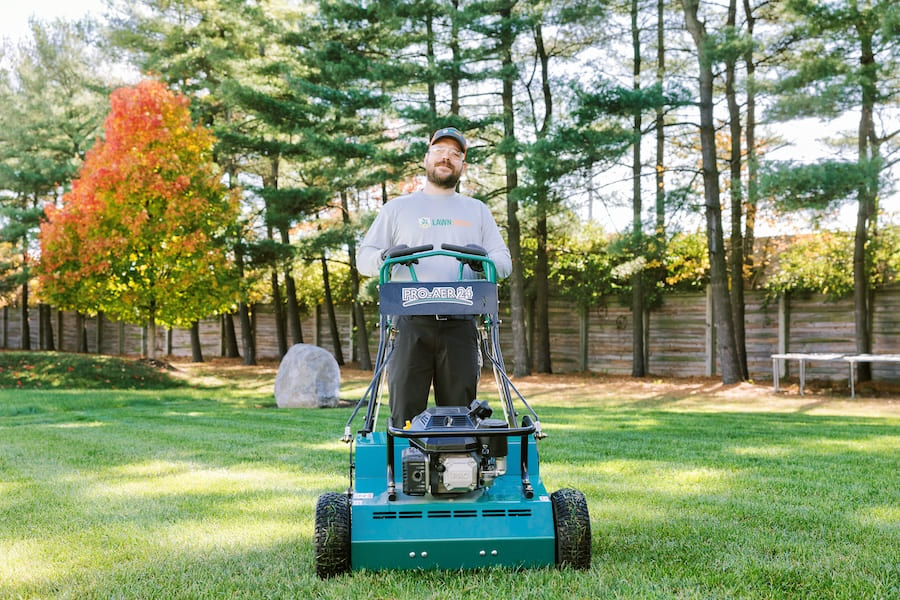
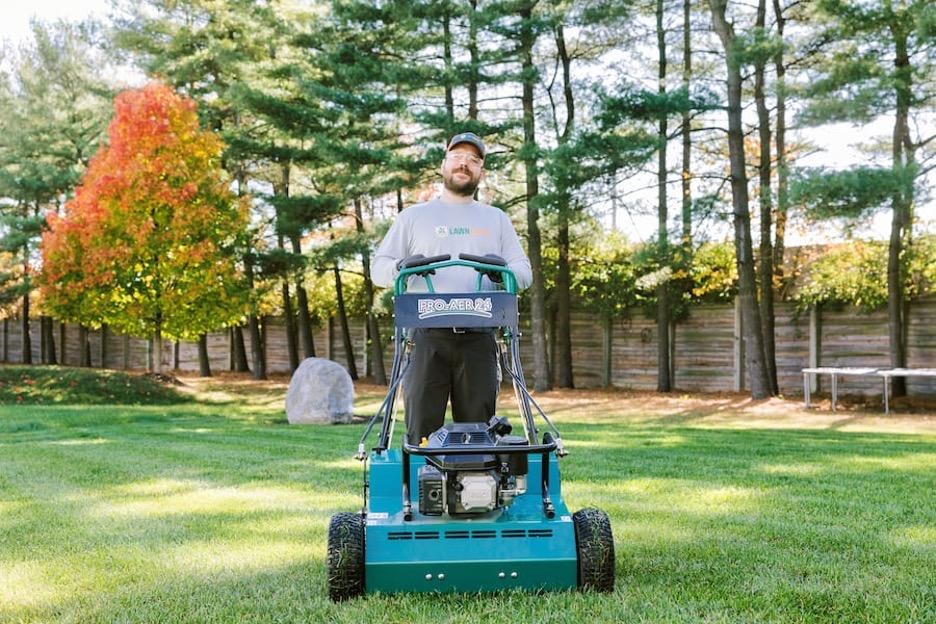
Once you know the cause, the fall work is fairly consistent. Core aerate to relieve compaction and open the surface, overseed the thin areas with a seed type suited to the light and soil in each part of the yard, and get seed down in September while soil is warm enough for fast germination. In this part of Connecticut the window runs from late August into early October, with mid September the best of it.
Keep the seeded areas continuously damp for the first two weeks, then transition to deeper and less frequent watering. Feed the lawn in fall. This is when cool season grass does its real root building, and the nitrogen you apply in October is what produces spring color without forcing soft growth in April.
What to Change for Next Summer
Fall repair fixes the damage. Changing a few habits keeps it from repeating. Water deeply and infrequently, roughly an inch a week in one or two applications rather than a light daily cycle, and run irrigation in the very early morning so blades dry quickly. Overnight watering in a coastal August is close to a guarantee of disease.
Raise the mowing height and keep it there. If grubs were confirmed this year, plan a preventive application for late spring or early summer when the eggs are hatching, rather than reacting in August after the roots are already gone. Curative options do exist for early fall while grubs are still small and feeding near the surface, but prevention is both cheaper and more reliable.
What to Do Next
Walk the lawn this week and write down the two or three things that actually bother you about it, then work backward from the window rather than forward from today. Almost every fall mistake we see in New Haven and Fairfield County comes from starting with the calendar instead of with the lawn.
If you would rather have someone look at it with you, Lawn Squad of New Haven and Fairfield offers a free quote. Call 833-816-7508 or find us at lawnsquad.com. Every Lawn Squad location is independently owned and operated, and our VitaminLawn fertilization and weed control program is built around the grass, soil, and conditions here rather than a national average.
A first visit is a walk of the property, a look at the thin areas, a check of mowing height and irrigation, and a straight conversation about what is realistic in the weeks left this season. At 30 days you should see color and density improve. At 90 days the lawn should be visibly thicker, with the root growth that carries it through winter.