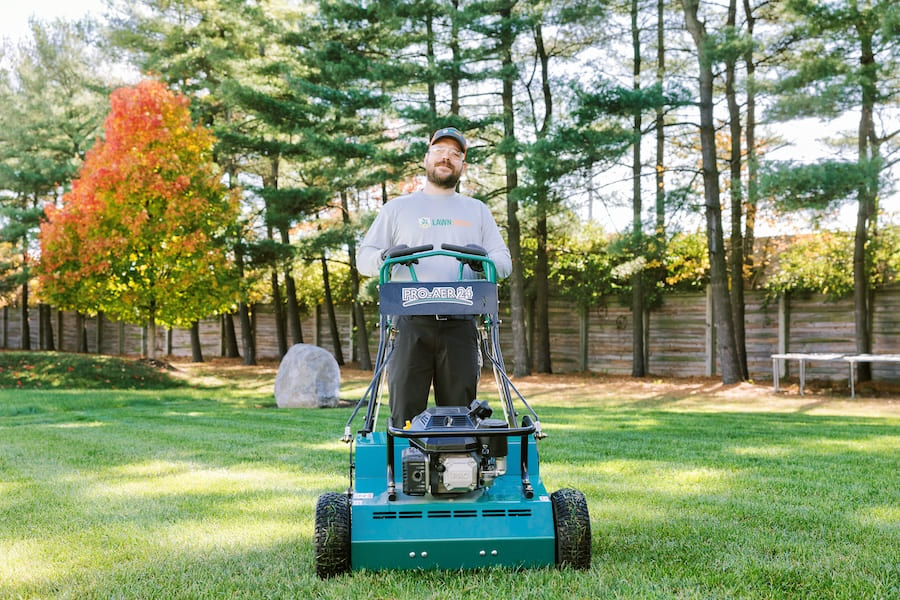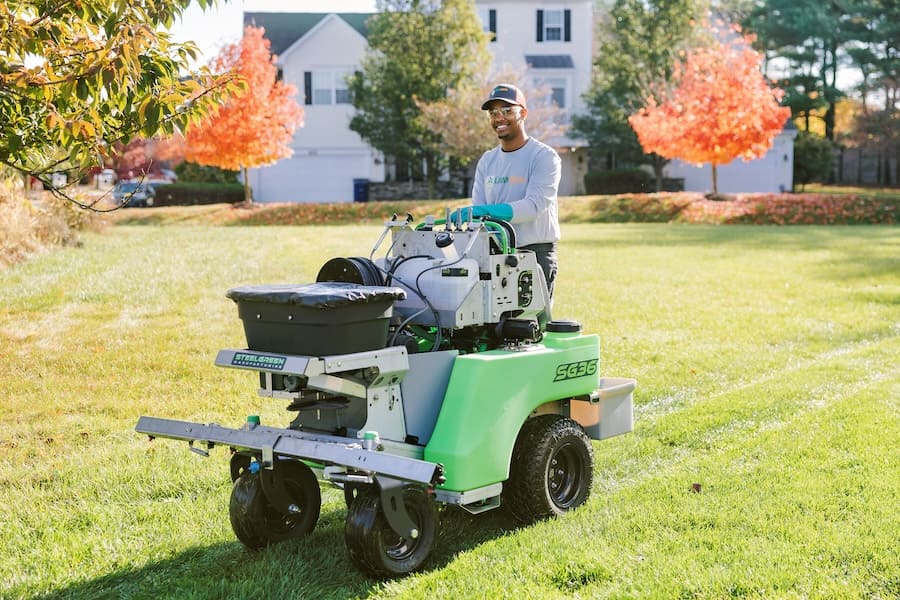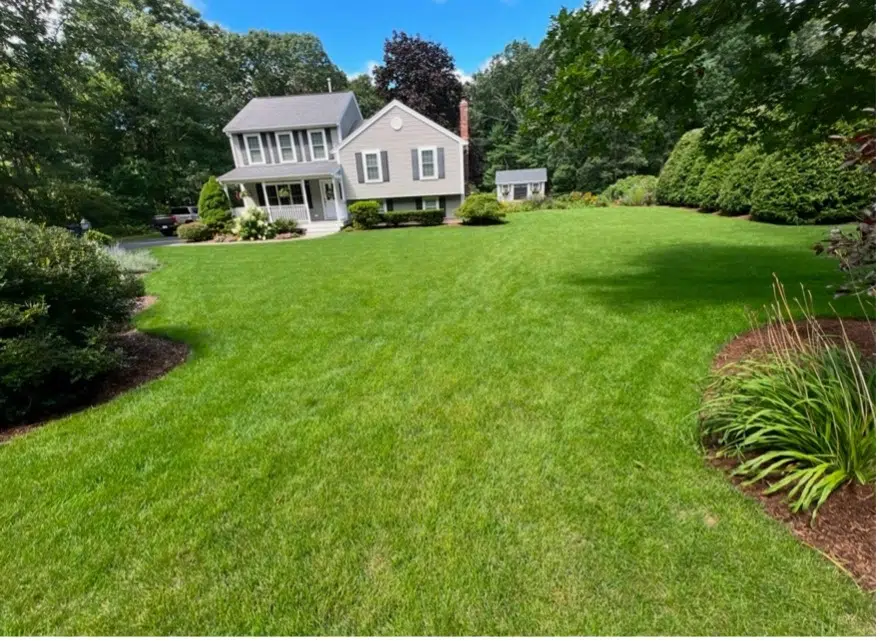
Short Answer: In Frederick, the aeration and overseeding window runs from roughly the third week of August through the first week of October, and the middle of September is the sweet spot. Soil is still warm enough to germinate tall fescue in seven to fourteen days, nights have cooled off, and seedlings get eight to ten weeks of root growth before the ground turns cold. Seed after mid October and you are gambling on a warm fall. Seed in spring instead and crabgrass takes the ground you just opened up.
Why Frederick Lawns Need Seed Every Single Year
Most lawns in and around Frederick are turf-type tall fescue, sometimes blended with a little Kentucky bluegrass. Tall fescue is a bunch-type grass. It grows in clumps and widens very slowly, and it has no rhizomes or stolons to send runners sideways into a bare spot. When a plant dies in August, nothing crawls over to fill the hole it leaves.
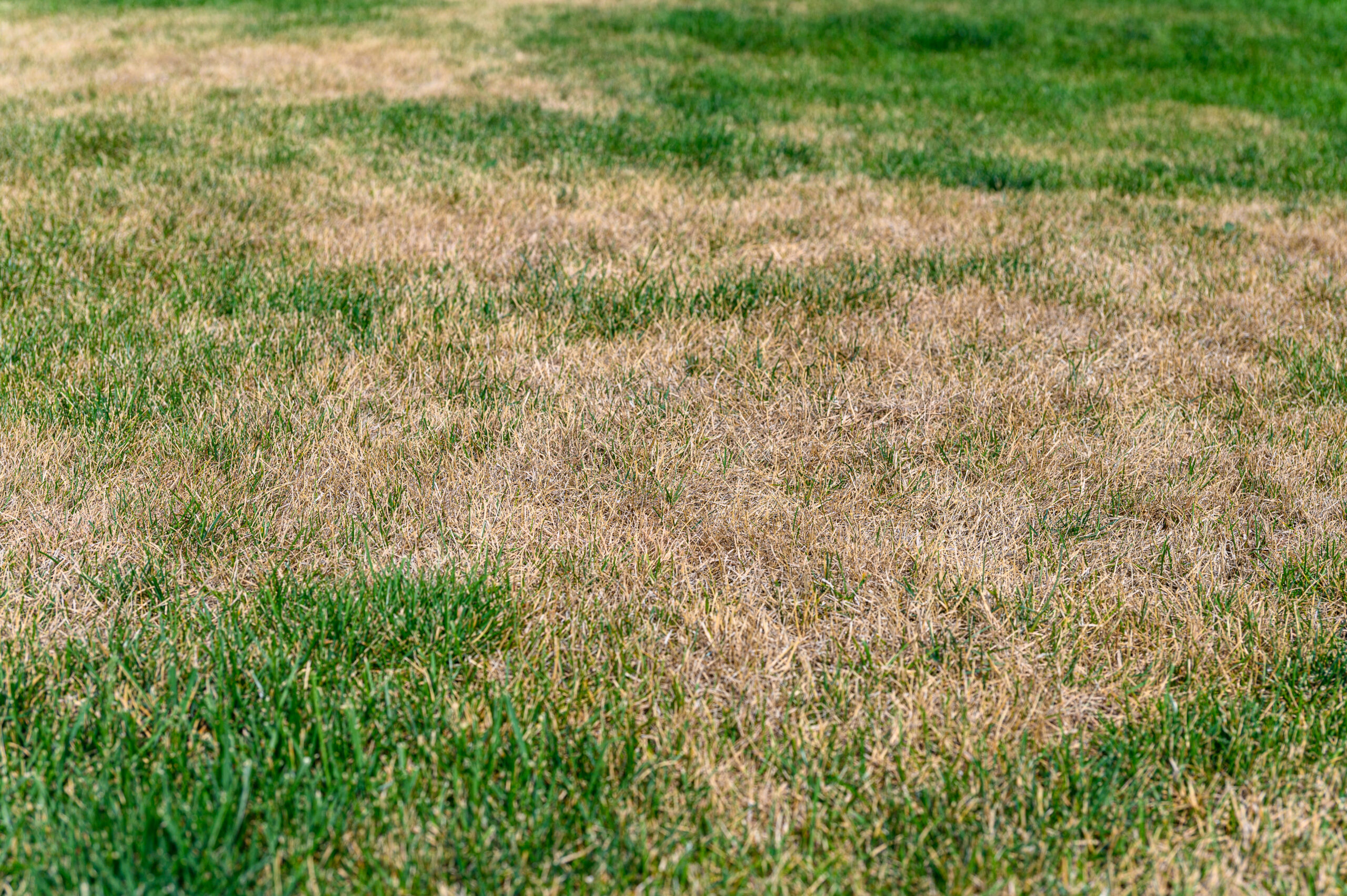
That matters more here than it does farther north. Frederick sits at the northern edge of the transition zone, which is the band where it gets too hot in summer for cool season grass to be comfortable and too cold in winter for warm season grass to be practical. Every July and August the lawn loses a percentage of its plants to heat, drought stress, and disease. If you never put seed back, the stand thins a little each year until crabgrass and nutsedge have room to move in.
The Window, Week by Week
The useful seeding window in Frederick County runs from about the third week of August to the first week of October. Inside that window, the second and third weeks of September are the two best weeks of the entire year.
- Late August: soil is warm and germination is fast, but a late heat wave can cook young seedlings. Workable if you can water attentively.
- September 5 through September 25: the target. Soil temperature sits in the sixties, nights have cooled, and seedlings get roughly ten weeks of growing time.
- Early October: still worth doing. Germination slows to two or three weeks and the plants head into winter smaller than you would like.
- After October 15: not worth the seed. You may get germination, but the seedlings will not build enough root mass to survive the first hard freeze and the frost heaving that follows.
Why Fall Beats Spring Every Time
Spring seeding fails in Frederick for two reasons that have nothing to do with how hard you work at it. First, you cannot apply a standard crabgrass pre-emergent to newly seeded ground, so you spend April and May watching crabgrass germinate in the exact bare soil you just prepared. Second, a spring seedling gets only eight to ten weeks of root development before the first ninety degree day arrives, and that is not enough root to survive a Maryland July.
Fall seedlings get the opposite deal. Cool weather is ahead of them instead of behind them, they get months of quiet root growth, and there is no crabgrass pressure until the following May. The same bag of seed produces a dramatically different lawn depending on which month it goes down.
Core Aeration Versus Everything Else
Core aeration pulls plugs of soil out of the ground and drops them on the surface. Removing the core is the part that matters. Punching a hole with a solid spike pushes soil sideways and compacts the wall of the hole, which accomplishes close to nothing on clay. Liquid soil conditioners have a role on lightly compacted ground, but they do not replace physical core removal on a lawn that gets driven on, played on, and mowed weekly.
For seeding specifically, the plugs help in two ways. The open holes give seed a protected pocket with soil contact on three sides instead of one, and the plugs themselves break down into a light topdressing over the following few weeks. On badly thinned lawns, slice seeding with a machine that cuts a shallow furrow and drops seed into it can beat aeration for raw germination rate. Some properties are best served by doing both.
What Frederick Soil Does to the Job
Soils across the Frederick Valley run heavy. Much of it is clay loam sitting over limestone, which holds water in spring, sets up hard in a dry August, and compacts under traffic far faster than a sandy soil would. Compacted clay is the single most common reason a lawn here looks excellent in May and looks terrible in August. The roots never got deep enough to reach the moisture that was still down there.
The limestone influence also means soil pH tends to run higher in this area than it does across most of the Northeast, which is generally good news for tall fescue. It is still worth pulling a soil test every few years. The fix for a phosphorus or potassium shortage is inexpensive, and the cost of guessing wrong is an entire season.
How Much Seed, and Which Seed
Rates depend on what you are actually doing. Overseeding an existing lawn that is moderately thin generally takes about four to six pounds of turf-type tall fescue per thousand square feet. A full renovation on bare ground takes closer to eight. Doubling the rate does not double the result. Seedlings compete with each other for water and light, and a stand that comes in too thick tends to be weak and disease prone.
Buy improved turf-type tall fescue rather than the cheapest bag on the shelf. The old forage-type fescues are coarse, light green, and clumpy, and they stay that way for years. Modern varieties are finer bladed, darker, and considerably better at resisting brown patch, which is the disease that does the most damage during a humid Frederick August.
Prep Before the Machine Shows Up
Mow shorter than usual the day before, down to about two and a half inches, and bag those clippings. You want seed to reach actual soil, not to hang up in a mat of thatch and grass blades. Mark irrigation heads, invisible fence wire, and any shallow utility lines so the aerator does not find them for you.
Water the lawn the day before if the ground is dry. A bone dry clay lawn will barely accept a tine, and you end up with shallow, crumbling cores and a lot of noise for very little benefit. If the thatch layer anywhere is thicker than about half an inch, dethatch that area first. Seed dropped onto heavy thatch will germinate, root into the thatch instead of the soil, and die the first time the surface dries out.
Watering the First Three Weeks
This is where most seeding jobs are won or lost, and it has nothing to do with the equipment. New seed needs the top half inch of soil to stay continuously damp until it germinates. In practice that means light watering two or three times a day for the first ten to fourteen days, not one long soak in the morning.
Once seedlings are up and you can see a green haze, shift toward fewer and deeper waterings to pull the new roots down. By week four you should be back to a normal schedule of roughly an inch a week including rainfall. Frederick usually gets helpful September rain, but usually is not a plan. Watch the forecast and fill in the gaps yourself.
What Not to Do After You Seed
Do not apply a standard crabgrass pre-emergent to newly seeded ground. The product cannot tell crabgrass from fescue, and it will stop your seed cold. There are a couple of seeding-safe options in narrow situations, but the default answer is to wait until the new grass is established.
Hold off on broadleaf weed control too. Most product labels want you to wait until new grass has been mowed two or three times, which around here usually lands in late October. Keep foot traffic light, keep the mower blade sharp so it cuts young plants instead of yanking them out of the ground, and skip bagging for the first few mowings if you can.
If You Already Missed the Window
If it is late October and nothing has gone down yet, the better move is to stop and change plans rather than force it. Put the money into a late fall fertilization that the existing plants can actually use, stay on top of leaf removal, and send the lawn into winter as strong as it can be. Then schedule aeration and overseeding for next September and get on the calendar early.
Dormant seeding in late November is a real option here, not a consolation prize. Seed goes down after soil is too cold to germinate, sits through the winter, and sprouts on its own schedule as the ground warms in early spring. It is less reliable than September seeding and it does not solve the spring crabgrass problem, but it beats leaving bare soil open all winter.
What to Do Next
Walk the lawn this week and write down the two or three things that actually bother you about it, then work backward from the window rather than forward from today. Almost every fall mistake we see in Frederick comes from starting with the calendar instead of with the lawn.
If you would rather have someone look at it with you, Lawn Squad of Frederick offers a free quote. Call 833-816-7508 or find us at lawnsquad.com. Every Lawn Squad location is independently owned and operated, and our VitaminLawn fertilization and weed control program is built around the grass, soil, and conditions here rather than a national average.
A first visit is a walk of the property, a look at the thin areas, a check of mowing height and irrigation, and a straight conversation about what is realistic in the weeks left this season. At 30 days you should see color and density improve. At 90 days the lawn should be visibly thicker, with the root growth that carries it through winter.