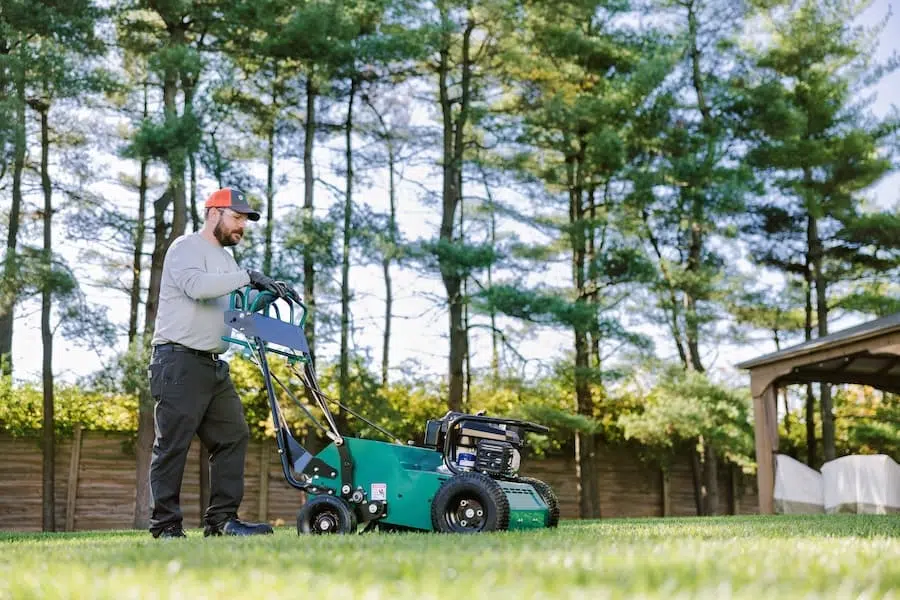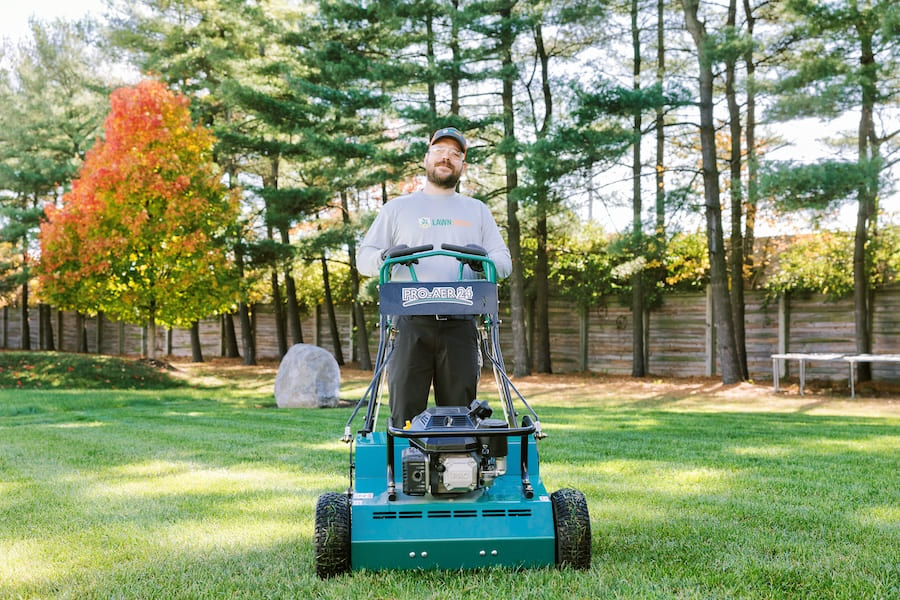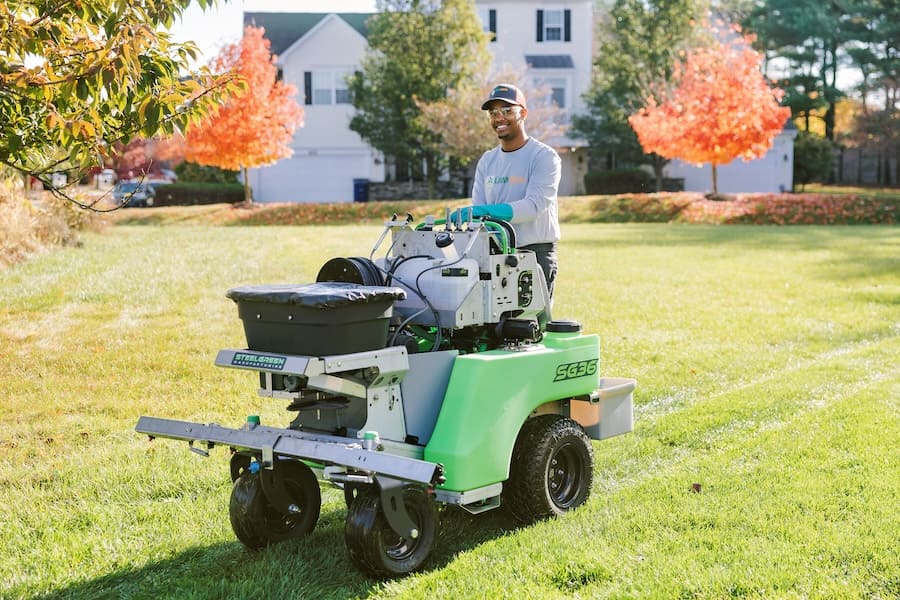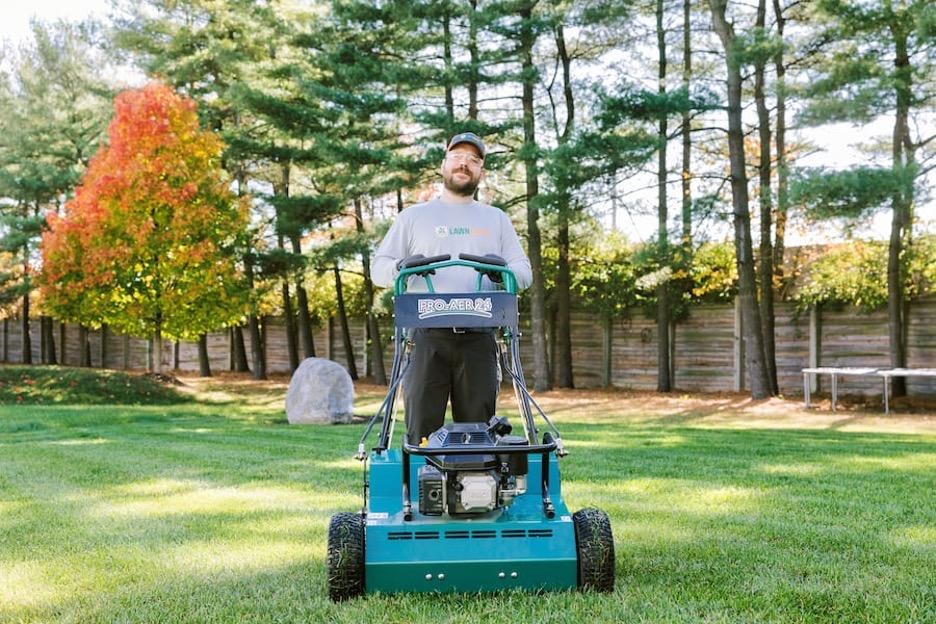
Short Answer: Late August through the middle of September is the window in Aurora, and it closes earlier than most homeowners expect. Seedlings need roughly six to eight weeks of decent growing weather before the first hard frost, and northern Illinois can see that frost in early to mid October. Aerate first, then seed immediately into the open holes. Our heavy clay compacts badly, especially in subdivisions built on former farmland where construction stripped the topsoil, so most Aurora lawns benefit from core aeration every year or two rather than occasionally.
If you do one thing for an Aurora lawn all year, this is it. Fall aeration and overseeding does more here than any other service, and the reason comes down to what our soil and our short season do to cool-season grass.
The complication is that our window is genuinely narrow, narrower than in much of the country, and it does not wait for a free weekend.
Why Aurora Lawns Need This
Lawns here are cool-season grasses, mostly Kentucky bluegrass, perennial ryegrass, tall fescue, or a blend. They have two productive periods a year, spring and fall, and fall is the more valuable of the two because root growth dominates.
Then there is our soil. Much of the Fox Valley sits on heavy clay, and clay compacts under traffic, equipment, and its own weight.
Subdivisions built on former farmland have it worst. Construction equipment compacted the subsoil, topsoil was stripped or thinned, and sod went down over the result. Those lawns look excellent for two or three years while the sod’s original root mass carries them, then begin an annual summer decline as new roots fail to penetrate what is underneath.
Compacted clay does not let roots down, water in, or air move. A lawn growing in it runs on a shallow root system with nothing in reserve for July.
The Window, Specifically
Work backward from frost rather than forward from Labor Day.
A seedling needs roughly six to eight weeks of decent growing weather to build enough root system to survive a northern Illinois winter. Aurora typically sees its first hard freeze somewhere in early to mid October, though it varies.
That arithmetic puts the comfortable seeding window from late August through about the middle of September. The end of September is the outer limit. October seeding here is generally a poor investment.
Soil temperature is the other constraint. As it drops through the fifties, germination slows sharply. Kentucky bluegrass, already slow at fourteen to thirty days, becomes impractical late in the window, which is why late seedings often come up mostly ryegrass regardless of what was in the bag.
Aerate First, Then Seed
The order matters. Seed broadcast over an unaerated lawn largely lands on thatch and existing blades, germinates on dew, and dies.
Core aeration pulls plugs out and leaves several hundred openings per hundred square feet, and every one is a pocket of exposed soil that holds moisture and shelters seed. Germination rates in aeration holes are dramatically higher than beside them.
Leave the cores on the surface. They look untidy for a week or two, and as rain and mowing break them down they work soil microbes into the thatch layer and speed its decomposition. Raking them up discards that for no reason.
On badly thinned lawns, slice seeding is worth asking about, since it cuts grooves and places seed directly in them in a single pass.
Do You Actually Need Aeration
You do not have to take anyone’s word for it.
Water the lawn, wait a day, then push a long screwdriver into the soil using hand pressure only. Six inches easily means compaction is not your issue. Stopping at two inches means it is.
Better, cut a wedge of turf four inches deep with a spade and look at the profile. Roots concentrated in the top inch above dense gray clay is the standard Aurora picture, and it is exactly what aeration addresses.
While the wedge is out, measure the thatch, the spongy brown layer between green growth and soil. Under half an inch is fine. Over three quarters of an inch is contributing to your problems.
Seed Choice for Northern Illinois
Kentucky bluegrass is the traditional choice here and there is a real reason for it: it spreads by rhizomes and repairs its own damage, which neither fescue nor ryegrass does. A bluegrass lawn recovers from summer losses on its own.
The trade is germination speed. Bluegrass takes fourteen to thirty days, which is a long time to keep a seedbed moist, and it demands more water and fertility than the alternatives.
Turf type tall fescue roots deeper and handles heat and drought better, which matters more in our summers than it used to. It does not spread, so a fescue lawn needs overseeding every fall.
Perennial ryegrass germinates fastest of the three, in five to ten days, and is usually included in blends to hold soil and provide quick cover while slower species establish.
Most good blends for this area use all three. Read the label rather than the bag front, particularly the weed seed and other crop lines.
The Three Weeks After
Watering is where seedings fail, and the rule inverts from the rest of the season.
Established turf wants deep, infrequent soaking. New seed wants short, frequent cycles keeping the top inch continuously moist. A seedling has no root system, everything it can reach is in that top inch, and one hot dry afternoon during germination kills the entire seeding.
That means light watering two or three times a day while it is still warm, tapering as September cools. Once seedlings emerge, extend the interval and increase volume week by week so you are back toward normal by about four weeks.
Stopping too early is the most common late failure. Seed that germinated beautifully still dies in October if water stops the week it came up.
What Not to Do While Seed Is Establishing
- No broadleaf weed control within roughly four weeks either side of seeding. The label interval exists because ignoring it kills seedlings.
- Keep foot traffic and pets off until the new grass has been mowed two or three times.
- Wait to mow until new grass reaches three to four inches, and sharpen the blade first. A dull blade pulls unrooted seedlings out of the ground.
- No heavy nitrogen. A starter fertilizer at seeding is correct; pushing top growth on rootless plants is not.
- Stay ahead of leaves. A layer left on new seedlings smothers them in days, and there is no established plant underneath to recover.
Finish the Season Properly
Two more things after the seed is in, both of which matter for a winter as long as ours.
The late fall feeding, made in October while the grass is still green but growth has clearly slowed, is the most valuable application of the year. Nitrogen then goes into roots and stored carbohydrates rather than leaf growth, and those reserves drive spring green up.
And bring the mowing height down gradually over the last several cuts to finish around two to two and a half inches. Left too long, blades mat under snow and invite snow mold. Cut too short, the crown is exposed to winter desiccation. Gradual is the operative word, since removing more than a third of the blade at once forces the plant to rebuild leaf tissue instead of roots.
What to Do Next
Walk the lawn this week and write down the two or three things that actually bother you about it, then work backward from the window rather than forward from today. Almost every fall mistake we see in Aurora comes from starting with the calendar instead of with the lawn.
If you would rather have someone look at it with you, Lawn Squad of Aurora offers a free quote. Call 833-816-7508 or find us at lawnsquad.com. Every Lawn Squad location is independently owned and operated, and our VitaminLawn fertilization and weed control program is built around the grass, soil, and conditions here rather than a national average.
A first visit is a walk of the property, a look at the thin areas, a check of mowing height and irrigation, and a straight conversation about what is realistic in the weeks left this season. At 30 days you should see color and density improve. At 90 days the lawn should be visibly thicker, with the root growth that carries it through winter.