Short Answer: The single best window to core aerate and overseed a Kentucky bluegrass or fescue lawn in Aurora, Naperville, or the Fox Valley is the last week of August through the first three weeks of September. That window only works if the prep happens in July: walking the lawn to identify the worst areas, pulling a soil test, ordering a seed blend matched to the property, scheduling the aerator and the seed delivery, and setting up the irrigation plan for the 21-day germination period. Homeowners who wait until early September to start planning compete for the same booking calendar and frequently end up with a lower-quality blend or a delayed service date that misses the ideal window.
In a normal year across the Fox Valley, the strongest lawn renovation work happens in a tight three-week window from the last days of August through about the 20th of September. The soil is still warm enough for Kentucky bluegrass and turf-type tall fescue to germinate fast (typically 14 to 21 days for a good blend), the air is cooling, the dew window is widening, and the new seedlings have eight to ten weeks of friendly weather to develop a root system before the first hard frost.
That window is generous if you start preparing now. It is brutally short if you wait. The single biggest reason fall renovation projects underperform in Aurora, Naperville, Plainfield, and Oswego is not a bad seed blend or a bad aerator. It is a homeowner calling in early September to schedule, then learning that the prep work that should have happened in July still has not happened.
This is the article we write every July for customers who are looking at a thin or stressed lawn right now and thinking, “we need to do something serious in the fall.” Here is the planning sequence that turns “we need to do something” into a result you can actually see in October.
Why Fall, Not Spring, Is the Right Renovation Window in Our Climate
Homeowners new to the Fox Valley often ask why we push fall so hard for renovation work. The short version: cool-season grass evolved to germinate and establish in the conditions we have from late August through mid-October. Warm soil from summer carries into early fall, which speeds germination. Air temperatures fall into the 60s and 70s during the day, which is exactly where Kentucky bluegrass and fescue want to be. Weed pressure (crabgrass especially) is winding down rather than ramping up, so the new seedlings are not fighting for sunlight and water from day one.
Spring renovation in Aurora has a different problem. The temperature window opens too late (April soils are slow to warm), and by the time the seedlings have established, summer heat arrives and stresses immature plants that have not yet built a real root system. Spring-seeded lawns regularly thin in their first July. Fall-seeded lawns enter their first summer with a full year of root development behind them.
That is the math behind every successful fall renovation in our service area. The question is whether the prep work to take advantage of it happens on time.
Walk the Lawn Now and Map the Worst Areas
The first July task is a walk-through with a notepad. The fall renovation is most effective when the seed and the aerator are concentrated where the lawn actually needs help, not spread evenly across acres of already-healthy turf.
Walk the lawn and look for: thin areas where the soil is visible through the canopy, patches of dead or dormant grass that have not greened back even with watering, sections where the soil feels rock-hard under foot pressure, low spots that stayed soggy in May, areas under maple or oak canopy where the grass has thinned year over year, and the high-traffic strips between the back door and the patio or between the driveway and the fence.
Each of those zones needs a slightly different treatment in September. A compacted strip needs extra aeration passes. A shaded zone may need a finer fescue blend rather than a bluegrass-heavy mix. A thin area on healthy soil just needs seed-to-soil contact and water. Knowing this in July means the seed order and the service plan match the property, not a generic spec.
Pull a Soil Test in July, Not in September
Soil tests are the cheapest insurance in lawn care, and they take two to three weeks for results to come back from a state lab. Pull samples in early July and the results are in your hands by the end of the month, in time to adjust pH, phosphorus, or potassium before September.
Across most of Aurora, Yorkville, and the Fox Valley, the soil tests we see come back with two consistent issues: a pH that has drifted into the high 6s or low 7s (alkaline enough to limit nutrient uptake), and phosphorus that is low compared to what new seedlings need to establish strong roots. Both can be corrected with the right starter fertilizer at the time of seeding and an elemental sulfur application if pH adjustment is needed.
The University of Illinois Extension office in DuPage and Kendall Counties can point homeowners toward state-certified soil testing labs, and we are happy to interpret the results and translate them into a treatment plan. The cost is generally $20 to $50 per test, which is trivial against the cost of overseeding a lawn that does not have the right nutrients to support the new growth.
Choose the Right Seed Blend for Your Property
A serious overseed needs the right blend, and the bag matters more than most homeowners realize. Big-box “Midwest mix” bags often contain heavy proportions of cheap perennial ryegrass that germinates fast but burns out by year three, leaving you renovating again. The blends we use across the Fox Valley balance three components for long-term success.
- Kentucky bluegrass. Two or three top-rated varieties from current National Turfgrass Evaluation Program trials, chosen for disease resistance and heat tolerance. Bluegrass spreads by rhizomes and fills in over time, which is what you want for long-term coverage.
- Turf-type tall fescue. Deeper rooting than bluegrass, more drought tolerant, and helpful on the heavier clay soils common in Aurora and Plainfield subdivisions. Modern tall fescue varieties have a finer leaf texture than the old K-31 stuff and blend visually with bluegrass.
- A small fraction of perennial ryegrass. Five to ten percent maximum, used as a “nurse” species that germinates in five to seven days and holds soil while the slower bluegrass and fescue catch up. Too much rye and the lawn looks coarse, struggles in heat, and dies off in years two and three.
For shaded properties common in older Naperville and Batavia neighborhoods, we shift the blend toward fine fescues (creeping red, chewings, hard fescue) which handle low light far better than bluegrass.
Book the Aerator and the Service Date Now
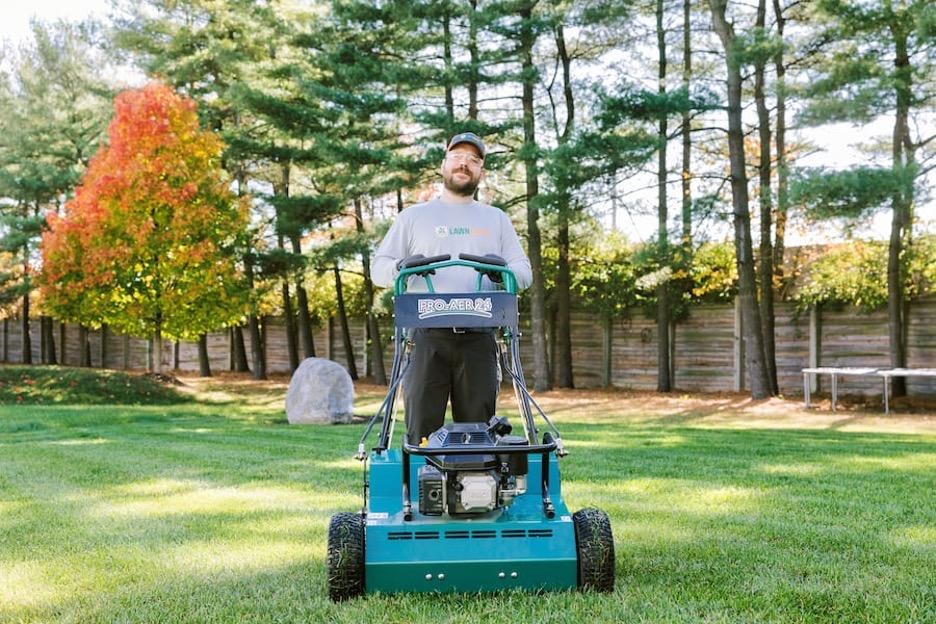
Core aeration equipment is in heavy demand from late August through September across the Fox Valley. The available service windows fill up week by week, and the homeowners who book in July get the dates they want. Homeowners who call September 5th are looking at the third or fourth week of the month, which is the back edge of the ideal window for our climate.
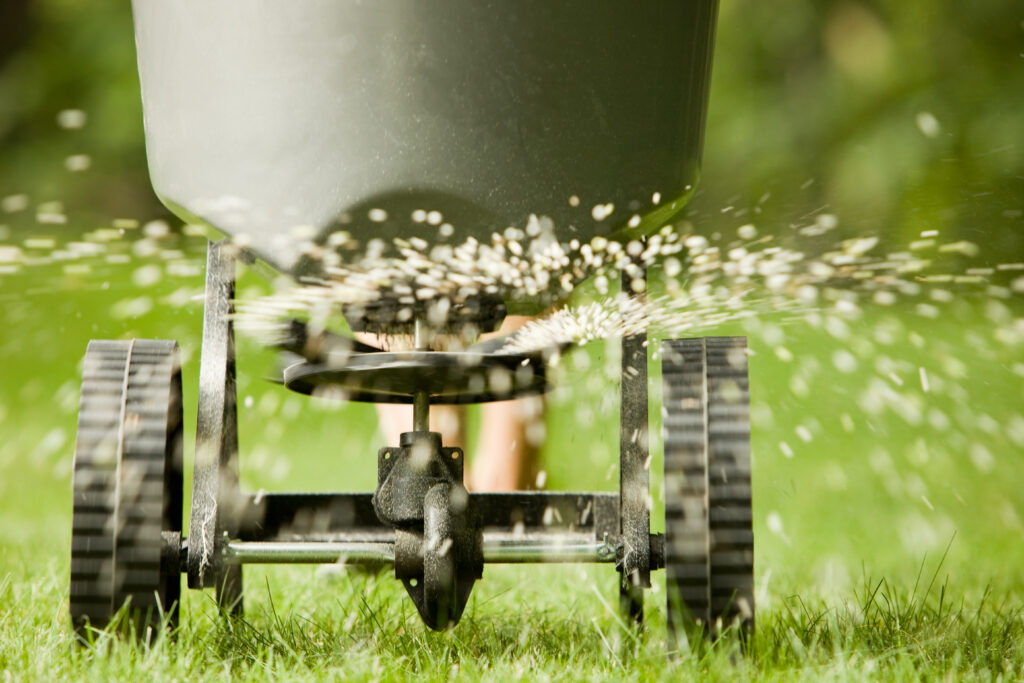
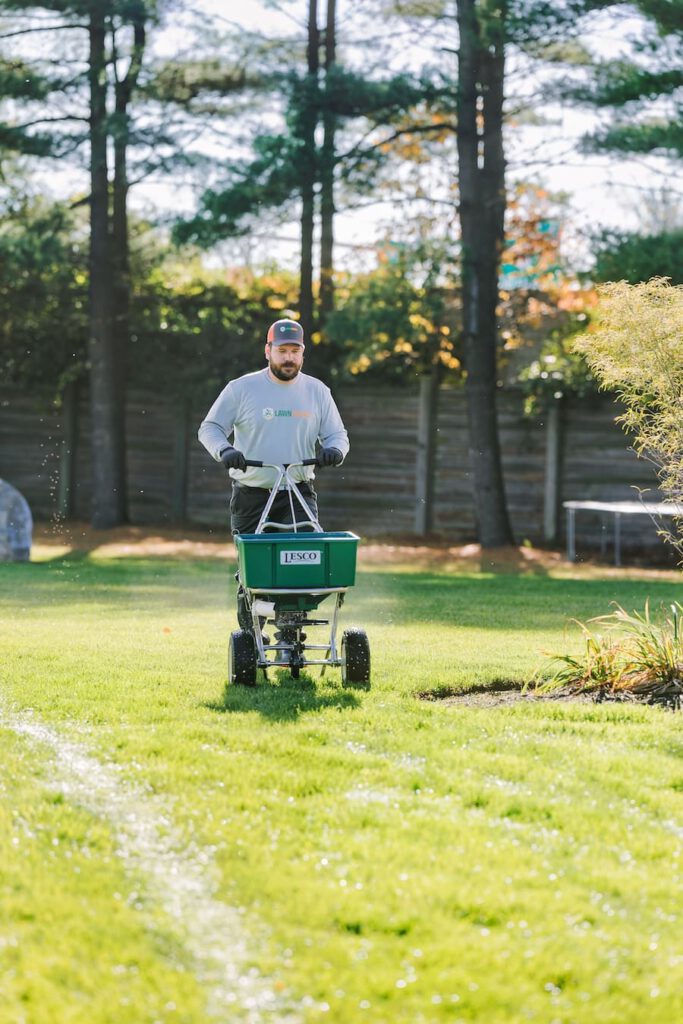
A proper renovation pass includes a double-direction core aeration (two passes at perpendicular angles for serious compaction), seed broadcast at the right rate for the property’s condition (typically 3 to 5 pounds per thousand square feet for overseed, higher for renovation of bare areas), a starter fertilizer with the right phosphorus level, and a follow-up plan for the first six weeks of new-seedling care.
Booking early also gives the lawn time to be mowed shorter (2.5 inches) the week before aeration, which we recommend so that the seed lands on soil rather than thatch.
Plan the Irrigation Sequence Before You Seed
Germination is the make-or-break phase, and it is entirely a watering problem. Newly broadcast seed has a small reservoir of moisture inside the seed coat. If that seed dries out before the radicle (root tip) anchors into the soil, the seed is dead. There is no recovery. You either keep the top half-inch of soil consistently moist for the first 14 to 21 days, or you lose the investment.
The right watering plan after seeding is light and frequent: five to ten minutes per zone, two or three times per day for the first two weeks, then gradually backing off to once per day for the next two weeks, then transitioning to the deep-watering schedule we use on established turf. This is the opposite of how we water established lawns in summer, and it is one of the biggest mental shifts for homeowners.
If your irrigation controller is old and does not support multiple start times or daily schedule changes, July is the month to budget for a controller upgrade. A smart controller pays for itself across a single renovation cycle.
What to Do Next
If you have a renovation in your head for September and would rather have someone build the full plan now (the walk-through, the soil test, the seed selection, the service booking, and the watering schedule), this is what our July visits are designed to do.
Lawn Squad of Aurora serves Aurora, Batavia, Bristol, Fox Valley, Montgomery, Mooseheart, Naperville, North Aurora, Oswego, Plainfield, Plano, and Yorkville.
Call us at 630-389-4996 or request a free quote at lawnsquad.com. Our VitaminLawn program treats fall aeration and overseeding as the cornerstone of cool-season lawn care, with the planning starting in July and the field work timed to the local soil and weather windows we have been tracking across the Fox Valley for years. The September lawn you want starts with the decisions you make this month.