
Short Answer: June is when Central Georgia Bermuda and Zoysia hit their stride. The right monthly plan looks like this: mow Bermuda at 1.5 to 2 inches and Zoysia at 1.5 to 2.5 inches once or twice a week, water deeply twice a week to deliver about 1 inch total (early morning only), apply a balanced nitrogen-potassium fertilizer at half a pound of nitrogen per thousand square feet, watch for early signs of dollar spot and brown patch, and start scouting for fire ants, mole crickets, and armyworms which become active this month. Red clay soil holds water longer than expected, so deep-and-infrequent watering is the right call across our service area from Macon to Warner Robins to Dublin.
If you have a Bermuda or Zoysia lawn in Macon, Warner Robins, Perry, Milledgeville, or anywhere across the heart of middle Georgia, June is the month when everything you did right in spring starts paying off. Soil temperatures are above 75 consistently. The grass is in full growth mode. Roots are pushing deep into red Georgia clay. The lawn is ready to look its best, if you give it the right inputs.
June is also when minor problems become major problems fast. A small disease patch in early June can take over a section of yard by the end of the month if conditions favor it. A fire ant mound you ignore today becomes ten mounds in two weeks. So the work this month is part maintenance, part scouting.
Here is the playbook we follow on Central Georgia Bermuda and Zoysia lawns through June.
Mowing: Get the Height and Frequency Right
Different grasses want different heights. Setting the deck once and forgetting it for the season is the most common Central Georgia lawn care mistake we see.
Common Bermuda (including the seeded varieties many older Macon and Milledgeville lawns have): mow at 1.5 to 2 inches. It can go shorter, but shorter requires more frequent mowing and a reel mower for the cleanest cut. Most homeowners with rotary mowers do best in that 1.5 to 2 range.
Hybrid Bermuda (Tifway 419, TifGrand, TifTuf, Latitude 36) is finer textured and tolerates shorter mowing. If you have a reel mower or a high-quality rotary, you can hold these around 1 inch. With a standard rotary mower, keep them at 1.5 inches for a clean cut.
Zoysia (Emerald, Empire, Zeon, JaMur are all common in our service area) wants 1.5 to 2.5 inches depending on variety. Empire and Zeon tolerate a wider range. Emerald wants the lower end. When in doubt, 2 inches works for most Zoysia in our area.
The frequency rule across all warm-season grasses: never remove more than one-third of the blade in a single mowing. June growth rates in Central Georgia heat mean Bermuda often needs mowing twice a week. Zoysia is slower but still wants weekly mowing once it is fully growing.
Sharpen the blade. A dull rotary blade tears Bermuda and Zoysia leaf tips, leaving a frosted appearance the day after mowing and creating open wounds that brown patch and dollar spot exploit.
Watering: Deep, Infrequent, and Early
The Central Georgia summer rule on red clay soil: one inch of water per week total, delivered in two deep cycles, between 4 and 8 a.m.
One inch is a baseline. During a stretch of 95-degree days with no rain, push it to 1.25 inches. During a wet week with regular afternoon thunderstorms, skip irrigation entirely and let the rain do the work.
The trap most homeowners fall into is daily light watering. A timer set for 10 minutes every morning puts down maybe a quarter inch of water, which evaporates from clay soil before it reaches deep roots. The grass develops shallow roots dependent on the next sprinkler cycle, and the first week of July heat browns it out.
The catch-can test is the easiest way to know what your system actually puts down. Place four straight-sided containers in a zone, run the zone for 15 minutes, measure the average depth. Use that number to calculate how long the zone needs to run to deliver half an inch.
Cycle-and-soak is the secret on Georgia red clay. Run a zone for 15 minutes, let the water soak in for 30 minutes, run it for another 15 minutes. You will get deeper penetration than a single 30-minute cycle because clay accepts water slowly.
Fertility: Feed for Sustained Growth, Not Showy Flush
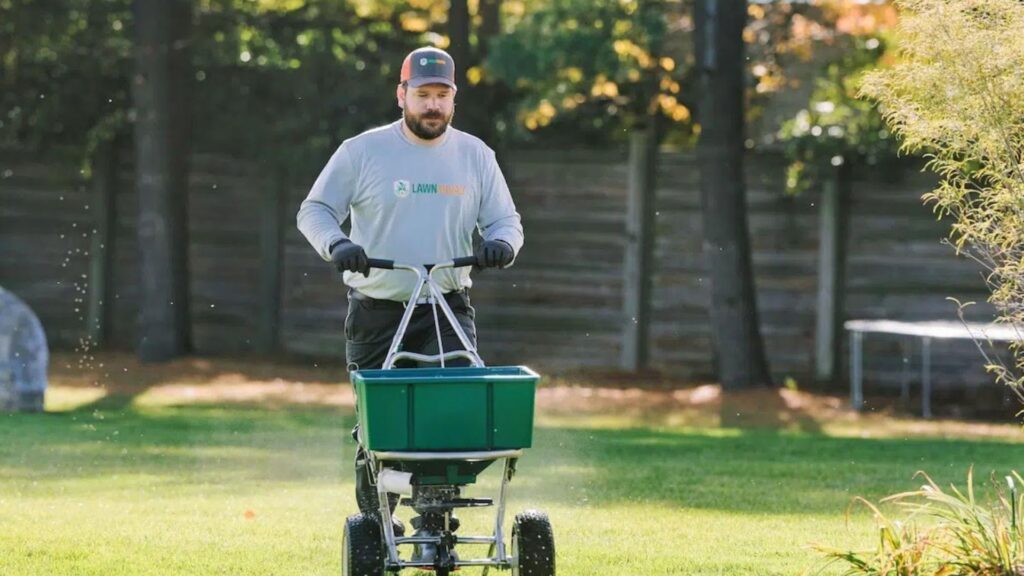
June is a feeding month for warm-season grass. Bermuda and Zoysia are pulling nutrients hard and the lawn responds visibly to fertilizer when applied at the right rate.
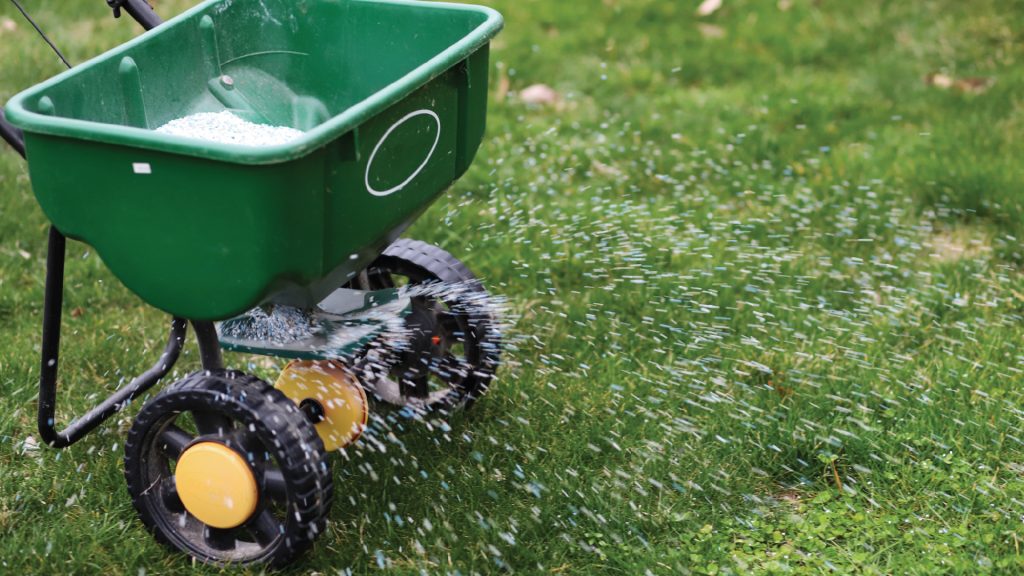
Target rate: half a pound of nitrogen per thousand square feet per application, with the right product giving you a slow-release component so the lawn gets a sustained four to six weeks of feeding rather than a two-week flush.
Avoid the temptation to dump a full pound of nitrogen at once. Heavy nitrogen pushes excess top growth, increases mowing frequency, depletes carbohydrate reserves the plant needs for stress tolerance, and sets up disease pressure. Steady feeding at modest rates beats heavy intermittent feeding every time.
Look for products with potassium (the K in N-P-K). Central Georgia soils are often potassium deficient, and potassium is the nutrient that drives heat tolerance, drought tolerance, and disease resistance. A 3-1-2 or 4-1-2 ratio works well for June feeding here.
Soil pH on Central Georgia red clay typically runs acidic, often in the 5.0 to 5.5 range. If you have not soil tested in three years, this is a good month to pull samples and send them to the UGA Extension lab. Most lawns benefit from a lime application based on the test results, and June is a fine month to apply it.
Disease Watch: Catch It Early
Two diseases hit Bermuda and Zoysia hardest in Central Georgia June.
Dollar spot: small bleached spots two to three inches across, often coalescing into larger patches. Most common on lawns low on nitrogen, with heavy dew patterns, or under thin nighttime watering. A modest nitrogen application often pushes the lawn past it.
Brown patch (also called large patch on Zoysia): tan to brown circular patches, often with a darker smoke ring around the edge, that expand fast in humid warm weather. Zoysia is particularly susceptible. The textbook trigger is warm humid nights with the lawn wet, so evening watering is a fast way to invite it.
The best disease defense in June is cultural: morning watering only, mowing height at the higher end of the range, sharp blade, and moderate (not heavy) nitrogen. When patches are visible and expanding, a propiconazole or azoxystrobin fungicide application interrupts the disease cycle.
Pest Scouting: Three to Watch
Fire ants are at peak activity in June. We will go deeper on fire ants, mole crickets, and armyworms in the companion piece this month. The short version for the monthly plan: scout the lawn weekly for fresh ant mounds, listen for mole cricket activity at dusk (they make a soft trilling sound), and watch for sudden brown patches with chewed grass blades, which are armyworm signs.
Early detection beats late treatment on all three pests. A walk around the yard every Saturday morning while the coffee is fresh costs nothing and catches problems before they become expensive.
What to Skip This Month
Several common lawn tasks should not happen in June on Central Georgia warm-season lawns.
- No pre-emergent herbicide. The germination window for most summer annual weeds is past. If you are seeing crabgrass already, post-emergent products are the right tool, not pre-emergent.
- No scalping. June is not the month to lower the deck dramatically. Spring scalping (early April) is a different conversation.
- No core aeration. Wait until July or August for warm-season aeration, when the grass is at peak recovery capacity.
- No heavy nitrogen blast. Steady, modest, slow-release nitrogen wins.
- No evening watering. Morning only on warm-season grass in our climate, every single time.
Where Central Georgia Lawns Diverge from Other Southern Regions
People sometimes ask whether our Macon and Warner Robins lawns should be treated like Atlanta lawns or like coastal Georgia lawns. The answer is neither, exactly.
Our red clay soil holds water longer than the sandier soils of coastal Georgia, so we water less often than coastal homeowners do. Our elevation and continental position mean nighttime temperatures drop more than they do in coastal areas, which gives our lawns a small overnight recovery window the coast does not get. We also do not face the salt exposure coastal lawns deal with.
Compared to North Georgia and the Atlanta metro, our summer is hotter and longer, but our winter is milder, which means Bermuda recovers from dormancy earlier in spring and stays green longer into fall. The growing season is several weeks longer than in the foothills.
These details matter. Generic Southern lawn advice from a national source often misses the Central Georgia specifics, and we run into customers who applied Atlanta or Florida advice and ended up with mediocre results. Our climate is its own thing.
What to Do Next
If you would rather have a local team execute this monthly plan on your lawn instead of doing it yourself, we make that easy.
Lawn Squad of Central Georgia serves Allentown, Bolingbroke, Bonaire, Byron, Cadwell, Centerville, Chauncey, Chester, Clinchfield, Cochran, Danville, Dexter, Dry Branch, Dublin, Dudley, East Dublin, Eastman, Fort Valley, Gordon, Gray, Haddock, Hardwick, Harrison, Hawkinsville, Hillsboro, Irwinton, Jeffersonville, Kathleen, Macon, McIntyre, Milledgeville, Montrose, Oconee, Perry, Rentz, Sandersville, Smarr, Tennille, Toomsboro, Warner Robins, Warthen, and Wrightsville.
Call us at 478-901-2620 or request a free quote at lawnsquad.com. Our VitaminLawn program is tuned for Central Georgia Bermuda and Zoysia on red clay soil, so the timing, products, and rates are already calibrated for our specific summer pattern.