Short Answer: A browning July lawn in Dayton is almost always one of three things: heat dormancy (uniform straw color, firm crowns, recovers with cooler weather), drought stress (footprints stay pressed in, soil dry past two inches, color fades from the tips down), or fungal disease (defined patches with a darker outer ring, mushy or webby leaves in the morning, often after evening watering). The fix is different for each, and watering the wrong problem makes it worse. Walk the lawn at 7 a.m., look at pattern and edges, pull a few blades, and check the soil with a screwdriver before you turn on the sprinkler.
By the second week of July, we get a predictable wave of calls from Dayton, Centerville, Kettering, Beavercreek, and Oakwood. The pattern is always the same. The lawn looked fine in late June. Then a weekend of upper-80s and humid nights rolled through, the homeowner left town, and on Monday morning there are brown patches that were not there before. The question is always, what is killing my lawn, and the honest answer is that we have to look.
The three suspects in July are heat dormancy, drought stress, and fungal disease. They look similar at a glance, they often happen together, and the treatment for one is the worst possible response to another. Watering a brown patch outbreak makes it spread overnight. Spraying fungicide on a drought-stressed lawn wastes money. Letting a truly drought-starved lawn coast on hope buys you a renovation in September.
Walk the Lawn at 7 A.M., Not at Noon
The single most useful diagnostic habit in July is the early morning walk. Between 6:30 and 8 a.m., three things are visible that disappear by midday. Dew sits on the canopy and outlines fungal growth in fine webs or rings. Footprints pressed into stressed turf stay flat instead of springing back. The color difference between healthy and struggling areas is sharper before the sun flattens everything to the same hot-tan tone.
Carry your phone for photos and a long screwdriver. That is the entire diagnostic kit. Take pictures from above and from a low angle. The low angle is where you see the patch shape, the edges, and whether the surrounding grass is involved.
Walk the whole property, not just the front. The micro-climates across a Dayton yard are real. Lawns along the Great Miami, Stillwater, or Mad River bottoms hold humidity longer in low spots and stay wetter overnight, which favors disease. Upland sections on the south or west side of the house dry first and show drought ahead of the rest of the yard. The story is in the pattern.
Heat Dormancy: Uniform, Predictable, Reversible
Kentucky bluegrass and tall fescue, the two grasses that make up most Dayton lawns, are cool-season species. When soil temperatures sit above 80 degrees for several days running and nights stay warm, both can slip into a protective dormancy. The blades go straw-colored. Growth stops. The grass looks dead.
It is not dead. The crowns at the base of each plant are still alive, and the root system is conserving water. Healthy cool-season turf here can stay dormant for four to six weeks and bounce back when temperatures drop and rain returns.
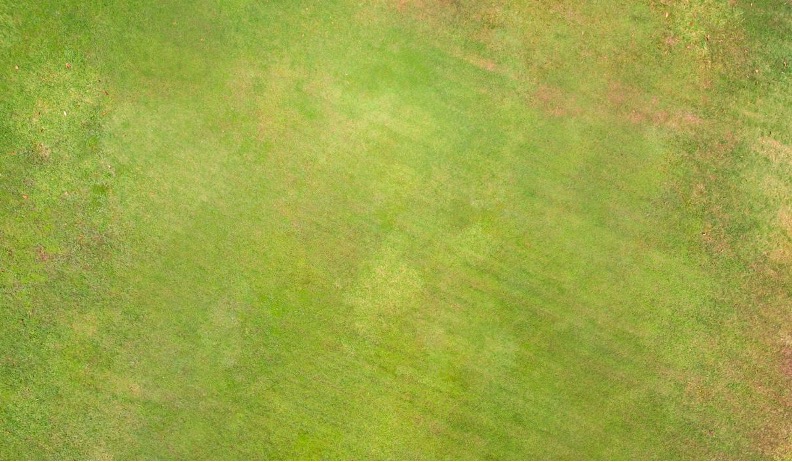
How you recognize it: the color change is uniform across large areas, not in patches. The transition from green to tan is gradual, not abrupt. Pulled blades have a tan upper section and a still-firm white crown at the base. The whole front yard looks the same as the back. Shaded areas often hold green longer than open sun, which is one of the simplest tells.
The right response is to stop fighting it. If the lawn went dormant and you have not been watering, do not start now. Cycling between dormant and not-dormant is harder on the plant than letting it ride. Mow only when there is growth to mow, raise the deck to 4 inches, and wait for August rains.
Drought Stress: Patterns That Match Sun, Slope, and Sprinkler Heads
Drought stress is also brown, but the shape of the damage is different. You see it first on south-facing slopes, along sidewalks and driveways where reflected heat compounds the problem, in spots where the sprinkler head does not reach, and on the high crowns of yards that grade away from the foundation. The pattern follows the geography of the yard, not random circles.
Two tests separate drought from dormancy. First, the footprint test. Walk across the suspect area and look back. Healthy turf springs back within a minute. Drought-stressed turf holds the footprint flat. Second, the screwdriver test. Push a long screwdriver into the soil. If it slides four inches with light pressure, the root zone is moist. If it stops at two inches or refuses to enter, the soil is dry past where roots can reach water.
Drought-stressed blades fade tip-first. If the upper third of a blade is bleached and the bottom is still greenish, that is dehydration. Dormancy tends to take the whole blade together.
The response is one inch of water per week, delivered in one or two early-morning soakings between 4 and 7 a.m. On Miami Valley clay, that is usually a 45 to 60 minute cycle, or two 30-minute cycles two or three days apart. Pulse the water if you see runoff so the clay can absorb. The goal is depth, not surface wetting.
Fungal Disease: Patches With Personality
Disease is where July diagnosis gets interesting, and where most homeowner mistakes happen. The three we see most often in Dayton are brown patch on tall fescue, dollar spot on Kentucky bluegrass, and, in older established lawns in Oakwood and parts of Kettering, summer patch.
Brown patch shows up as circular tan or smoky patches one foot to several feet across, often with a darker outer ring that is most visible in the morning while dew is present. The grass inside the ring is matted and the blades pull free easily. Brown patch loves overnight leaf wetness, warm nights above 68 degrees, and humidity that holds dew on the canopy until 10 a.m.
Dollar spot makes small silver-dollar-sized bleached patches that grow together into larger irregular shapes. The bleached spots on individual blades have a tan band with a darker margin, an hourglass shape across the leaf. You can see fine white webbing in the morning that disappears as the dew evaporates.
Summer patch is the harder one to catch early. It develops as irregular yellowish rings or arcs, often with greener grass in the center, in lawns mowed too short and pushed with spring nitrogen. By the time it is visible, the root damage is already done. This is why we keep mowing height at 3.5 inches and skip heavy summer nitrogen.
Disease pressure is highest in the lower-lying areas of Dayton lawns, especially the flood plain neighborhoods along the rivers where mornings hold dew an extra hour. If your yard sits low or backs up to a creek, watch the back fence line first.
The Pattern Cheat Sheet
- Uniform straw color across the whole lawn, firm white crowns, slow gradient: heat dormancy. Wait it out.
- Brown along sidewalks, south slopes, high spots, sprinkler dead zones: drought. Deep early-morning soakings.
- Circular or irregular patches with a defined edge, often a darker outer ring at dawn, mushy or webby blades, worse in low spots: disease. Stop evening watering, raise the mower, call us before reaching for fungicide.
- Lawn dries faster than the neighbor’s identical yard: compaction. The fix is fall core aeration, not more water.
- Damage worst over a sprinkler head or right at the spray arc edge: irrigation calibration, not a turf problem.
The Wright-Patt Move-In Note
For the Wright-Patterson families we work with: summer moves mean a lot of you inherit a lawn in July without knowing what it looked like in May. The question we get is always whether it is worth saving. The honest answer is that almost every Dayton-area lawn is salvageable from where it sits in July, with a corrected program through August and a fall aeration. Hold the panic until September.
What the Diagnosis Changes About July Care
This matters in real dollars because the three problems take opposite actions. Water a brown patch outbreak and it spreads by morning. Skip watering a drought-stressed area and the crowns die. Spray fungicide on a dormant yard and the lawn would have greened up anyway.
It is also why we are careful with fertilizer in July. A stressed lawn cannot use heavy nitrogen, and pushing growth in summer creates the soft tissue that brown patch and dollar spot infect. The main feeding window here is September. Hold the nitrogen.
Mowing matters as much as anything. Stay at 3.5 inches, four if the lawn is stressed. Mow only when there is enough growth to take a third of the blade. Sharp blade, dry grass, never in the heat of the day.
When to Call Us
If a brown area is larger than a doormat and growing day over day, if you see defined ring shapes in the morning, if the screwdriver will not enter the soil, or if you are not sure which of the three this is, that is the time to call.
What to Do Next
If you would rather have someone walk the property, identify the actual problem, and apply the right treatment in the right weather window, that is exactly what we are here for.
Lawn Squad of Dayton serves homeowners across the Dayton metro and the surrounding Miami Valley, including Centerville, Beavercreek, Kettering, Springboro, Oakwood, West Carrollton, Vandalia, and the Wright-Patterson community.
Call us at 937-345-3159 or request a free quote at lawnsquad.com. Our VitaminLawn program is built specifically for Miami Valley cool-season grasses, our clay loam soils, and the humid-summer disease pressure that defines lawns in this region. We will tell you straight what we see, what it actually is, and whether it needs a treatment or just patience.