Short Answer: Cleveland lawns are cool-season turf (Kentucky bluegrass, tall fescue, and perennial rye blends), and their default reaction to July heat is dormancy. A uniformly tan or straw-colored lawn that crunches underfoot but has firm crowns at the soil line is almost always heat dormancy, and it is protective rather than a problem. Disease shows up as defined patches, spots on individual blades, or fungal mycelium visible in early morning dew (dollar spot and leaf spot are the July culprits here). True drought stress shows as footprints that stay pressed into the lawn, a blue-gray cast before browning, and crowns that crumble between your fingers. The fix depends entirely on which one you have. Watering a dormant lawn wakes it up and weakens it. Watering a diseased lawn at the wrong time of day feeds the fungus. Reading the lawn correctly is the whole game in July.
The phone calls start the second week of July. A homeowner in Rocky River walks out, looks at the front yard, and sees something that was not there last week. Some of the lawn is tan. Some has small round spots. One stretch by the driveway looks blue-gray and limp. The instinct is to turn the irrigation up and hope.
We can usually save the trip and the water bill if we walk through the lawn together first. Three different problems all look like browning grass at a glance, and the right response for each is almost the opposite of the right response for the others. This is the diagnostic we run every time we step onto a Cleveland lawn in July.
Cool-Season Grass, Cool-Season Logic
Almost every residential lawn from Westlake to Mentor is a blend of Kentucky bluegrass, turf-type tall fescue, and perennial ryegrass. These cool-season species grow hardest in spring and fall, when nights are in the 50s and days are in the 60s and 70s. July, even a lake-moderated July, is past their comfort zone.
What they do in response is shut down on purpose. Top growth stops, the blades turn tan, and the plant moves its energy reserves down into the crown (the white tissue right at the soil line) to wait for the heat to break. This is heat dormancy. The lawn looks dead. It is not. It is conserving.
Most of what looks alarming in July is the lawn doing exactly what it should. The real question is whether the changes you see fit that protective pattern, or whether something else is happening underneath.
Reading Heat Dormancy
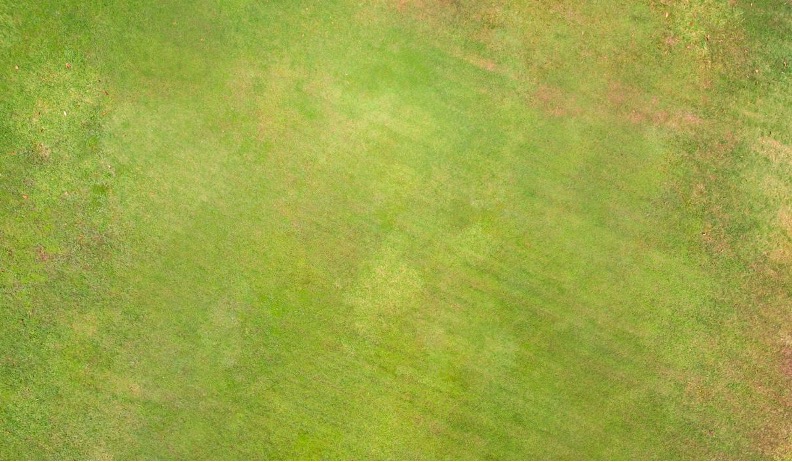
Heat dormancy has a recognizable signature. It shows up uniformly across sunny portions of the lawn, especially on south- and west-facing slopes, near sidewalks and driveways, and in any area without irrigation. Shaded areas under mature trees stay greener because soil temperatures stay cooler. That contrast is one of the strongest single tells we use.
The blades turn straw-colored from the tip down and feel dry and crunchy underfoot. When you part the canopy and look at the crown right at the soil, the tissue should be firm and slightly off-white or pale green. That firm crown is the lawn’s bank account. As long as it is intact, the plant is alive and will come back when the weather breaks.
Tug gently on a handful of blades. Dormant grass releases the top leaves but the crown and roots stay anchored. If the whole plant lifts out of the soil with almost no effort, that is a different problem.
The right response is patience and discipline. Mow higher, around 3.5 to 4 inches, only when needed. Stay off the lawn as much as possible because dormant turf bruises easily. Apply no fertilizer, no aggressive weed control, and no heavy irrigation. A light watering every two to three weeks (about a quarter inch) is enough to keep crowns hydrated without breaking dormancy. Pushing a dormant lawn back into growth in July uses up reserves the plant needs to make it to September.
Reading July Disease Pressure
The two disease names you need to know in Cleveland in July are dollar spot and leaf spot. Both thrive in the warm, humid air that comes off Lake Erie and settles into our lawns overnight. Dew that sits on the canopy from sunset until 9 or 10 the next morning is exactly the environment these fungi want.
Dollar spot announces itself with small, round, silver-dollar-sized bleached patches scattered across the lawn. In a heavy infection the spots merge into larger irregular areas, but the starting unit is that small, round, defined edge. The grass blades inside the spots show tan lesions with reddish-brown borders. If you walk out at 6 a.m. while dew is still on the lawn, you can sometimes see fine white fungal mycelium webbing across the affected areas. That mycelium burns off in the sun and is gone by 9 a.m., which is one reason we ask homeowners to send us morning photos.
Leaf spot shows up as small dark lesions on individual blades, often with a tan center and a purple or dark brown border. It can progress to a thinning, ratty-looking turf where the whole stand looks like it is losing density rather than browning in clear patches. Kentucky bluegrass varieties are especially susceptible.
Disease is the diagnosis when:
- Browning shows up in defined shapes (circles, rings, irregular but bordered patches) rather than as a uniform tan blanket.
- Individual blades have lesions or spots, not just dry tips.
- You see the problem in shaded or moist areas, not just full sun.
- It is getting worse week over week despite cooler nights or rain.
- Your irrigation runs in the evening or after dark, leaving the canopy wet through the night.
The fix for July disease is rarely a fungicide as a first move on a residential lawn. Cultural correction matters more. We shift irrigation to early morning (between 4 a.m. and 8 a.m.) so the canopy dries fast. We back off nitrogen because feeding a stressed, diseased lawn pushes lush tissue that fungi attack. We mow at the taller end of the range with sharp blades to avoid frayed cuts that invite infection. If the disease is severe and spreading, we apply a targeted fungicide, but only after the cultural fixes are in place.
Reading True Drought Stress
Drought stress is different from heat dormancy, and the distinction matters because drought-stressed lawns are actively losing crowns rather than just going to sleep. The signs we look for:
- A blue-gray cast to the canopy before any browning starts. Healthy and dormant grass is green or tan. Wilting drought-stressed grass turns silvery and dull first.
- Footprints that stay pressed into the turf for minutes after you walk across it. Hydrated grass blades bounce back. Drought-stressed blades cannot.
- Crowns at the soil line that are brown, brittle, and crumble between your fingers. That is tissue death, not dormancy.
- The browning shows up worst in spots that match a hidden problem (a buried slab of concrete from an old patio, the strip along a south-facing brick foundation that bakes all day, a sandy section where water drains too fast).
Cleveland summers, with Lake Erie moderating temperatures and humidity holding moisture in the upper soil, usually do not produce widespread true drought in residential lawns. What we see more often is drought stress in specific microspots while the rest of the lawn is in healthy heat dormancy. Those microspots need targeted help: a deep soaking in the early morning to rehydrate the soil profile, and sometimes a closer look at why that spot dries out so much faster than the rest of the yard.
The Quick Field Test
When we walk a lawn in July, we run a three-step check that takes about five minutes. Try it the next time you are not sure what you are looking at.
One: stand back and look at the pattern. Uniform tan across sunny areas with green in the shade points to heat dormancy. Defined patches or spots point to disease. Browning that follows a hidden feature (foundation, driveway edge, sandy patch) points to drought.
Two: pull a few blades from a brown area. Tug gently. If the crown holds and the blades release at the tips, the plant is alive. If the whole plant lifts out easily and the crown crumbles, that area is dying.
Three: walk the lawn at 6 a.m. with the dew still on. Look for fungal mycelium (fine white webbing on the canopy), individual blade lesions, and footprints that linger after you walk through. Those three observations alone usually tell us whether to back off, treat, or rehydrate.
Common Cleveland FAQ
How long can my lawn stay dormant before it actually dies? A healthy cool-season lawn can hold dormancy safely for four to six weeks. Past that, even firm crowns start to dehydrate. If we get into a stretch where July dormancy runs into a dry August, we add light watering (about a quarter inch every two weeks) to keep crowns alive without pulling the lawn out of dormancy. Plan for this rather than panic-watering at week three.
Should I keep mowing while my lawn is dormant? Mow only when there is growth to remove. Dormant grass barely grows. If a mower is rolling over a tan lawn in 90-degree weather, you are bruising crowns and inviting damage. When you do mow, raise the deck to 3.5 to 4 inches and make sure the blade is sharp.
My neighbor’s lawn is bright green and mine is tan. What are they doing? They are almost always running heavy irrigation, sometimes daily. Bright-green July lawns in Cleveland are forced lawns, and they often pay for it later with disease pressure, shallow rooting, and more grub damage because beetles prefer moist soil for egg-laying. A dormant lawn is a healthier lawn going into fall.
Can I fertilize a stressed July lawn to push it back? No, and we cannot emphasize this enough. Nitrogen in July on cool-season turf is one of the fastest ways to invite disease, deepen heat damage, and burn the lawn. We hold the next fertilizer round until temperatures cool in late August or early September.
What to Do Next
If you are looking at your lawn this week and you are not sure which of these three problems you have, send us a photo or schedule a visit. Reading the lawn correctly in July is the difference between coasting through the summer with a healthy stand of turf and spending fall trying to recover from one bad reaction.
Lawn Squad of Cleveland serves Amherst, Avon, Avon Lake, Bay Village, Beachwood, Berea, Brecksville, Brook Park, Broadview Heights, Brunswick, Cleveland, Columbia Station, Eastlake, Elyria, Euclid, Gates Mills, Grafton, Hinckley, Independence, Lakewood, Lorain, Maple Heights, Medina, Mentor, North Olmsted, North Ridgeville, North Royalton, Oberlin, Olmsted Falls, Painesville, Perry, Richfield, Rocky River, Sheffield Lake, Strongsville, Valley City, Vermilion, Westlake, Wickliffe, and Willoughby.
Call us at 440-271-3113 or request a free quote at lawnsquad.com. Our VitaminLawn program is built around the cool-season grasses, clay soils, and lake-effect weather patterns that define Cleveland lawns. The right diagnosis in July is what sets up a strong September recovery.