Core Aeration in Central Indiana: What Is Still Worth Doing in October
Short Answer: By October the two halves of fall aeration work have separated in Central Indiana. Core aeration itself is still genuinely worth doing, because relieving compaction does not depend on anything establishing before winter, and the open channels give lime, fertilizer, and amendments a route into the root zone with the whole dormant season to work. Overseeding is the part with a real deadline, and in this market that deadline has arrived. The first week or two of October is the last reliable point for new seed here. Here is how to spend October well.
October in Central Indiana is the month the fall lawn window starts closing, and it closes faster than most homeowners expect.
What makes it tricky is that the pieces of fall lawn work do not all expire on the same date. One of them is nearly out of time and the others have weeks left, and treating them as a single decision means either rushing something or abandoning something unnecessarily.
Here is what is still on the table this month, what is not, and how to get the most out of what is left.
What Core Aeration Actually Does
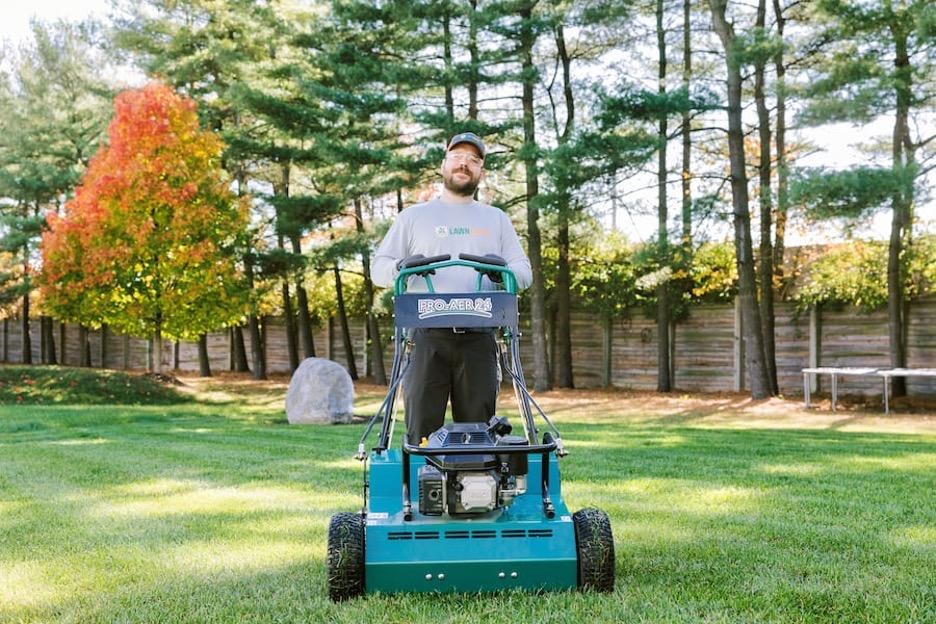
Core aeration pulls thousands of small plugs of soil and thatch out of your lawn, leaving holes roughly two to three inches deep across the entire surface. The plugs get left on top to break down, which is the part homeowners notice and the part that looks untidy for a week or so.
The holes are the point. Each one is a channel that lets water, air, and nutrients bypass the compacted surface layer and reach the root zone directly. Compacted soil is dense enough that water runs off rather than soaking in, roots cannot push downward, and fertilizer sits near the surface where it does far less good than intended.
It is worth distinguishing this from spike aeration, which punches holes with solid tines and removes nothing. Spiking pushes soil sideways and compresses it against the surrounding soil, which can make compaction worse over time. Core aeration is the only version that genuinely relieves it.
Coverage matters as much as the technique. Hole density is what determines the result, and a single fast pass leaves far more untouched ground than most homeowners assume. Two slower passes in opposing directions produce meaningfully better results than one rushed pass.
Why Central Indiana Soil Makes This Necessary
The soils across central Indiana are glacial till, deep and fertile and very fine textured, with a high clay fraction that packs tightly under any regular traffic.
Flat terrain compounds the drainage problem. On sloped ground, poor infiltration at least produces runoff. On level ground, water that cannot soak in stands in the root zone and pushes air out of it. Roots without oxygen stop functioning, which is why lawns here often look worse after a wet spring than during a dry summer.
Then the same compaction produces the opposite failure in July. Roots that never developed depth because the soil was too dense have nothing to draw on when the water stops, and a lawn that drowned in May browns out in August.
Construction history makes this worse in newer developments. Lots graded with topsoil stripped, driven on by heavy equipment through the build, and then given a thin layer of topsoil back have a compacted pan exactly where roots need to go. On a soil that was already dense, that is a substantial handicap.
Where October Leaves You in Central Indiana
October in Central Indiana is the closing edge of the window rather than the middle of it, and the two halves of this work now have different deadlines.
Overseeding is the time sensitive half. The first week or two of October is generally the last point where new seed can germinate and build enough root to survive the winter reliably. Past that, germination still happens and survival gets progressively less likely, which means later seeding is increasingly a gamble rather than an investment.
Aeration itself stays worthwhile considerably later. Compaction relief does not depend on establishment, and opening up some of the heaviest glacial till clay in the Midwest helps whether or not anything gets seeded into the holes. The channels also give lime, fertilizer, and amendments a route into the root zone, and those have all winter to work.
The practical rule for Central Indiana right now: if it is early October, move quickly and do both. If it is late October, aerate and feed now and plan the overseeding for next September.
Aeration Without Overseeding Is Still Worth Doing
This is worth saying plainly, because a lot of homeowners assume the two services are a package and skip both when the seeding window closes.
Aeration on its own addresses the constraint underneath most lawn problems. It improves how much water actually enters the soil instead of running off, lets air back into a root zone that compaction has closed up, and gives roots somewhere to grow that was not available to them before. None of that requires a single seed.
It also changes what everything else you apply is worth. Fertilizer, lime, and soil amendments applied to compacted ground largely stay at the surface. Applied right after aeration, they move down through thousands of open channels into the zone where roots can actually use them, and they have the entire dormant season to integrate.
There is a timing detail worth getting right on the soil itself. Aerating saturated ground smears and compresses the walls of each hole rather than pulling a clean plug, which wastes the pass, while ground that has gone hard and dry resists the tines and produces shallow holes. Moist rather than wet is the target, and in October that sometimes means working around the weather instead of a fixed date.
If you are going to do one thing on your lawn this month, aerating and then feeding into the open holes is a better use of the money than seed that will not make it to spring.
What to Expect in the Weeks After
The first thing you will notice is the plugs, and they are the most common source of homeowner concern. They look messy, they are scattered across the lawn, and they will be there for one to two weeks. Leave them. As they break down they return organic matter and soil microbes to the surface, which actively helps decompose thatch.
Beyond that the improvements are gradual rather than dramatic. Within the first few weeks you should notice water soaking in faster after rain, and areas that used to puddle or run off draining more effectively.
In October specifically, much of the benefit is deferred to spring rather than visible now. The soil structure you open up this month is what determines how the lawn handles the wet conditions of an early spring thaw and how quickly roots can get moving once soil temperatures rise.
The larger benefit builds over seasons. Lawns aerated consistently year after year develop measurably deeper root systems, denser turf, and better drought tolerance than lawns that are never aerated.
How Often Your Lawn Actually Needs It
Annual aeration is the right baseline for most central Indiana lawns, and on soil this heavy we would resist stretching it.
Compaction on dense glacial till rebuilds within a single season under normal use, and the drainage benefit fades as the channels close. On these soils the annual interval is maintenance rather than an upsell.
Properties with persistent wet areas, dogs, heavy traffic, or recent construction compaction benefit from twice yearly treatment until the profile genuinely improves. Newer subdivisions in particular need a more aggressive schedule for the first several years than an established neighborhood does.
The compounding is the real argument. Several consecutive years of aeration on heavy till produces measurably better infiltration and deeper roots, and the lawn’s tolerance for both the wet spring and the dry August improves together.
What to Do Next
Check the date honestly. If it is the first week or two of October in Central Indiana, move now and do both aeration and overseeding together, because that combination is worth more than either alone.
If it is later in the month, aerate and feed now and plan the overseeding for next September. Seed that does not survive the winter is not a partial result, it is a total loss, and there is no reason to buy it.
Visit lawnsquad.com to find the Lawn Squad location nearest you and request a free quote. Our VitaminLawn program is built specifically for the grass types, soils, and weather patterns in each market we serve.
How Much Does Fall Lawn Aeration Cost in Central Indiana?
Short Answer: Fall core aeration around Central Indiana generally runs somewhere between $125 and $300 for a typical residential lot, with most quotes landing in the middle of that range. The number moves with measured turf square footage, how many beds, trees, and fence gates a technician has to navigate, and whether the machine has to be carried through a narrow side gate. Bundling overseeding with the aeration usually brings the total into the $300 to $550 range, because quality cool season seed is a genuine material cost. Nearly every reputable company prices from measured lawn size rather than by the hour, so the most accurate figure comes from a quote on your actual property.
If you are reading this, you are probably standing in a yard that looked fine in June and looks tired now. Maybe the grass thinned along the walkway. Maybe water puddles in the same low spot every time it rains instead of soaking in. Somebody mentioned aeration, you looked it up, and the first thing you wanted to know was the one thing most lawn care websites will not tell you plainly. What does it cost?
That is a fair question and it deserves a real answer rather than a form to fill out. We talk with a lot of homeowners across Central Indiana and the surrounding Fox Valley every fall, and the ones who feel best about their decision understood the pricing before anybody showed up in a truck. So here is how aeration is actually priced, and how to tell whether the number in front of you is reasonable.
What You Are Actually Paying For
Core aeration is a machine pulling thousands of small plugs of soil out of your lawn and dropping them on the surface. Those plugs are usually about half an inch across and two to three inches deep, and the holes they leave behind are the whole point. Air, water, and fertilizer move straight down into the root zone instead of running across a compacted surface. Roots grow into the open channels. The plugs break down over a couple of weeks and return soil microbes to the thatch layer, where they help decompose it naturally.
So the price is covering a commercial aerator that weighs several hundred pounds, the fuel and wear that comes with running it, the labor to walk it across every square foot of turf, and the experience to know which direction to run passes and how many to make. It is a short visit on the calendar and a heavy one in terms of equipment.
The Ranges We See Around Central Indiana
For a standard residential lot in our area, aeration alone commonly falls between $125 and $300. Smaller in town lots tend toward the low end. Larger properties on the west and far east sides of Aurora, and homes on half acre and larger parcels toward the edges of Kane County, climb from there. Very large properties are often quoted per thousand square feet rather than as a flat number.
When overseeding is added, the total typically runs $300 to $550 for the same range of properties. That jump is not markup. Good cool season seed blends built for Central Indiana, meaning quality Kentucky bluegrass, perennial ryegrass, and turf type tall fescue, cost real money per pound, and a proper overseed rate is not a light dusting. A company quoting overseeding far below that range is usually either seeding thin or using a cheap blend heavy on annual ryegrass, which looks great for eight weeks and then dies.
The honest caveat is that these are ranges, not a price list. Two homes on the same street can differ by a hundred dollars because one has an open rectangle of turf and the other has four island beds, a swing set, and a dog run.
What Pushes an Central Indiana Quote Up or Down
Measured square footage is the biggest factor, and reputable companies measure rather than eyeball. After that it comes down to how hard the property is to move a machine across. A gate narrower than 36 inches means the aerator has to be tipped and muscled through, and that is labor. Steep slopes, retaining walls, and curved island beds all slow the work down.
Utility marking matters too. Irrigation heads, invisible dog fence wire, and shallow lighting cable are all things a two and a half inch tine will find. A good crew asks about these before starting and works around flagged areas, and properties with a lot of buried infrastructure take longer.
Why Central Indiana Soil Makes This Worth the Money
Most of the Fox Valley sits on heavy clay left behind by glaciers, and a lot of our subdivisions have an extra complication. When homes are built, topsoil gets scraped away, heavy equipment packs the subsoil down for months, and then a few inches of new soil and sod go down on top of that compacted layer. The lawn looks finished on day one. Underneath, roots hit a hard pan and stop.
Clay compacts more easily than sandy soil and holds that compaction longer. Add years of mowing, kids, dogs, and winter freeze and thaw cycles, and the pore space roots need keeps shrinking. That is the mechanism behind the symptoms homeowners describe to us most often. Water running off instead of soaking in. Grass that browns first in the same spots every August. A lawn that responds less and less to the same fertilizer that used to work. In sandy soil, skipping a year is not a big deal. Here it compounds.
Core Aeration Versus the Cheaper Alternatives
You will see liquid aeration advertised at a lower price, often under a hundred dollars. These are soil conditioning products, usually surfactant based, that help water penetrate and can loosen soil chemistry modestly over time. They are not nothing. They are also not a substitute for physically removing soil cores from compacted clay. We would rather you know that before spending the money than feel misled in April.
Spike aeration, whether from rented shoes or a tow behind roller, is the option we steer people away from. Spikes do not remove anything. They push soil sideways, which compresses the walls of each hole further. On clay that can leave you slightly worse off than before.
Renting a core aerator yourself is legitimate. A weekend rental typically runs $90 to $150 plus fuel, plus a way to haul several hundred pounds, plus a Saturday. Many homeowners run those numbers and decide the difference is not worth the weekend.
Where the Money Gets Wasted
Aeration is a poor investment in a few specific situations, and we would rather say so than sell a service that will not perform. Aerating a lawn that is more weed than grass mostly gives weed seed a better seedbed. In that case a fall broadleaf application first, then aeration and overseeding the following season, produces a better result for the same total spend.
Timing is the other place money disappears. Aeration done in the heat of July stresses cool season turf right when it is least able to recover. Done too late, after soil temperatures drop and growth stops, the holes simply sit open through winter. In our area the productive window runs from roughly late August through mid October, when soil is still warm enough for root growth and the grass is actively recovering.
The third waste is aerating without feeding, which is why aeration and a fall fertilizer application are usually scheduled close together.
Is Overseeding Worth the Extra Cost
For most Central Indiana lawns, yes, and the reason is biological rather than promotional. Kentucky bluegrass, which makes up much of the sod installed in our subdivisions, spreads by underground rhizomes and can fill small gaps on its own. Perennial ryegrass and tall fescue grow in bunches and cannot. As those plants age out or thin from summer stress, nothing moves in to replace them except weeds.
Overseeding right after aeration puts seed into open holes where it contacts soil, stays moist, and has a real chance of germinating. Seed broadcast onto an unaerated lawn mostly sits on thatch and feeds birds. The extra cost buys you the difference between seed that establishes and seed that does not.
Most homeowners we talk to are surprised that the payoff shows up the following April rather than in three weeks. Seedlings spend fall building roots, and the thicker, more uniform lawn arrives in spring.
What to Do Next
Start by walking your own lawn with a screwdriver. Push it into the soil in a few places when the ground is neither bone dry nor soaked. If it slides in with light pressure, compaction probably is not your limiting factor this year. If you have to lean on it, that is your answer, and it is the same field test we use.
When you request a quote, ask three things. Ask whether the price is based on measured square footage. Ask what seed blend is being used if overseeding is included, and what the application rate is. Ask how the crew handles irrigation heads and pet fence wire. Companies that answer those clearly are generally the ones that do the work carefully.
Here is what to expect from the visit itself. It usually takes under an hour on an average lot. The lawn will look rough for a week or two with plugs scattered across it, and leaving those plugs to break down naturally is correct rather than lazy. If you overseeded, light and frequent watering for the first two to three weeks matters more than anything else you do.
If you would rather have someone else handle the timing, the measuring, the seed selection, and the machine work for your Central Indiana lawn, we are here for that. Visit lawnsquad.com to find Lawn Squad of Central Indiana and request a free quote on your property.