Pennsylvania’s Fertilizer Law and Your November Feeding: What Bucks and Montgomery County Homeowners Need to Know
Pennsylvania’s Fertilizer Law and Your November Feeding: What Bucks and Montgomery County Homeowners Need to Know
Short Answer: Pennsylvania’s fertilizer law, passed in 2022, applies to homeowners as well as lawn care companies. For a November feeding in Bucks and Montgomery Counties, the key rules are simple: no nitrogen or phosphorus fertilizer between December 15 and March 1, none on snow-covered ground or ground frozen at least two inches deep, no phosphorus unless you are establishing or repairing turf, a 15-foot buffer from streams and ponds, and any granules on pavement swept back onto the lawn. Early November, before the ground freezes, remains the ideal window for a late-season feeding.
If you are reading this, you may have heard that Pennsylvania changed its rules on lawn fertilizer and wondered what that means for the bag sitting in your garage. That is a fair question. The state’s fertilizer law, which took effect in 2022, applies to everyone who fertilizes a lawn, not just professionals.
Most homeowners we talk to across Bucks and Montgomery Counties are glad to follow the rules. They just want a clear explanation of what the rules are, without wading through legal language. Here is what matters for a November feeding, and why the timing that works best for your lawn already lines up with the law.
Why Pennsylvania Has a Fertilizer Law
Southeastern Pennsylvania is crisscrossed by creeks and rivers. Neshaminy Creek, Perkiomen Creek, the Wissahickon, Pennypack Creek, and dozens of smaller streams drain into the Delaware and Schuylkill rivers. Fertilizer that washes off lawns, driveways, and streets ends up in those waterways, where excess nitrogen and phosphorus feed algae and harm water quality.
Pennsylvania’s law aims to reduce that runoff by setting rules for when, where, and how much fertilizer can be applied to turf. Penn State Extension notes that the law places responsibilities on home gardeners, and the Pennsylvania Department of Agriculture has made clear that homeowners are expected to follow the rate limits and application restrictions written on the product label.
The Winter Cutoff: December 15 to March 1
The rule that matters most for a late-season feeding is the winter window. Under the law, nitrogen and phosphorus fertilizers may not be applied after December 15 or before March 1. They also may not be applied any time the ground is snow-covered or frozen to a depth of at least two inches.
For most years in Bucks and Montgomery Counties, that is not a problem. The best time for a late-season feeding is early November, well before December 15. The cutoff is mainly a backstop against applications made too late to do the lawn any good.
No Phosphorus Unless You Are Repairing Turf
The law also restricts phosphorus. Phosphate may not be applied unless you are establishing, reestablishing, or repairing a turf area, or using an enhanced efficiency phosphorus fertilizer.
For an established lawn getting a late-season feeding, that means choosing a product with zero for the middle number on the bag. Most maintenance lawn fertilizers already fit. If you seeded bare spots or overseeded this fall, a starter fertilizer with phosphorus was appropriate at seeding time.
Rate Limits
The law limits how much nitrogen can go down at once. Pennsylvania’s fertilizer law limits total nitrogen application to 0.9 pounds per 1,000 square feet in a single application. The product label will list application rates that comply, which is one more reason to follow the label rather than adding a little extra for good measure.
For a late-season feeding, a modest rate is all the lawn needs anyway. The goal is to give the grass something to store for winter, not to push a surge of growth.
Where You Can and Cannot Apply
A few location rules round out the law. Fertilizer may not be applied within 15 feet of a lake, pond, wetland, stream, creek, or river, with a narrower setback allowed when using a spreader with a deflector. Any fertilizer that lands on a sidewalk, driveway, patio, or street must be swept back onto the turf. And fertilizer must be applied with a properly calibrated device designed for fertilizer.
If your property backs up to one of the many creeks in the area, that 15-foot buffer is worth marking before you start spreading.
Why Early November Is Still the Best Time
Here is the good news. The law does not change the fact that early November is one of the most valuable feeding windows of the year for the cool-season lawns in our area. Penn State turfgrass specialists have long recommended a feeding in early November, before the ground freezes, as part of a strong annual plan for Pennsylvania lawns.
Most lawns in Bucks and Montgomery Counties are Kentucky bluegrass, perennial ryegrass, tall fescue, or a blend. In November, these grasses slow down on top but keep their roots working until the soil freezes. A late-season feeding gets stored in the roots and crowns and fuels an earlier, more even green-up next spring.
Watch the Weather
Even inside the legal window, the day you pick matters. A light rain or gentle watering after application helps move fertilizer into the soil. A heavy downpour can wash it off sloped or compacted lawns. Penn State Extension notes that fertilizer should not be applied before a heavy rain.
Frost on the grass in the morning does not mean the ground is frozen. If a screwdriver pushes easily into the soil mid-morning, the ground is workable.
What This Means if You Hire Someone
The law applies to lawn care companies too. The Pennsylvania Department of Agriculture encourages homeowners to ask whether a company is aware of and complies with the fertilizer law. It is a fair question, and any professional should be able to explain how they handle phosphorus, rate limits, setbacks, and the winter cutoff.
Leaves Before Fertilizer
By early November, many lawns in the region are covered with leaves from oaks, maples, and tulip poplars. Fertilizer spread over a thick leaf layer never reaches the soil, and much of it gets raked or bagged up later. Mulching light leaf cover with the mower or clearing heavier layers before the late-season feeding makes sure the nutrients go where they are needed.
Calibrate the Spreader
The law requires using a properly calibrated device designed for fertilizer, and that rule exists for a good reason. Spreader settings printed on the bag are a starting point, but they vary with your spreader model, walking speed, and the condition of the equipment. An uncalibrated spreader can put down far more or far less than the label rate, and uneven application shows up next spring as dark green stripes next to pale ones.
Here is what we have found works best. Set the spreader at half the recommended rate, walk the lawn in one direction, then walk it again at a right angle. Close the spreader at the end of each pass before turning. That approach makes it much easier to stay at or under the label rate while still covering the whole lawn evenly.
Do Not Use Fertilizer on Ice
It can be tempting to toss leftover granules on an icy step or driveway in January. Fertilizer is not a de-icer, and it washes straight off pavement into storm drains with the next melt. Keep leftover fertilizer sealed and dry until spring.
What a Law-Friendly Feeding Looks Like Next Spring
Imagine your yard next April. The lawn greened up early and evenly. The buffer along the creek at the back of the yard is healthy, and no fertilizer ended up on the driveway or in the street. You followed the rules, and the lawn is better for it.
What to Do Next
If you are handling it yourself, plan your late-season feeding for early November, well before the December 15 cutoff and before the ground freezes. Choose a product with no phosphorus unless you are repairing turf, follow the label rate, keep 15 feet from any stream or pond, avoid applying before heavy rain, and sweep any granules on pavement back onto the lawn.
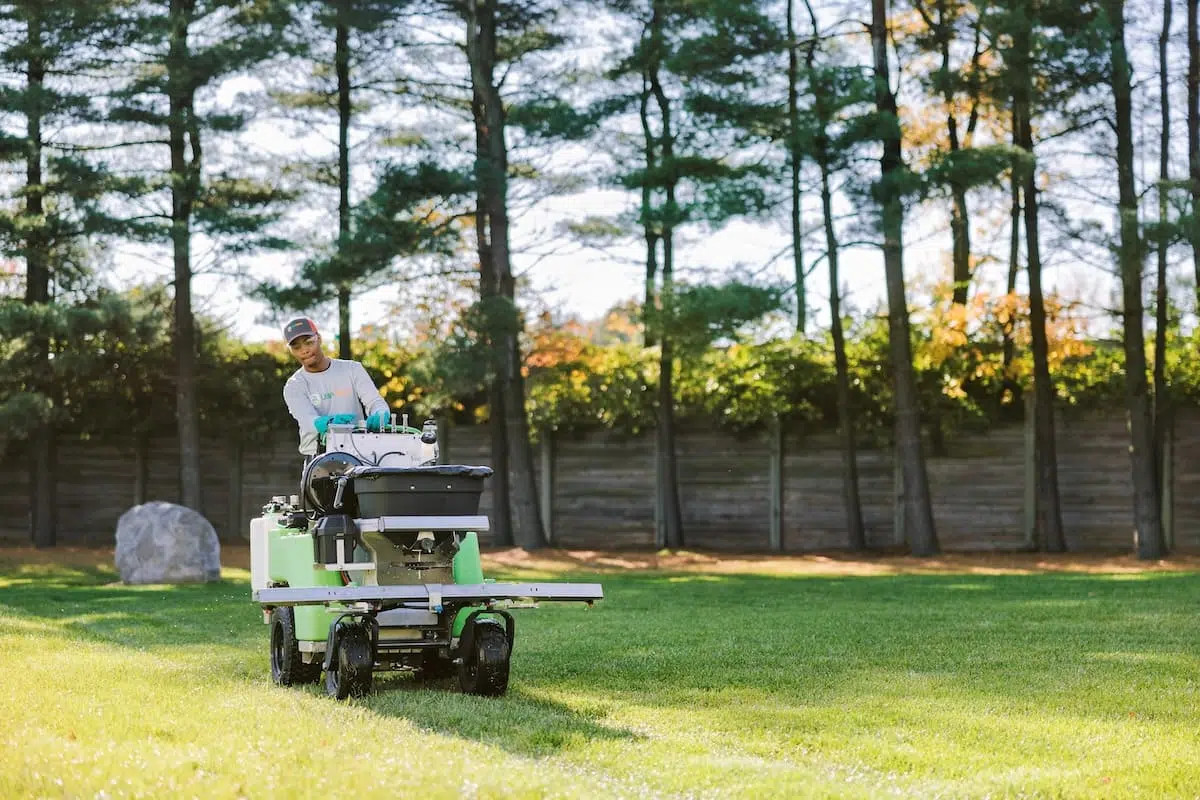
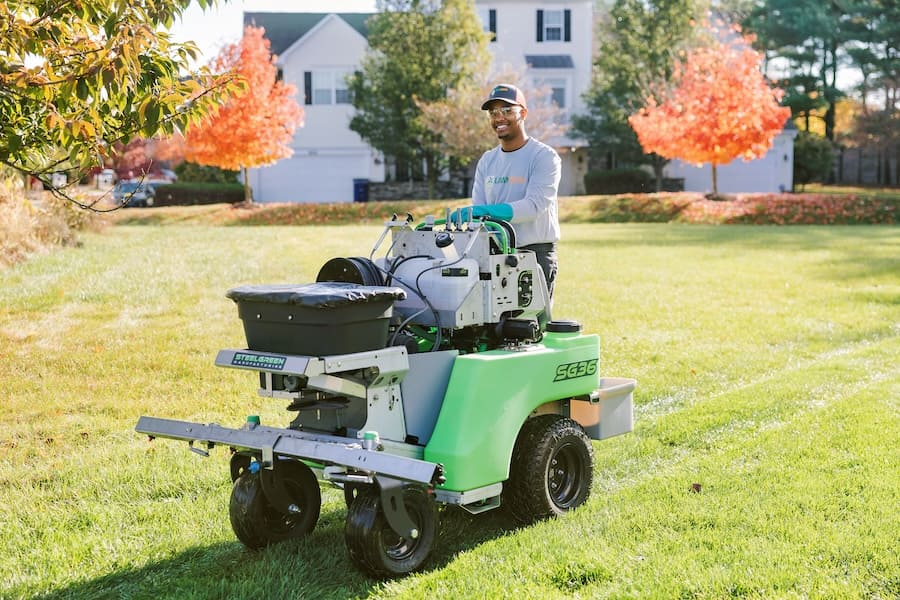
If you would rather have someone else handle the timing decisions, product selection, and application for your lawn, we are here for that. Lawn Squad of Bucks and Montgomery Counties serves homeowners across both counties. Visit lawnsquad.com to request a free quote. Our VitaminLawn program is built for the grass types, soils, and weather patterns we deal with in southeastern Pennsylvania, and for the rules the state sets on how lawns can be fed.
Here is what to expect. We will look at your grass, talk through how your lawn handled this year, and explain what we would apply before winter and why. If your lawn does not need a late-season application, we will tell you that honestly.