Sandy Loam Over Clay: How Central Georgia Soil Handles Fertilizer
Short Answer: Central Georgia sits along the fall line, where Piedmont clay to the north meets the sandy coastal plain to the south, so many lawns here have sandy topsoil sitting over a clay layer. The sand holds almost no nutrients and lets water and fertilizer move down quickly. The clay beneath then slows drainage abruptly, which can leave water perched in the root zone after heavy rain. The combination means light frequent feeding with slow release nitrogen works far better than heavy applications, and drainage problems here are often about the layer boundary rather than the surface.
If your lawn seems to dry out in three days during a hot week but stays soggy for two days after a downpour, you are not imagining a contradiction. A lot of Central Georgia properties sit on layered soil, and layered soil does both.
Understanding what is under your grass explains several things that otherwise look like product failures or irrigation problems. Here is how our soil is put together and what it means for feeding a lawn.
Where We Sit Geologically
Central Georgia straddles the fall line, the boundary where the hard rock of the Piedmont gives way to the softer sediments of the coastal plain. Macon sits essentially on it, which is why the Ocmulgee drops as it does and why the city grew where it did.
North of that line you get the red clay associated with the Georgia Piedmont. South and east you get sandy coastal plain soils, including the sandhills that run through our region. In between, and across much of our service area, you get properties with sandy or sandy loam topsoil sitting over clay at varying depths.
The depth varies a great deal, sometimes within a single yard. Some lots have two feet of sandy loam before clay. Others have six inches. Construction grading and imported fill add further variation, so the property next door may behave differently from yours, and the front yard may differ from the back on the same lot.
The Sand Layer Holds Almost Nothing
Soil retains nutrients through a property called cation exchange capacity, essentially its ability to hold nutrient ions where roots can reach them. Sand has very little, because the particles are large, round, and chemically inactive compared with clay or organic matter.
So nitrogen applied to sandy topsoil does not stay put. It dissolves, moves downward with rain and irrigation, and a meaningful share travels past the root zone before the grass takes it up. Potassium leaches readily too.
That produces the pattern homeowners describe most often. A heavy application delivers a surge of color and growth for two or three weeks, then the lawn fades and it looks like the fertilizer stopped working. What actually happened is that most of it left.
The response is not more fertilizer. It is lighter applications more often, using slow release nitrogen that dissolves gradually over six to eight weeks so less is mobile at any moment. The same annual amount divided across more applications produces a steadier lawn for the same money.
The Clay Layer Changes Drainage
Here is where layering does something a uniform soil would not. Water moves quickly down through sand, then hits the clay and slows dramatically, because clay transmits water far more slowly.
After a heavy rain, that can leave water sitting at the boundary, saturating the lower part of the root zone while the surface looks and feels dry. Roots sitting in saturated soil have no access to oxygen, and prolonged wet conditions at that depth cause root decline and invite disease.
It is also why some Central Georgia lawns have persistent soggy areas that have nothing to do with a low spot on the surface. The grade looks fine, and the problem is the shape of the clay layer underneath, which does not necessarily follow the surface contour at all.
Where a lawn browns in summer and stays wet after storms in the same spot, shallow sand over clay is a strong candidate for the explanation. That combination confuses people because the two symptoms seem contradictory, and on layered soil they are not contradictory at all. They are the same condition showing itself in two different weather patterns.
Root Depth Gets Complicated
Grass roots generally grow readily through sandy loam and slow considerably when they reach dense clay, particularly if that clay was compacted during construction.
So your effective root zone is often the depth of the sandy layer rather than the depth roots are theoretically capable of. On a lot with eight inches of sand over clay, a Bermuda lawn that could root a foot and a half deep in good soil may be functionally limited to that eight inches.
That is why drought stress arrives faster than expected on these properties. The lawn has a shallower water reservoir than the grass species would suggest, and our summers test it hard.
It also means heavy fertilizer applications underperform, since a limited root mass cannot take up a large dose in the window before water moves it past.
Finding Out What You Have
This is genuinely worth thirty minutes and it costs nothing but effort.
Dig a hole a foot deep in two or three places across the yard, ideally in an area that performs well and one that struggles. Look at the profile from the side. You will usually see a lighter sandy layer on top and a distinct change to denser, often redder or grayer material below. Note the depth where that change happens.
Feel the material too. Sandy loam is gritty and crumbles in your hand. Clay is smooth, sticky when moist, and holds together when squeezed. The transition is usually obvious once you are looking for it.
If the struggling area has noticeably less sand above the clay, you have likely found your answer, and it is a structural condition rather than a fertility one.
Working With It
Several adjustments make a real difference and none of them are exotic.
Feed lighter and more often, with slow release nitrogen. On sand over clay this is the single most important change, and it applies whether you handle it yourself or hire it out.
Water deeply enough to reach the root zone but not so much that you drive water to the clay boundary and leave it perched. On these soils, moderate and regular generally beats heavy and occasional, which is the opposite of the standard advice written for deep uniform soil.
Core aerate, particularly where the sandy layer is shallow, since it helps water move through and helps organic matter work down.
And build organic matter, which is the only durable improvement. Topdressing with quality compost, returning clippings with a mulching mower, and consistent aeration increase the sand’s ability to hold both water and nutrients. It works across years rather than seasons, and it is genuinely the fix rather than a workaround.
Why This Changes Your Fall Application
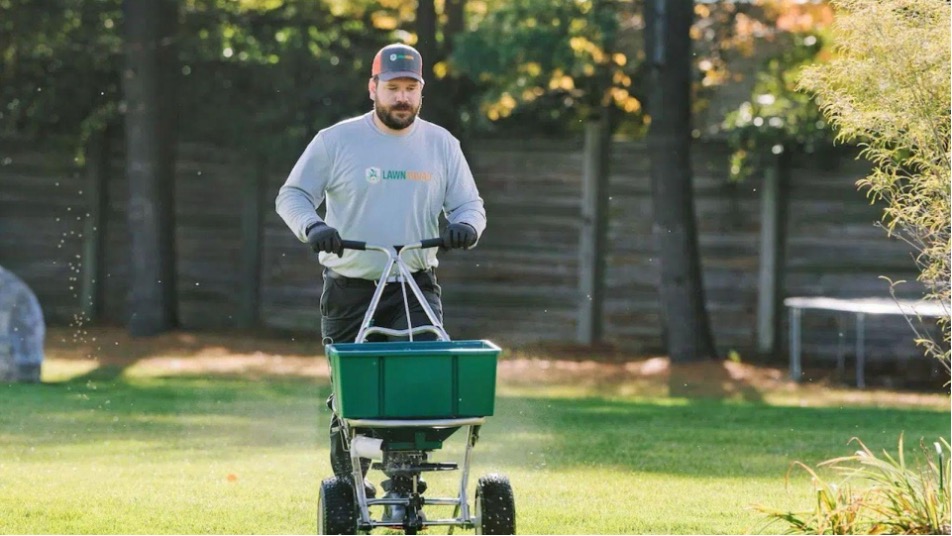
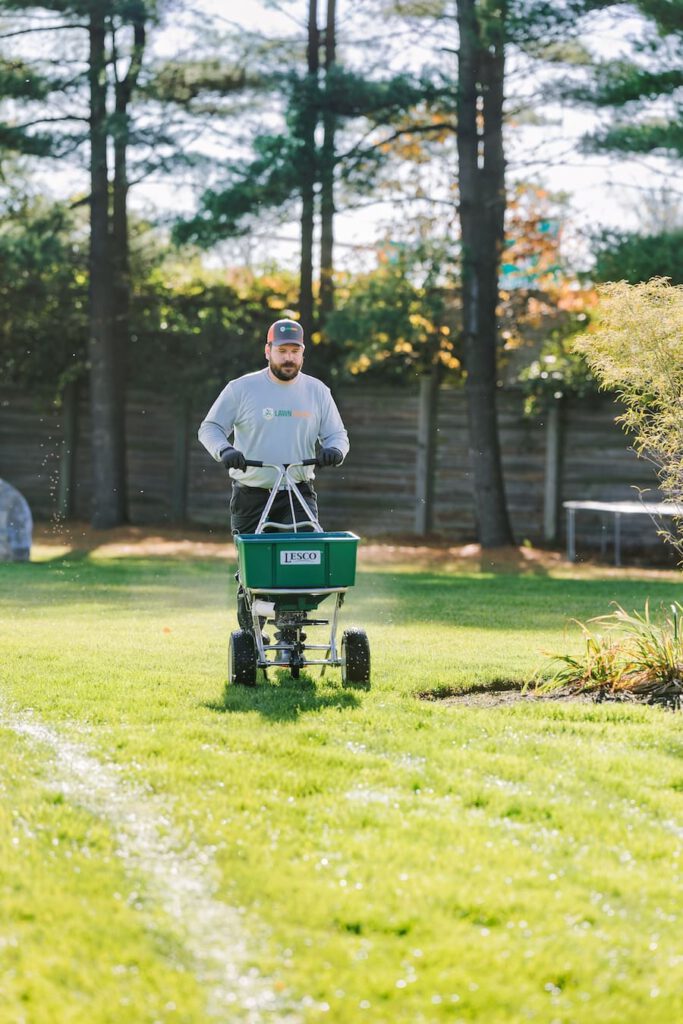
Two practical consequences for the application you are making right now. First, rate. A moderate application suits layered soil better than a heavy one, because a shallow effective root zone cannot take up a large dose before water carries it past. Splitting the same annual nitrogen across more applications is the efficient approach here.
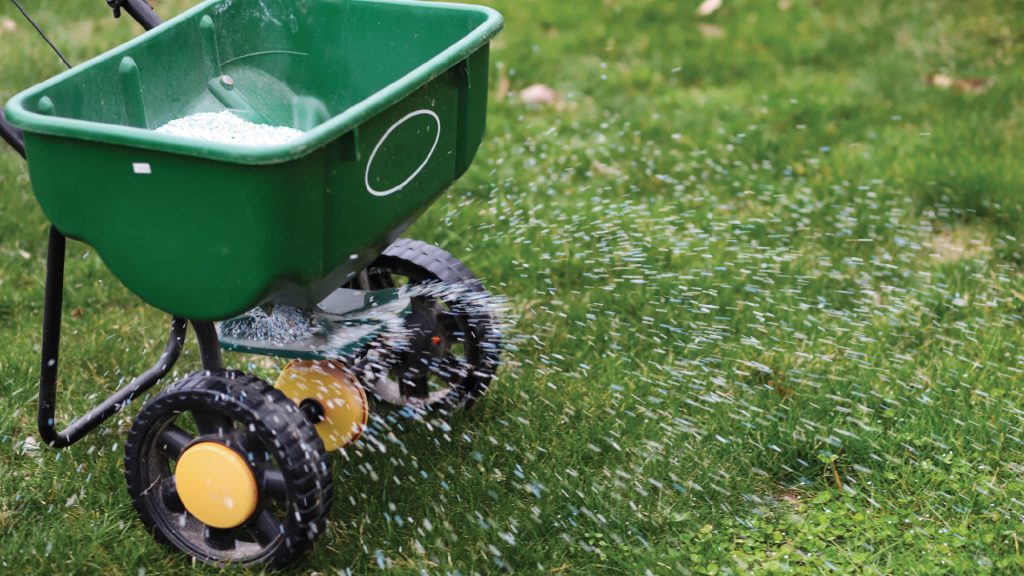
Second, watering it in. Granular product needs moisture to dissolve, but a heavy soaking right afterward on sandy topsoil drives nitrogen straight down to the clay boundary and out of reach. Roughly a quarter to a half inch is generally enough to dissolve and settle the application without overshooting it.
And if your grass is centipede, which is common across our area, the rate question matters more than the soil question. Centipede wants very little nitrogen in any soil, and on sandy ground it still wants very little.
What to Do Next
Dig two holes this week, one in a good area and one in a struggling area, and note where the sand gives way to clay. That single observation explains more about your lawn than most homeowners here ever learn.
Check the bag in your garage for the nitrogen breakdown. If none of it is slow release, that is likely the main reason your applications fade quickly, and switching products will do more than raising the rate.
Get a soil test as well, since our soils generally run acidic and low pH compounds the fertility problem by making what does stay in the root zone less available to roots.
If you would rather have someone read the soil and build a schedule around it, we are here for that. Visit lawnsquad.com to find Lawn Squad of Central Georgia and request a free evaluation. Our VitaminLawn program is built around the fall line soils and grasses we actually work with here.