Why South Miami Lawns Turn Yellow on Limestone Soil
Short Answer: Most yellow lawns in South Miami are not short on fertilizer. They are sitting on oolitic limestone with a soil pH commonly between 7.5 and above 8, and at that pH iron and manganese convert into forms grass roots cannot absorb. The nutrients are physically present and chemically unavailable. The tell is yellowing between the veins of the blade while the veins stay green, showing on newest growth first. The effective treatment is iron and manganese applied to the leaf rather than the soil, because foliar uptake bypasses the soil chemistry entirely. Adding nitrogen does not fix it and often makes the lawn look worse.
There is a particular frustration that comes from feeding a lawn faithfully and getting a pale, washed out yellow green in return while a neighbor who seems to do less has a deeper color. If that describes your situation, the odds are good that nothing you have done is wrong. You are standing on limestone.
This is the single most common lawn complaint we hear across South Miami, and it has a specific cause and a specific fix. It is also the problem most likely to get treated with the wrong product, because the symptom looks exactly like hunger and hunger looks like it calls for fertilizer.
What Is Actually Under Your Grass
Much of our area sits on oolitic limestone, a porous rock formed from ancient marine deposits. In many South Miami yards you hit rock within a foot of the surface, and what sits above it is a thin layer of marl or sand, sometimes trucked in fill.
Limestone is calcium carbonate, and it makes soil alkaline. Soil pH across our area commonly runs between 7.5 and above 8, sometimes higher on properties where crushed limestone fill was used during construction. For reference, most turf grass performs best somewhere between 6.0 and 7.0.
That number is not a minor deviation. Soil pH governs which nutrients are chemically available to plant roots, and once you climb above roughly 7.5, specific nutrients start dropping out of reach regardless of how much of them is present.
How High pH Locks Nutrients Away
Iron is the main casualty. At high pH, iron reacts with other soil elements and forms compounds that are essentially insoluble. Plant roots can only take up nutrients dissolved in soil water, so iron sitting in an insoluble form might as well not be there.
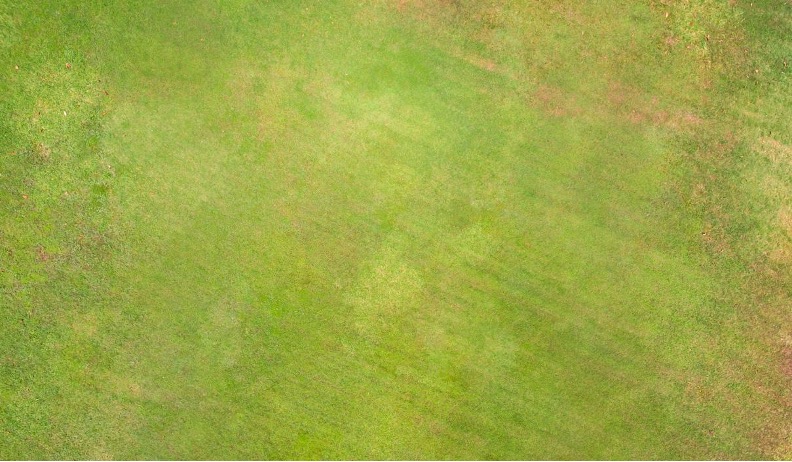
Iron is required for chlorophyll production, and chlorophyll is what makes grass green. A plant that cannot get iron cannot build chlorophyll, so the blades come in pale and yellow no matter how much nitrogen is available. This is called iron chlorosis, and on limestone soils it is not an occasional problem, it is the default condition.
Manganese goes the same way and often alongside it. Manganese is also involved in chlorophyll function, and high pH reduces its availability on the same chemistry. Many South Miami lawns are short on both at once, which is why a product containing only iron sometimes produces a partial result.
Zinc becomes less available too. The pattern is consistent: the micronutrients your grass needs in small amounts are exactly the ones our soil chemistry withholds.
How to Tell It From Nitrogen Deficiency
This distinction is the practical heart of the matter, because the two look similar from a standing position and call for opposite responses. Getting down and looking closely at an individual blade settles it in about ten seconds.
Iron chlorosis produces yellowing between the veins of the blade while the veins themselves stay green, a pattern called interveinal chlorosis. On a broad bladed grass like St. Augustine it is visible to the naked eye. It shows on the newest growth first, because iron does not move around within the plant once it has been deposited in older tissue.
Nitrogen deficiency looks different. The yellowing is uniform across the whole blade, veins included, and it appears on older growth first because the plant moves nitrogen out of aging tissue to supply new growth. A nitrogen deficient lawn also grows slowly and thins out. An iron deficient lawn often keeps growing at a normal rate while looking pale, which is a useful clue on its own.
If your lawn is growing well enough to need mowing on schedule but looks yellow, that combination points strongly to micronutrients rather than nitrogen.
Why Adding Nitrogen Makes It Worse
The instinct to feed a yellow lawn more nitrogen is understandable and it backfires here in a way worth spelling out.
Nitrogen drives the plant to produce new leaf tissue. New tissue requires iron to make chlorophyll. If iron is unavailable, you have now produced more tissue competing for the same inadequate iron supply, and the existing iron gets diluted across more growth. Lawns frequently look paler two weeks after a nitrogen application for exactly this reason.
There are secondary costs too. Excess nitrogen on year round growing St. Augustine builds thatch, because growth outpaces decomposition. Thick lush growth is also more attractive to chinch bugs, which remain active here through mild winters, and more susceptible to fungal problems. So the response to a yellow lawn can produce a thatchy, pest prone, still yellow lawn.
What Actually Works
The effective approach is applying iron and manganese to the leaf rather than to the soil. A foliar application is absorbed directly through the blade, which bypasses the soil chemistry entirely. There is no pH problem to solve because the nutrient never has to pass through the soil.
Response is usually visible within a few days to a week, and it can be dramatic on a lawn that has been chlorotic for a long time. Chelated iron products, where the iron is bound to an organic molecule that keeps it available, work better than simple iron sulfate in our conditions, particularly when applied to soil rather than leaf.
We want to be honest about the limitation. This is a treatment, not a cure. The soil chemistry has not changed, so the deficiency returns and applications repeat through the year. On our lawns, micronutrient applications are a routine recurring part of care rather than a one time correction. Anyone selling a permanent single application fix for limestone soil is overselling.
Can You Lower the pH
Homeowners ask this constantly and deserve a straight answer, which is mostly no, not meaningfully, and not permanently.
Soil acidifiers like elemental sulfur do lower pH, and on a soil with moderate alkalinity they can help. The problem here is that the source of alkalinity is limestone bedrock, sometimes inches away. It buffers relentlessly. You can acidify the top few inches temporarily, and the underlying rock pulls it back. Attempting to acidify a yard sitting on oolitic limestone is closer to bailing than to fixing.
What does help modestly is building organic matter, which improves nutrient holding and buffers the root zone somewhat. Topdressing with quality compost, returning clippings instead of bagging them, and core aeration all contribute over years. That is worth doing for several reasons, though it will not take your pH to 6.5.
The realistic framing is management rather than correction. Grass grows well here, it just needs its micronutrients supplied in a form the soil cannot intercept.
What to Do Next
Go look closely at a yellow blade right now. Hold it up and check whether the veins are still green while the tissue between them has gone yellow. If so, you have your answer and you can stop buying nitrogen to solve it.
Get a soil test. On limestone soil the pH number is the most useful single piece of information you can have about your yard, and a test also rules out the possibility that something else is going on. It costs a fraction of one application and it ends the guessing.
Here is what to expect from treatment. A foliar iron application greens the lawn within about a week, sometimes faster, and holds for several weeks to a couple of months before fading. That recurrence is normal here rather than a sign of failure. Pair it with a moderate slow release nitrogen rate rather than a heavy one, since the goal is steady growth the available iron can keep up with.
If you would rather have someone handle the micronutrient side of our limestone soils rather than working it out by trial and error, we are here for that. Visit lawnsquad.com to find Lawn Squad of South Miami and request a free evaluation. Our VitaminLawn program is built around the high pH soils, year round growth, and St. Augustine lawns we actually work with here.