Does My Aurora Lawn Actually Need Aeration This Fall?
Short Answer: Most established Aurora lawns benefit from annual fall core aeration, because the heavy clay soil common across the Fox Valley compacts easily and stays that way. Three quick checks will tell you where yours stands. Push a screwdriver six inches into moist soil, and if it takes real effort, you are compacted. Cut out a small wedge of turf and look at the roots, which should reach well past two inches. Watch where water sits after a rain instead of soaking in. Lawns under three years old on undisturbed soil, or lawns that are more weed than grass, are the two cases where we usually recommend waiting.
If you are standing in your yard right now wondering whether aeration is something your lawn genuinely needs or just something lawn care companies sell every September, that is a reasonable place to be. It is not a cheap service, the machine leaves your lawn looking chewed up for two weeks, and nobody wants to pay for something the grass was going to do on its own.
Here is the good news. Compaction is one of the few lawn problems you can diagnose yourself in about ten minutes, with tools already in your garage. You do not need a soil lab or a salesperson. Below are the three checks we run when we walk a property, what the results mean, and the specific situations where we tell homeowners to skip it this year.
Test One: The Screwdriver
This is the field test we use most, and it is the one we teach homeowners first. Take an ordinary six inch flathead screwdriver and push it straight down into the lawn in several spots. Do this a day or two after rain or watering, when the soil is moist but not saturated. Dry clay will resist no matter what, and soaked clay will accept almost anything, so timing matters.
If the screwdriver slides in to the handle with light hand pressure, your soil has good structure and aeration is optional this year. If you have to push hard, or lean on it with body weight, or it stops around two inches, that resistance is exactly what grass roots are running into. Roots are far weaker than your arm.
Test at least five spots, and be deliberate about where. Check the strip along the driveway, the path everyone walks from the back door to the garage, and the area where the dog turns around. Then check an out of the way corner. Most Aurora lawns we walk are not uniformly compacted. They have compacted traffic lanes and comfortable edges.
Test Two: Cut a Wedge and Look at the Roots
Take a spade and cut a triangular wedge about four inches deep, then lift it out and set it on the grass. This sounds destructive and it is not. Press it back in when you are done, water it, and it heals within two weeks.
What you want to see is white roots extending down through the profile, ideally four inches or more. What we usually find on compacted clay is a dense mat of roots in the top inch and a half, then a fairly abrupt stop where the soil gets tight and gray. That shallow root plate is why the lawn browns out in August. Two hot dry weeks are all it takes when roots have nowhere to draw from.
Look at the soil color too. Healthy soil is crumbly and dark. Compacted subsoil is often gray, dense, and comes out in a solid block rather than breaking apart in your hand.
Test Three: Watch Where the Water Goes
The next time it rains hard, or the next time your irrigation runs, go outside and watch. Water should disappear into the turf within a few minutes. If it beads up, runs downhill across the surface, or pools in the same depressions every single time, the soil is not accepting it.
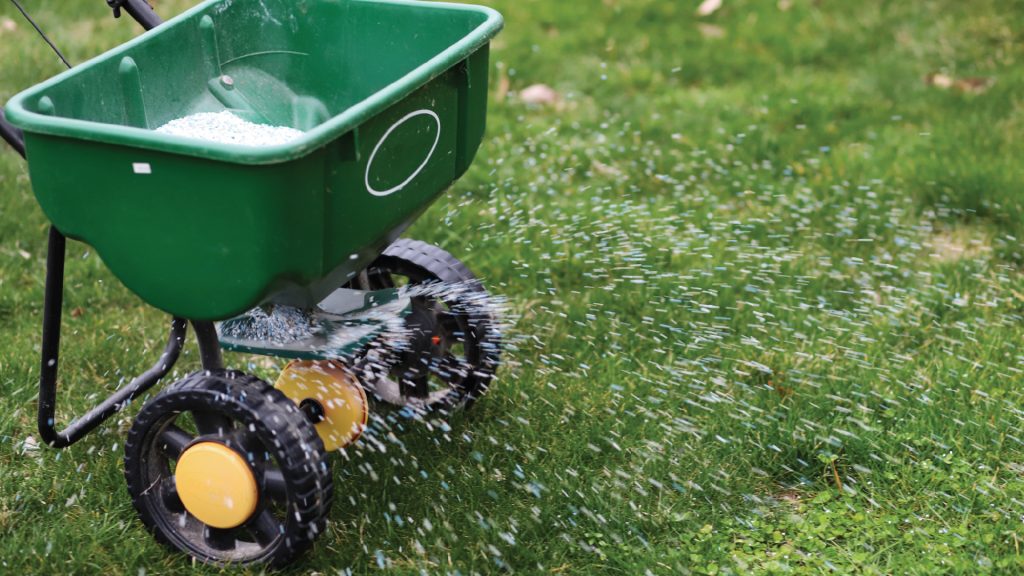
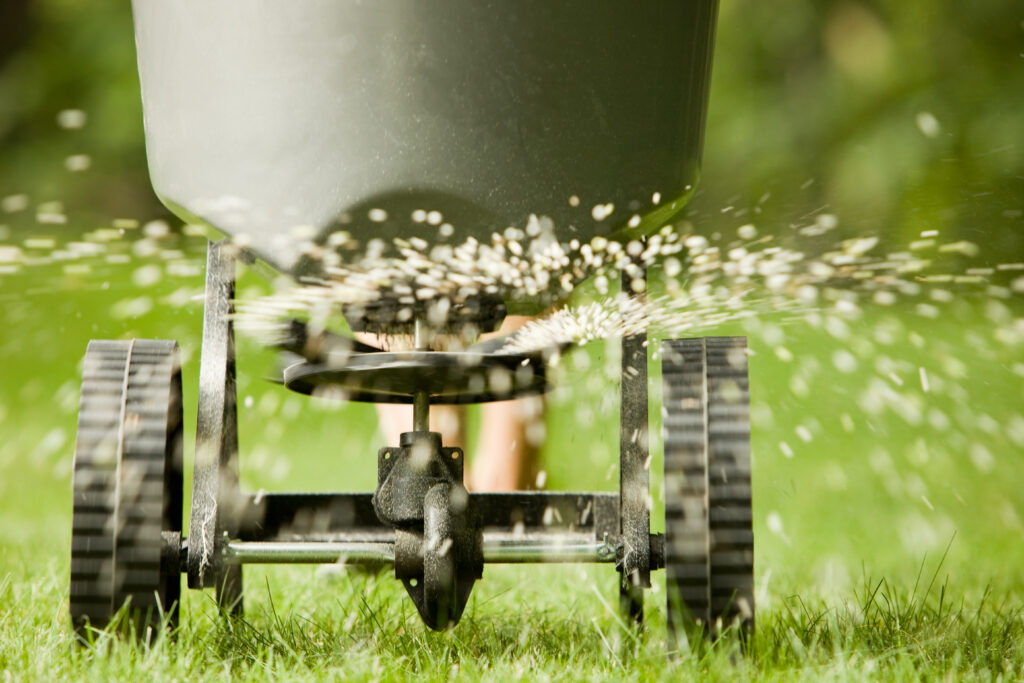
This one tells you something the other two do not, which is how much of what you are paying for is actually reaching the plant. Fertilizer, whether granular or liquid, needs to move into the root zone to do anything. On a compacted lawn, a meaningful share of it runs off toward the street and the storm drain. Homeowners who tell us their lawn stopped responding to feeding are often describing a delivery problem, not a nutrition problem.
Thatch and Compaction Are Not the Same Thing
This is where a lot of well meaning advice goes sideways. Thatch is the spongy layer of undecomposed stems and roots sitting between the green grass and the soil surface. Compaction is the soil underneath being squeezed tight. They produce similar symptoms and they call for different responses.
When you cut your wedge, measure the brown spongy layer above the soil line. Under half an inch is normal and actually helpful, since it insulates roots and holds moisture. Over three quarters of an inch starts to cause problems, because water and fertilizer sit in it rather than passing through, and roots begin growing into the thatch instead of the soil.
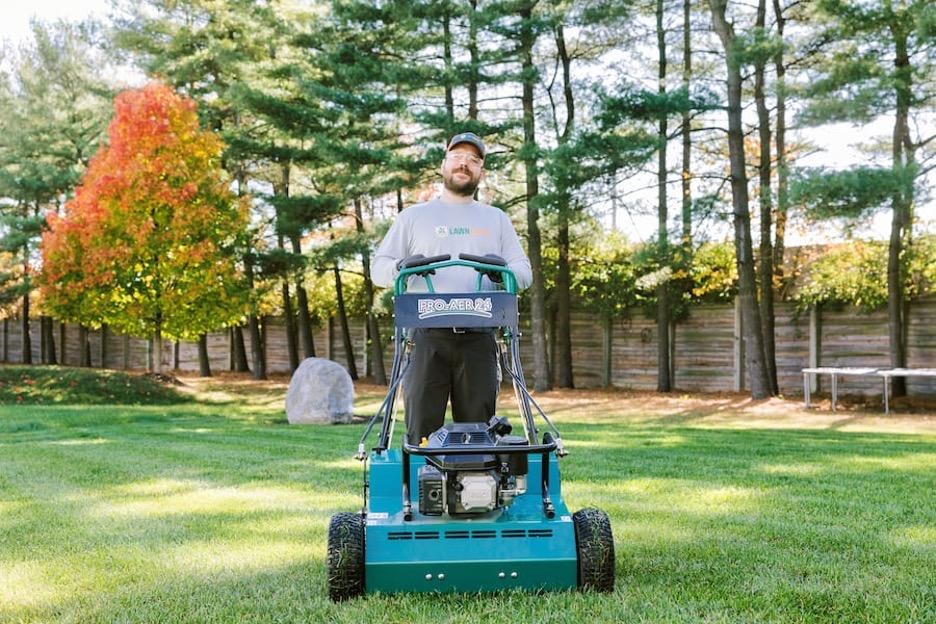
Core aeration helps both conditions, which is convenient. Pulling plugs breaks through the thatch layer physically, and the soil microbes in those plugs land on top of the thatch and speed up its decomposition. Heavy thatch over three quarters of an inch may also call for dethatching or verticutting, which is a separate service. Worth knowing before you assume one visit solves everything.
One correction we offer often. Grass clippings do not cause thatch. Clippings are mostly water and break down quickly, so mulching them back into the lawn is fine and actually returns nitrogen. Thatch comes from stems and root tissue, and it builds up fastest on overfertilized lawns and on compacted soil where microbial activity is low.
Why Newer Aurora Neighborhoods Compact Faster
If your home was built in the last fifteen or twenty years, there is a specific reason your lawn may be struggling more than an older home down the road. During construction, native topsoil gets stripped, heavy equipment runs across the subsoil for months, and then a thin layer of soil and sod goes down on top of a compacted base.
The lawn looks perfect the day you move in. Two or three years later it starts thinning, and the usual reaction is to add more fertilizer. The real issue is that roots hit a construction pan a few inches down and cannot get past it. Annual aeration is how that layer gets opened up over time, and it is genuinely a multi year project rather than a single fix.
Older neighborhoods around downtown Aurora and the established streets near the Fox River often have deeper native soil and different problems, usually mature tree shade and root competition rather than construction compaction.
How Often Lawns Around Here Need It
For most established lawns on Fox Valley clay, once a year in fall is the right cadence. Clay does not stay open. The holes close within a season, and the soil settles back toward where it started. Annual aeration is maintenance rather than repair.
Some properties justify twice a year. Heavily used backyards with kids and dogs, lawns that host regular gatherings, and areas that stayed wet all spring can benefit from a spring pass in addition to the fall one. Lawns on lighter or sandier soil, which do exist in pockets, often do fine every other year.
Fall is the better single choice in our climate because cool season grasses are in their strongest growth phase from September into late October. Soil is still warm, air is cooler, and the plant is putting energy into roots. Aerating in July, by contrast, stresses turf when it is least able to recover and opens the canopy for crabgrass.
When We Tell People to Wait
There are three situations where we recommend holding off, and we would rather say so than book work that will disappoint you. The first is brand new sod or seed. Turf established less than a year needs its roots knitted in before anything mechanical rolls across it.
The second is a lawn that is more weed than grass. Opening soil creates an excellent seedbed, and if the dominant seed bank is weeds, that is what fills the holes. A fall broadleaf application, then aeration and overseeding the following year, is the better sequence.
The third is unmarked irrigation, invisible dog fence wire, or shallow lighting cable that nobody can locate. Tines go two to three inches deep and will find all of it. Marking first is not optional.
What to Do Next
Go run the screwdriver test today. It takes five minutes and it will tell you more than any article can, because it tells you about your specific yard rather than the average one. Try the traffic lanes and an untouched corner, and notice the difference between them.
If the screwdriver fights you, plan on aeration while the window is still open. In our area that window generally runs from late August through mid October, before soil temperatures drop and root growth slows for winter. Pairing aeration with overseeding and a fall feeding in the same few weeks is how you get the most out of a single visit.
Here is what to expect afterward. Plugs stay on the surface and break down over two to three weeks, which is by design. The lawn looks worse before it looks better. If seed went down, keep the top inch of soil consistently moist with short frequent watering rather than long soaks, and hold off on the first mow until new grass reaches about three inches.
If you would rather have someone else handle the timing, the equipment, and the seed decisions for your Aurora lawn, we are here for that. Visit lawnsquad.com to find Lawn Squad of Aurora and request a free evaluation. Our VitaminLawn program is built around the clay soils, cool season grasses, and weather swings we work with here in the Fox Valley.