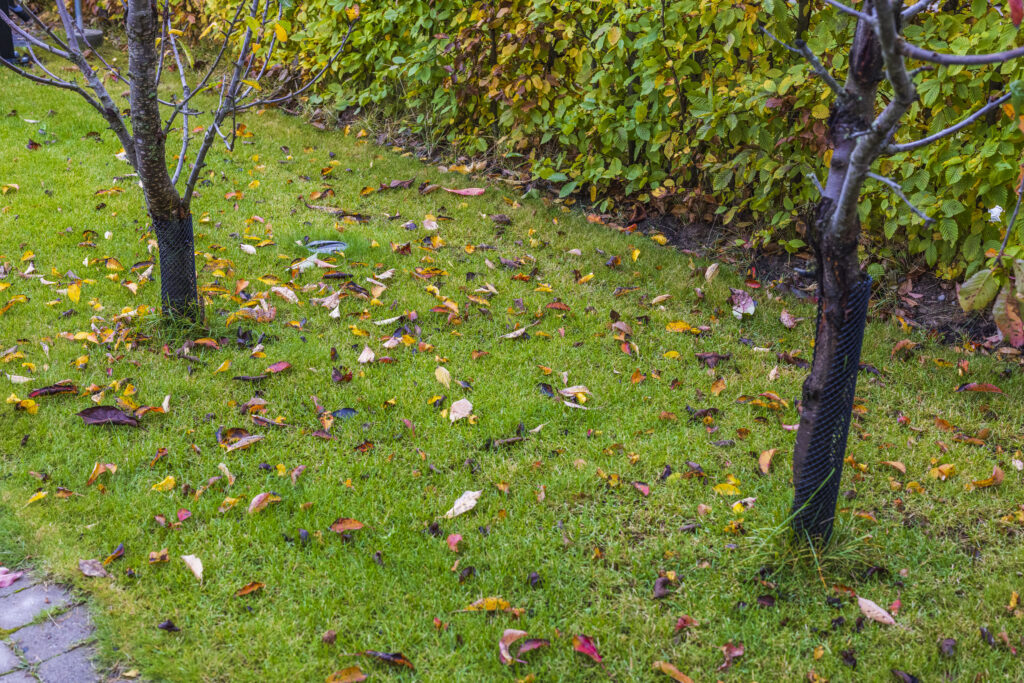
Short Answer: Mulch-mow most of them and remove the rest. Chopping a moderate leaf layer into small pieces with the mower returns organic matter and nutrients to soil that needs both, and it saves hauling. The limit is volume. If you cannot see grass after a pass, or the leaves are wet and matting, that layer has to come off. Work in stages through the season rather than waiting for one enormous cleanup, and check your village or town code first, because several Westchester municipalities restrict gas-powered leaf blowers during parts of the year.

Why the Volume Here Is Genuinely Different
Westchester properties sit under mature canopy that took eighty or a hundred years to grow. A single large oak or Norway maple can drop enough material to bury the lawn beneath it, and many lots have a dozen such trees. Advice written for a subdivision with two young ornamentals does not scale to a Chappaqua or Bedford property. Homeowners here are not deciding whether to bother with leaves, they are deciding how to move a substantial volume of material efficiently. The good news is that most of it does not need to leave the property at all.
Leaves Left Whole Will Damage the Lawn
Understand what you are actually preventing. A layer of whole leaves that sits through a wet November and then gets pressed down by snow forms a mat. That mat blocks light, holds moisture against the grass crowns, and creates the dark, humid conditions snow mold thrives in. It also gives voles cover to tunnel and feed on turf all winter, which is why homeowners find winding surface trails in April. The dead patches you see in spring are not from cold. They are from what sat on the grass for four months.
Mulch-Mowing Is the Default, Not a Compromise
Running the mower over a moderate leaf layer chops it into fragments small enough to fall through the grass canopy and reach soil, where they break down over the following months. This is not a shortcut. It returns carbon, potassium, and micronutrients, feeds soil biology, and slowly builds the organic matter that improves water holding and structure. Westchester County has actively promoted mulching leaves in place rather than hauling them off, precisely because the material has real value on site and disposal has real cost.
How to Mulch-Mow So It Actually Works
Technique matters. Work on dry leaves whenever possible, because wet leaves clump and smear instead of shattering. Raise the deck slightly, remove the bag, and use a mulching blade if you have one. Go slowly and make multiple passes over the same area rather than one fast pass, since the leaves need to be re-cut several times to get small enough. Overlapping passes in alternating directions helps. If you finish and can still identify whole leaves lying on the surface, the pieces are too large and you need another pass.
Know When the Layer Is Too Much
Mulching has a real ceiling and pretending otherwise damages the lawn. The practical test is simple: after your passes, you should clearly see grass blades standing up through the chopped material. If the surface still looks like leaf litter, the volume exceeded what the canopy can absorb, and that excess needs to be removed. Beneath heavy oaks, expect to remove a meaningful share regardless of technique. Aim for a split rather than an absolute, mulching what you can across most of the lawn and hauling the surplus from the worst areas.
Oak and Beech Are the Slow Ones
Not all leaves behave alike. Maple, ash, and birch leaves are thin, break down within a season, and mulch easily. Oak leaves are leathery, high in lignin, and slow to decompose, sometimes taking more than a year in whole form. Beech is similar and additionally tends to hold its leaves late into winter. Under an oak-dominated canopy, chop more aggressively with extra passes, and accept that you will be removing more material than a neighbor under maples. Oak leaves also mat unusually tightly when wet, which is exactly the snow mold scenario.
The Acidity Concern Is Overstated
Homeowners often worry that mulched oak or pine material will acidify the soil and harm the grass. Fresh oak leaves are mildly acidic, but the quantity involved has very little measurable effect on soil pH once decomposition finishes, and the effect is far smaller than the annual variation from fertilizer and rainfall. Westchester soils under long-established woodland canopy do frequently test acidic, which is worth addressing with lime if a soil test calls for it, but that is a legacy of decades of forest, not the result of mulching last October’s leaves.
Check Your Municipality’s Blower Rules
This is a genuine local constraint. A number of Westchester villages and towns have adopted ordinances restricting gas-powered leaf blowers, with limits that vary by municipality and often by season, day of week, and hour. Some are seasonal restrictions, some limit the number of machines on a property, some are moving toward electric-only. Rules change, so check your own village or town code for the current year rather than assuming, and confirm your landscaper is working within it. The practical effect is that leaf work here needs to be spread across more visits than it used to.
Work in Stages Instead of One Big Push
The single most useful change most Westchester homeowners can make is to stop treating leaf cleanup as one November event. Mulch-mow every seven to ten days from the time leaves start falling in earnest. Each pass handles a manageable layer, technique works better on thin dry layers, and you never face the impossible mat. Waiting until every tree is bare guarantees an overwhelming volume, likely on wet material, at the exact point in the season when the lawn is least able to recover. Staged mulching also spreads the labor and the cost over weeks.
Do Not Forget Beds, Gutters, and Drainage
Leaves that blow off the lawn cause problems elsewhere. A thick layer in planting beds is generally fine and acts as free mulch, but keep it pulled back from the crowns of perennials and away from shrub stems where it holds moisture and invites rot. Clear leaves off catch basins, area drains, and window wells, since a clogged drain during a heavy autumn rain sends water somewhere you do not want it. Gutters full of oak leaves back up and dump water at the foundation, which shows up as a permanently soggy strip of lawn.
Pair Leaf Work With the Fall Lawn Program
Leaves are not a standalone chore, they are one item on a sequence. Grass needs light and air to use the fall growing season, which is the most productive stretch of the year for cool-season turf in this county. A lawn buried in October cannot take up the fall fertilizer application, and a newly overseeded area smothered under leaves loses the seedlings you just paid for. Get seeding done inside the September window, keep the leaf layer thin while new grass establishes, and take the final cut slightly shorter after the last significant drop.
What This Buys You in April
The payoff is not visible in November, which is why the work gets skipped. A lawn that went into winter clean, mowed to the right height, and with chopped leaf material worked into the soil greens up evenly and early. A lawn that went in under a mat comes out with matted straw-colored patches, vole trails, and thin areas that need repair right when spring weeds are germinating. Every hour spent mulching in October removes several hours of repair work the following spring, and it improves the soil while doing it.
What to Do Next
Walk the lawn this week and write down the two or three things that actually bother you about it, then work backward from the window rather than forward from today. Almost every fall mistake we see in Westchester comes from starting with the calendar instead of with the lawn.
If you would rather have someone look at it with you, Lawn Squad of Westchester offers a free quote. Call 833-816-7508 or find us at lawnsquad.com. Every Lawn Squad location is independently owned and operated, and our VitaminLawn fertilization and weed control program is built around the grass, soil, and conditions here rather than a national average.
A first visit is a walk of the property, a look at the thin areas, a check of mowing height and irrigation, and a straight conversation about what is realistic in the weeks left this season. At 30 days you should see color and density improve. At 90 days the lawn should be visibly thicker, with the root growth that carries it through winter.