
Short Answer: Maybe, but in Central Indiana most brown patches in September are not grubs. The definitive test takes two minutes. Grab a handful of turf at the edge of a brown area and pull. If it lifts like loose carpet with no roots holding it, you have grub feeding. If it stays anchored, look elsewhere. Then cut a one foot square flap of sod about four inches deep and count what is underneath. Fewer than eight to ten grubs per square foot in a healthy irrigated lawn is generally not worth treating.

Do the Tug Test First
Before you buy anything, walk out to the edge of a brown area where dead turf meets green turf and grab a handful of grass at the base. Pull firmly upward.
Healthy turf resists. It holds because roots are anchoring it in the soil. Turf that has been fed on by grubs comes up in a sheet, because the grubs have chewed the roots off just below the crown. There is nothing left to hold it down. That single test rules grubs in or out faster than anything else, and it costs nothing. If the sod lifts like a piece of loose carpet, keep going. If it holds firm, the brown patch has another cause and treating for grubs will not fix it.
How to Actually Count What Is Down There
The tug test tells you grubs are present. It does not tell you how many, and the number is what determines whether treatment is justified.
Use a spade to cut three sides of a one foot square, about four inches deep, at the transition between dead and living turf. Fold the flap back like a page and sift through the soil and root zone. White grubs are cream colored, curled into a C shape, with a brown head and three pairs of legs near the front. Count them, then fold the sod back and step it down. Do this in three or four spots around the property, because grub populations in Central Indiana lawns are patchy rather than uniform. An average across several samples is far more reliable than one hole.
What Species You Are Dealing With Here
Two grubs cause most of the lawn damage across the Indianapolis area and the surrounding counties. The masked chafer is the most common annual white grub in Indiana turf. Adults are tan beetles that fly at dusk in late June and early July, often swarming around porch lights, and the females lay eggs in moist irrigated turf.
Japanese beetle grubs are the other major player, and their adults are the metallic green and copper beetles that skeletonize rose and linden leaves in July. Both have a one year life cycle, which is why damage timing is so predictable. May and June beetles, the larger Phyllophaga species, run on a two or three year cycle and show up less often but can do serious damage in the year their grubs are large.
The Damage Timeline in Central Indiana
Understanding the calendar explains why September is when the phone rings. Eggs are laid in early to mid July and hatch within about two weeks. Newly hatched grubs are tiny and feed on fine root hairs, which does not produce visible symptoms. Through August they grow, and their feeding increases sharply.
Visible damage typically appears from mid August through September, which is also when the lawn is under the most heat and moisture stress and least able to compensate. By mid to late October, as soil temperatures fall, grubs move down below the frost line to overwinter. They return to the root zone briefly in spring, feed for a few weeks, then pupate. This is why an October or November grub treatment usually accomplishes nothing. The target has already left.
What the Threshold Number Means
Finding grubs is not the same as having a grub problem. Nearly every lawn in Central Indiana has some. The generally accepted action threshold for masked chafer and Japanese beetle in a healthy, irrigated lawn is roughly eight to ten grubs per square foot.
Below that, the grass outgrows the feeding and you will never see a symptom. Above it, the root loss exceeds what the plant can replace. That threshold drops for lawns already under stress. A thin lawn on compacted soil with shallow roots and no irrigation can show damage at four or five grubs per square foot, because it has no reserve capacity. A dense, deeply rooted, well watered lawn can carry more than ten with no visible effect. The number of grubs matters less than the health of the lawn carrying them.
The Look Alikes That Get Misdiagnosed
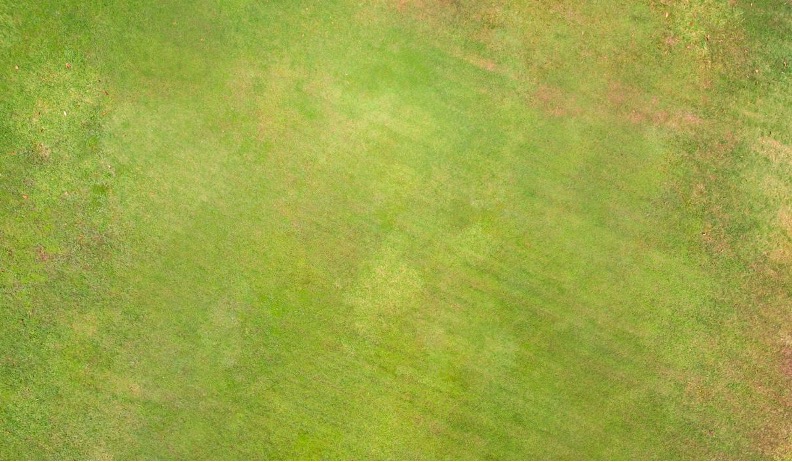
Several very different problems produce irregular brown areas in a Central Indiana lawn in late summer, and grubs get blamed for all of them.
- Drought dormancy, which is uniform, straw colored, follows the sunniest and highest ground, and greens back up after a good rain.
- Brown patch, a fungal disease of tall fescue and ryegrass that thrives in our humid nights, showing circular tan areas with a smoky edge on dewy mornings.
- Summer patch on Kentucky bluegrass, which appears as rings and crescents in compacted, sunny, closely mowed areas.
- Dog urine spots, which are small, sharply defined, and usually ringed with darker green.
- Nimblewill, a light green spreading grass that goes tan at frost and looks like a dead patch all winter, though it is very much alive.
- Shallow soil over buried construction debris, which dries out weeks before the ground around it.
Billbugs Are the Most Common Mistake
Bluegrass billbug deserves its own section because it is genuinely common in Indiana and it is routinely misidentified as grub damage. Billbug larvae are small, white, legless, and grain shaped, and they hollow out grass stems from the inside before moving to the crown and root zone.
The distinguishing test is easy. Tug an individual brown shoot rather than a handful. Billbug damaged stems snap off at the base and the broken end is packed with fine material that looks like sawdust. That frass is the giveaway, and grubs do not produce it. Billbug damage typically appears in June and July, earlier than grub damage, and it favors sunny areas along driveways and sidewalks. A curative grub product applied to a billbug problem does nothing at all.
Skunks, Raccoons, and the Mole Myth
If something is tearing your lawn up at night, that is meaningful evidence. Skunks and raccoons dig for grubs specifically, and the pattern of small conical holes and flipped up chunks of sod usually means the population is worth investigating.
Moles are a different story, and the belief that moles mean grubs is one of the most persistent myths in lawn care. Moles feed primarily on earthworms, which make up the large majority of their diet, with insect larvae as a supplement. On the rich, moist Crosby and Brookston soils common across the Indianapolis area, earthworm populations are high, and that is why moles are here. Killing every grub in the lawn will not remove them, and treating for grubs as a mole control strategy is money spent on the wrong problem.
Preventive Versus Curative Treatment
The two approaches work very differently and the distinction matters most in September.
Preventive products are applied in late spring or early summer, before or shortly after eggs hatch, and they remain in the root zone so newly hatched grubs die before they can do damage. They are the more reliable approach, and they are the right choice for lawns with a history of damage. Curative products are applied after grubs are present and must contact them directly, which means they need to be watered in thoroughly, generally with about half an inch of irrigation right after application. Curative treatment works best on small grubs. By late September the grubs in a Central Indiana lawn are large and much harder to kill, and by mid October they have gone deep. If you confirm a heavy population now, treat immediately rather than waiting for the weekend.
Repairing the Damage This Fall
Killing grubs does not regrow grass. Damaged areas have no roots and will not recover on their own, so plan on seed either way.
Rake out the dead turf, which comes up easily since nothing is holding it. Loosen the soil surface, because grub feeding leaves a spongy layer that needs firming and contact. Overseed with a quality turf type tall fescue blend, which handles our clay soils and summer heat better than bluegrass in most Central Indiana yards, or a bluegrass blend if you want the self repairing rhizome growth. Apply starter fertilizer and keep the area consistently damp for the first two to three weeks. September into the first week of October is the best seeding window we get all year here, so damage found now can be fully repaired before winter if you act on it promptly.
What to Do Next
Walk the lawn this week and write down the two or three things that actually bother you about it, then work backward from the window rather than forward from today. Almost every fall mistake we see in Central Indiana comes from starting with the calendar instead of with the lawn.
If you would rather have someone look at it with you, Lawn Squad of Central Indiana offers a free quote. Call 833-816-7508 or find us at lawnsquad.com. Every Lawn Squad location is independently owned and operated, and our VitaminLawn fertilization and weed control program is built around the grass, soil, and conditions here rather than a national average.
A first visit is a walk of the property, a look at the thin areas, a check of mowing height and irrigation, and a straight conversation about what is realistic in the weeks left this season. At 30 days you should see color and density improve. At 90 days the lawn should be visibly thicker, with the root growth that carries it through winter.