
Short Answer: Fall armyworms hatch in enormous numbers and feed as a group, so a Birmingham bermuda lawn can look fine on Friday and be chewed to brown stubble by Sunday. In most cases they are stripping leaf blades rather than killing the plant, and a lawn with healthy crowns usually recovers if you treat quickly and keep it watered. The damage looks catastrophic because it is fast and it advances as a visible front across the yard. Weekly scouting from August through October is the only reliable defense.
What Actually Happened to Your Lawn
The phone calls we get about this almost always sound the same. The lawn looked normal over the weekend, the homeowner left for work Monday, and by Wednesday afternoon a third of the front yard was brown, short, and ragged. Nobody sprayed anything. The irrigation is running. Nothing changed.
What changed is that several thousand caterpillars hatched and started eating. Fall armyworm moths fly north into central Alabama through the summer and lay egg masses of one hundred to two hundred eggs at a time, often on the underside of gutters, fence rails, patio umbrellas, and light fixtures rather than on the grass itself. Those eggs hatch, the larvae drop into the turf, and for the first week they are so small that they do almost no visible damage.
Then they reach their final growth stages, when a single caterpillar consumes more grass than it did in its entire life up to that point. That is the weekend when the lawn appears to fall apart. The feeding was building for two weeks and you could not see it.
Why They Are Called Armyworms
The name is descriptive rather than dramatic. Because an entire egg mass hatches together, the larvae move across a property as a dense group, consuming everything in a band and then advancing. Homeowners in Birmingham routinely describe watching a line move across the yard over two or three days, with green grass ahead of it and brown stubble behind.
That advancing front is the single most useful diagnostic feature. Drought stress appears first in the hottest, driest, most compacted spots and spreads unevenly. Disease appears in patches and rings. Armyworm damage has a distinct edge to it, and that edge moves.
Birmingham’s Armyworm Season
Fall armyworms cannot survive our winters. They overwinter along the Gulf Coast and in south Florida and re migrate north every year, which is why the severity swings so hard from one season to the next. Some years central Alabama sees almost nothing. Other years there are multiple heavy generations and entire neighborhoods get hit in the same week.
In the Birmingham area the pressure typically builds from late July, peaks somewhere between mid August and late September, and can continue producing generations until the first meaningful cold snap. September is usually the worst month, which is exactly when many homeowners have stopped paying close attention because the summer growth push is over.
Warm, wet late summers tend to produce heavier years. If you had them last September, that is not a guarantee you will have them this September, but it does mean your property has the surrounding habitat and structures that the moths favor.
How to Confirm It Is Armyworms and Not Something Else
Before treating anything, verify. Several different problems produce brown areas in a Birmingham lawn in September and the responses are not interchangeable.
- Look at the grass blades themselves. Armyworm feeding leaves ragged, chewed edges and blades eaten down to the midrib. Drought and disease do not chew.
- Get down on your hands and knees at the edge of the damage, in the green grass just ahead of the front, and part the canopy. That is where the active caterpillars are.
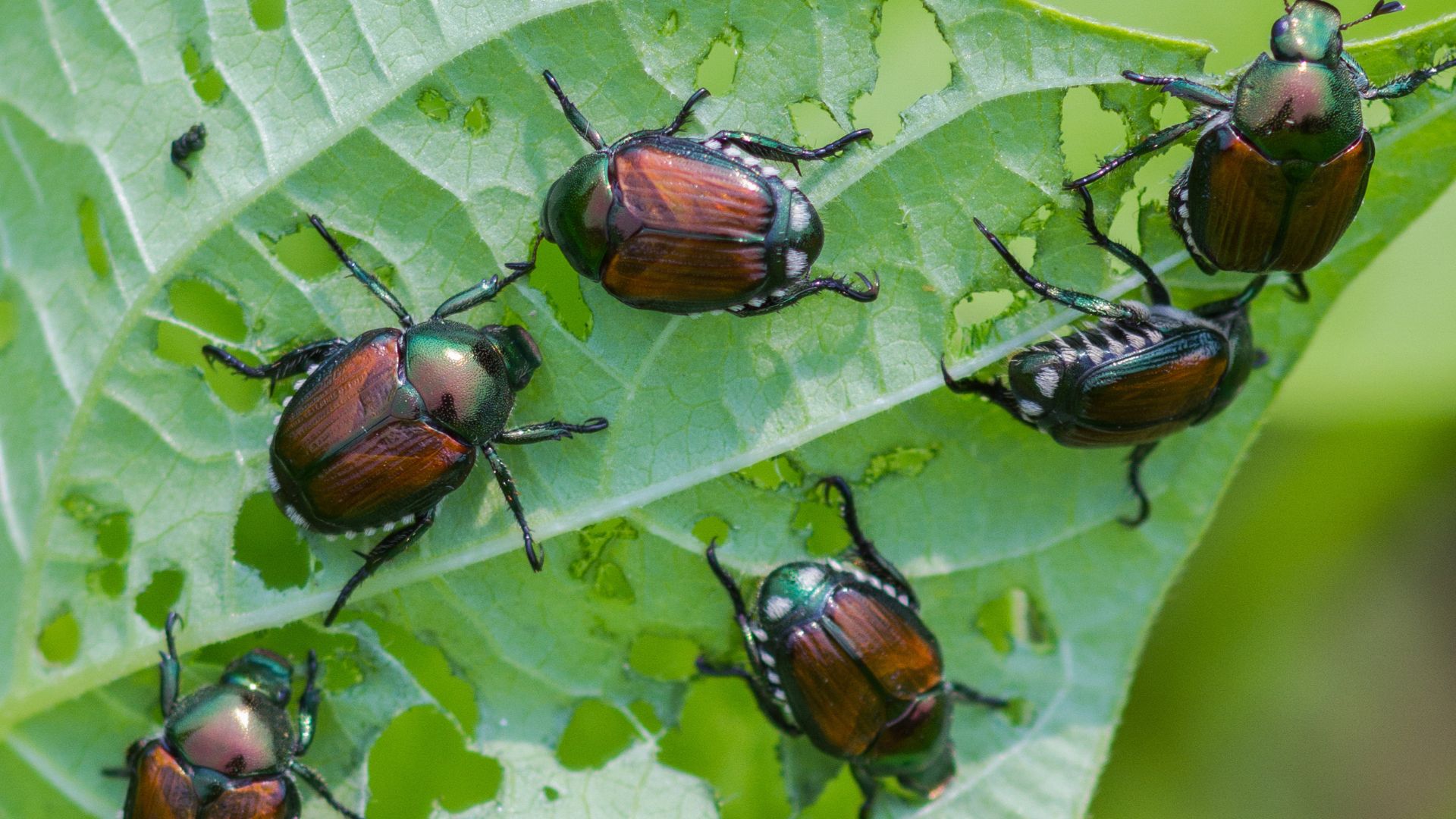
- Look for the caterpillars themselves. They range from about a quarter inch when young to roughly an inch and a half when mature, are usually green to brown with stripes running the length of the body, and carry a pale inverted Y marking on the head capsule.
- Watch for birds. A sudden concentration of birds working a section of lawn is one of the earliest signals people notice.
- Check the crowns. Push aside the chewed material and look at the base of the plant. If the crowns and stolons are still firm and light colored, the plant is alive.
The Soap Flush Test
The most reliable homeowner scouting method costs almost nothing. Mix a few tablespoons of liquid dish soap into two gallons of water and pour it slowly over a square yard of turf at the edge of the damaged area. The soap irritates soft bodied insects and drives them to the surface within a few minutes.
If you bring up two or three caterpillars in that square yard, you are looking at a developing problem worth treating. If you bring up a dozen, you are in an active infestation and time matters. This same flush will also reveal sod webworms and cutworms, which cause similar looking damage and are worth knowing about because their treatment timing differs.
Do this at the transition zone between green and damaged turf, never in the middle of the brown area. By the time an area is fully stripped, the caterpillars have already moved on.
Which Birmingham Lawns Get Hit Hardest
Armyworms will eat nearly any grass, but preference and visible damage vary. Bermuda is the most commonly affected lawn grass in the metro simply because it is the most common lawn grass in the metro. Tall fescue is also readily eaten. Zoysia takes damage but its density and slower growth sometimes mask it a little longer.
Well fertilized, lush, heavily irrigated lawns get hit hardest and get hit first. That is not a reason to starve a lawn, but it does mean the best looking yard on the street is frequently the one that gets eaten. Newly sodded areas are especially vulnerable because they have limited root reserves to recover from a total defoliation.
What to Do the Day You Find Them
Speed matters more than product selection. Armyworms in their last growth stages do most of the total damage of their entire life cycle in a few days, so a treatment applied Monday is worth far more than a better treatment applied Friday.
Mow first if the grass is tall, because that removes some larvae and improves coverage down in the canopy. Apply an appropriate labeled insecticide in the late afternoon or evening, since the caterpillars feed most heavily overnight and at dawn. Water the treatment in only if the product label directs it, because some materials need to stay on the leaf surface where the feeding happens rather than being moved into the soil.
Then check again in two or three days with another soap flush. Heavy years produce overlapping generations, and one treatment does not end the season.
Will the Lawn Actually Come Back
In most cases, yes, and faster than the damage suggests. Armyworms eat leaf tissue. They do not typically destroy crowns, stolons, or rhizomes, which is where a bermuda or zoysia lawn stores the ability to regrow. Once feeding stops, a healthy lawn with adequate moisture usually begins pushing new green growth within one to two weeks.
The risk is timing. An armyworm event in June leaves the entire summer for recovery. The same event in late September leaves very little growing season before dormancy, and a lawn that goes into winter fully defoliated with depleted reserves is more vulnerable to winter injury and slower to green up in spring. That is the real cost of a late season hit in Birmingham.
Newly installed sod and lawns that were already thin from drought or disease are the ones that sometimes do not recover and need repair the following spring.
Why You Should Not Fertilize Your Way Out of It
The instinct after armyworm damage is to throw down nitrogen to push regrowth. In late September in Birmingham that is the wrong move. Warm season grasses need roughly six weeks between the last nitrogen application and first frost so new growth can harden off, and our average first frost arrives in early to mid November.
Feeding heavily in late September or October to recover from armyworms trades a faster green up now for winter injury later, and it also increases large patch disease pressure as soil temperatures fall. The better response is water, patience, correct mowing height, and letting the plant use its own stored reserves. If the damage happens early enough in the season, a light feeding is reasonable. Past the third week of September, it usually is not.
Preventing the Next Outbreak
There is no practical way to stop the moths from arriving, so prevention here means early detection rather than exclusion.
- Scout weekly from late July through October, especially after warm humid stretches.
- Check the undersides of gutters, eaves, fence tops, and outdoor furniture for fuzzy gray egg masses and remove them.
- Walk the perimeter of the property, since damage frequently starts at the edges near pasture, wooded areas, or unmaintained lots.
- Note that a preventive application made too early does not carry through the whole migration window, which is why scouting beats blanket spraying on a schedule.
Neighborhoods tend to get hit together. If someone two doors down is dealing with it, check your own lawn that day rather than that weekend.
What to Do Next
Walk the lawn this week and write down the two or three things that actually bother you about it, then work backward from the window rather than forward from today. Almost every fall mistake we see in Birmingham comes from starting with the calendar instead of with the lawn.
If you would rather have someone look at it with you, Lawn Squad of Birmingham offers a free quote. Call 833-816-7508 or find us at lawnsquad.com. Every Lawn Squad location is independently owned and operated, and our VitaminLawn fertilization and weed control program is built around the grass, soil, and conditions here rather than a national average.
A first visit is a walk of the property, a look at the thin areas, a check of mowing height and irrigation, and a straight conversation about what is realistic in the weeks left this season. At 30 days you should see color and density improve. At 90 days the lawn should be visibly thicker, with the root growth that carries it through winter.