
Why Does Large Patch Treatment on My Huntsville Zoysia Start Before I See a Single Spot?
Short Answer: Large patch is caused by a soil borne fungus that infects zoysia crowns and leaf sheaths during the cool, wet conditions of fall, but the visible circles frequently do not appear until green up the following spring. Treating on symptoms means treating months after the infection took hold. Preventive applications are therefore timed to soil temperature falling through the low seventies at the two inch depth, which in the Tennessee Valley usually lands in early to mid fall. A second application extends protection through the infection period. Cultural corrections such as morning irrigation, better drainage, and no late nitrogen do a large share of the work.
Right now the zoysia is doing what you paid for. Dense enough that you leave footprints in it, thick enough that weeds cannot find daylight, and holding that dark blue green color even in the heat that settles into the valley in August. There is nothing to look at and nothing to worry about. Which is the problem, because the decision that determines what this same yard looks like next April is one you are making in the next several weeks, whether or not you know it.
Homeowners tend to feel a little cheated by that. Paying to treat a lawn with no visible problem runs against instinct. It is a fair reaction, and it deserves a real explanation rather than a sales answer.
What Large Patch Actually Is
Large patch is a disease of warm season turf caused by a strain of the soil fungus Rhizoctonia solani. The fungus lives in soil and thatch year round without doing much. It becomes aggressive only in a fairly narrow set of conditions, and when it does, it attacks the leaf sheaths and crowns right at the soil line rather than the leaf blades higher up.
That attack point explains everything else about this disease. The crown is where a grass plant regenerates. Damage there does not just brown the top, it disables the plant’s ability to push new growth. On zoysia, which is already the slowest spreading of the common warm season grasses in north Alabama, that translates into recovery measured in months.
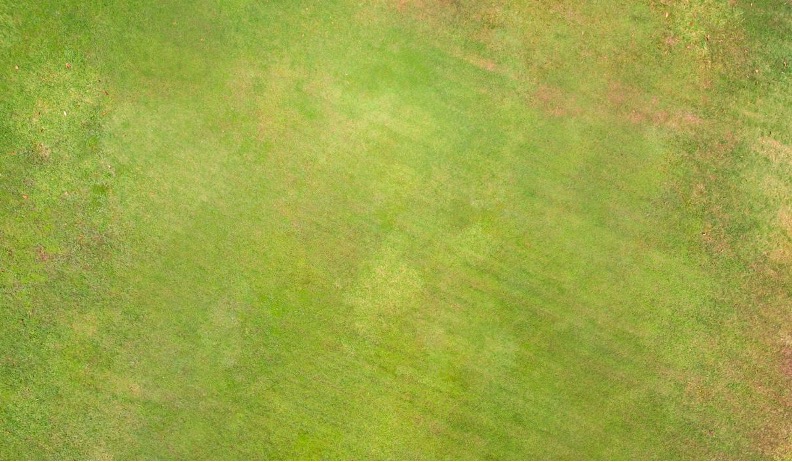
The classic look is a roughly circular area, often two or three feet across but sometimes far larger, with an orange or bronze cast to the outer margin where infection is active and a sunken, thinned interior. Pull a blade from the edge and it slides out easily with a rotted, water soaked, brown section at the base. That base rot is the confirmation.
The Fall Infection and Spring Symptom Gap
Here is the part that catches people. The fungus becomes active as soil cools in fall and moisture lingers. It infects while the zoysia is winding down toward dormancy and losing its ability to defend itself. Then the lawn goes brown for the winter, the damage is invisible against uniformly dormant turf, and everything sits quiet.
In spring the lawn greens up unevenly. Healthy areas turn while the infected circles stay tan, sometimes for weeks, sometimes for the better part of a season. Homeowners in Madison and Owens Cross Roads call us in April convinced something went wrong over the winter. Nothing went wrong in April. April is only when the receipt arrived.
That gap is the entire reason this disease is managed preventively. There is no symptom to react to during the window when reacting would help. We time the work to conditions instead, the same way you would put a cover on a boat before the storm rather than after.
The Soil Temperature Trigger We Watch
The trigger is soil temperature at roughly two inches deep falling through the low seventies and continuing down. Combine that with extended leaf wetness, from dew, fog, or rain sitting in the canopy overnight, and conditions favor infection. In the Tennessee Valley that combination generally shows up from early fall onward, though a warm dry September pushes it later and a cool wet one pulls it forward.
Air temperature is a poor substitute for that measurement. Soil holds heat and lags well behind the air, so a cool front that drops daytime highs by fifteen degrees may not move soil temperature much at all for a week or more. We monitor the soil directly, which is why we start these conversations in August rather than waiting for the first pleasant weekend.
One preventive application does not cover the whole infection period, because the material degrades over several weeks while the favorable conditions persist much longer. A second application timed a few weeks after the first is how we bridge that. On lawns with a documented history of large patch, that follow up is not optional in our view.
Why Valley Conditions Raise the Risk Here
Our geography works against us on this one. Huntsville sits in a broad valley ringed by mountains, and cool air drains off those slopes at night and pools on the flats. That is why you can drive from a ridge road down toward the Flint River bottoms on an October morning and watch fog thicken as you descend. Those long, heavy dew periods are exactly the leaf wetness the fungus needs, and they last well past sunrise on low lying properties around Big Cove, Ryland, and Gurley.
Our soils add to it. Unlike the acidic red clay south of us, much of the Tennessee Valley sits on limestone derived soil that runs closer to neutral or mildly alkaline, and it is often shallow over rock with imperfect internal drainage. Water that cannot move down stays in the root zone longer. Meanwhile the rapid buildout through Madison, Harvest, and Capshaw has left a lot of yards on compacted, graded subsoil where the topsoil layer is thin and drainage is worse than the neighborhood’s original ground ever was.
Add irrigation set to run at ten at night, and you have engineered ideal conditions without meaning to.
The Cultural Corrections That Do Half the Work
We would rather you fix conditions than buy more applications, so here is where the leverage actually is. Move irrigation to the early morning, ideally finishing shortly after sunrise. The goal is for the canopy to dry quickly, and morning watering shortens the wet period rather than extending it through the entire night.
Stop nitrogen on zoysia by the end of summer. Nitrogen applied into fall produces soft, succulent tissue at exactly the moment the fungus is looking for it, and lush late growth is one of the most consistently documented risk factors for this disease. Manage thatch as well. Zoysia builds thatch readily, and a thick spongy layer holds moisture against the crowns and houses the fungus. If a screwdriver is hard to push into the soil or the thatch layer measures more than about half an inch, core aeration in the growing season is worth doing.
Finally, look at airflow and shade. A zoysia lawn boxed in by fencing and mature trees in an older Huntsville neighborhood stays wet hours longer than an open lot in Meridianville. Selective pruning to open the canopy is a legitimate disease control measure, not just landscaping.
What Happens If You Wait Until Spring
Curative applications exist and have a place, primarily to stop an active outbreak from expanding. What they cannot do is regrow what is gone. Once crowns are killed, the only path back is zoysia creeping in laterally from the healthy margins, and zoysia is deliberate about that. A patch three feet across can take most of a growing season to close, and a bad case leaves a lawn looking rough from April into July.
There is a compounding cost too. Bare ground in spring is where weeds establish, so a large patch scar frequently becomes a weed problem on top of a turf problem. Sodding the worst areas is possible but far more expensive than the preventive program would have been. When we walk homeowners through that comparison, the fall decision usually makes itself.
What to Do Next
Start with an assessment while there is still time to act. If you saw slow, patchy green up this past spring, or circular thin areas that filled in late, assume the fungus is present and plan on prevention. If your zoysia has been clean and your drainage is good, we may tell you that cultural adjustments alone are a reasonable place to start. We would rather say that than sell an application you do not need.
A first visit runs about half an hour. We identify your grass, measure thatch, check compaction and drainage, look at irrigation timing and shade, and review last spring with you. From there we set the preventive timing against soil temperature. At 30 days there is nothing dramatic to see, which is exactly what success looks like with a preventive. At 90 days the lawn is heading into dormancy on schedule with the fungus suppressed through the infection window. The result you are buying shows up next April, in a lawn that greens up evenly instead of in patches.
Disease prevention works best inside a complete plan, which is how our VitaminLawn program is built, matching fertility timing, weed control, and disease pressure to your grass and our limestone valley soils. Lawn Squad of Huntsville serves Huntsville, Madison, Harvest, Athens, Toney, Capshaw, Hazel Green, Meridianville, New Market, Normal, Brownsboro, Big Cove, Gurley, Ryland, and Owens Cross Roads. Call 983-233-6002 or visit lawnsquad.com for a free quote. We are independently owned and operated and we stand behind our work with a satisfaction guarantee.