Short Answer: All three problems turn a Columbus lawn brown in July, but they look different and need different responses. Heat dormancy is uniform across the lawn, with firm white crowns at the soil and no patch pattern. Drought hits sun-exposed and high spots first, with footprints that do not spring back. Disease makes shaped patches with sharp edges, circular for brown patch on fescue and silver-dollar-sized for dollar spot on bluegrass. The pull test, the sprinkler test, and a close look at patch geometry will sort it out in 10 minutes. Watering a dormant lawn wastes money. Watering a diseased lawn makes the disease worse. Diagnosis comes first.
It is the second week of July in Hilliard. The lawn that looked rich and green on Memorial Day is now showing tan and brown in places, and you cannot quite tell what is going on. A neighbor in Powell tells you to water more. A neighbor in Upper Arlington tells you it is heat dormancy and to leave it alone. A guy on a forum says it is brown patch and you should spray fungicide. Three different answers, three different actions, and most of them are wrong for your particular lawn.
This is the classic Columbus July problem. We sit in the transition zone, where cool-season grasses (Kentucky bluegrass and tall fescue) try to survive a summer they did not evolve for. Add in clay soil that bakes hard, humid nights that feed fungi, and a few stretches of 90-plus heat without rain, and we get three completely different stress patterns that all look similar at a glance. The treatments are completely different. The cost of doing the wrong thing is steep.
This walkthrough is built so that you can stand on your own lawn, run three quick tests, and know within 10 minutes which of the three you are looking at.
The Three Causes, Compared at a Glance
Heat dormancy is a protective response in cool-season grass. When soil temperatures cross roughly 80 degrees and stay there, the grass stops top growth, browns the blades to reduce water loss, and pours its energy into keeping the crown (the small white growing point at the base) alive. The plant looks dead but is not. Cooler temperatures and rain in late August bring it back.
Drought stress is the absence of enough water for the plant to function. Unlike dormancy, drought is dangerous because the crown itself starts to dehydrate after about three weeks without water in Columbus July conditions. If the crown dies, that area will not come back without overseeding or sod.
Fungal disease is a living organism (Rhizoctonia for brown patch, Clarireedia for dollar spot) attacking the grass. Disease damage is not reversible by changing the weather. Even if the heat breaks, the diseased tissue stays dead and the pathogen stays in the soil waiting for the next humid night.
Test One: The Pull Test
Grab a small handful of grass in a brown area, between your thumb and the side of your index finger, and pull straight up firmly. Then look at what came out.
If the blades pull out clean from a soft, mushy base with no white crown attached, the plant is dead in that spot. This is either advanced drought (crown desiccated and died) or advanced disease (pathogen consumed the crown). Either way, that area is not coming back on its own.
If the blades resist the pull and stay attached to a firm white crown at the soil, the plant is alive. The brown color is heat dormancy or early drought, and recovery is possible.
If the blades come out easily but there is a firm white crown still in the soil where they snapped off, the plant is alive but stressed. You have caught it early, and intervention now will save it.
This single test sorts about 70 percent of Columbus July lawn calls. The crown either is or is not alive, and that decides almost everything else.
Test Two: The Pattern Test
Walk to the curb and look at the entire lawn as one picture. Then walk around the house and do the same thing.
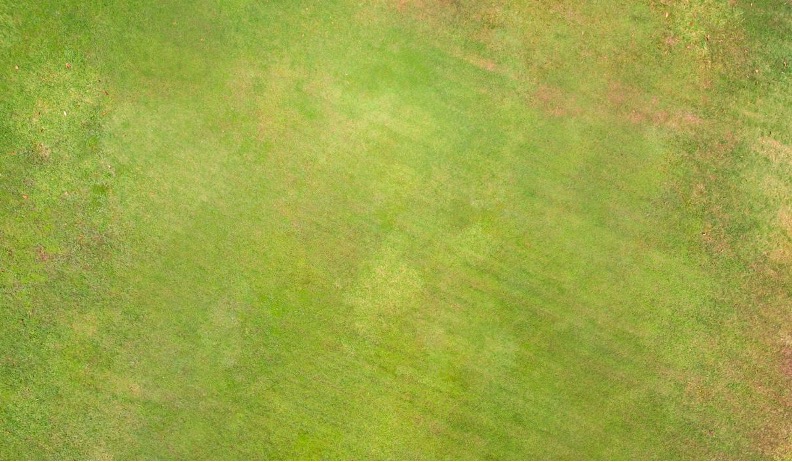
If the whole lawn is uniformly tan or two-tone (green in the deepest shade, tan everywhere else), that is heat dormancy or general drought. Cool-season grass under heat stress goes brown evenly because the stress is hitting the whole lawn at once.
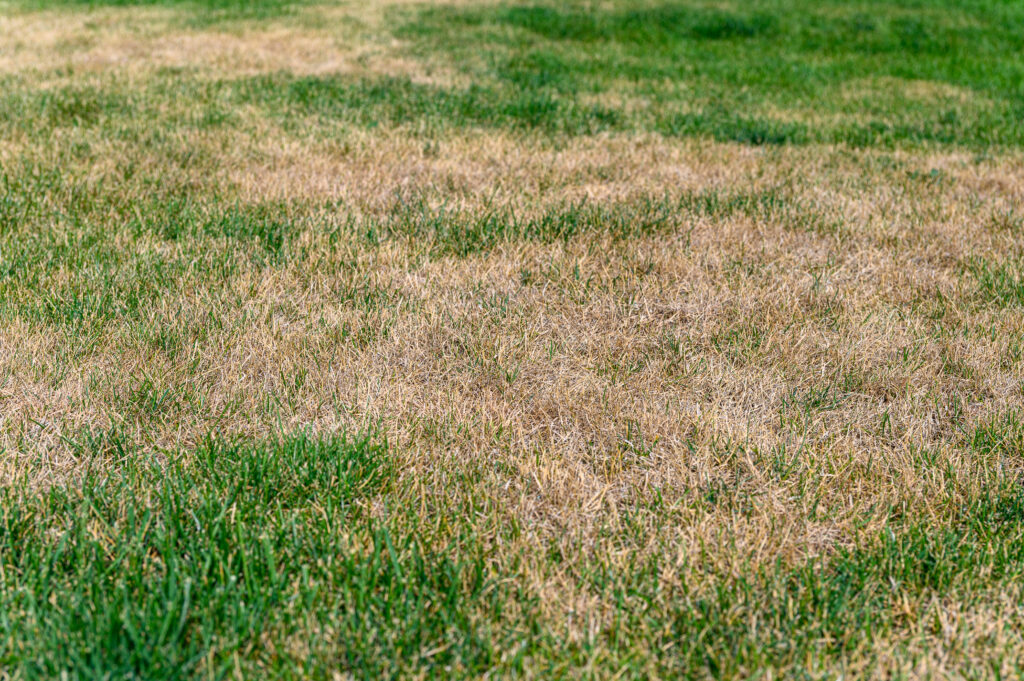
If you see distinct sun-baked stripes that follow the path of the sun, brown along the south wall and green on the north, brown on slopes and green in low spots, that is drought. Water is the variable. Wherever the sun is hottest or the soil is shallowest, you see brown first.
If you see circular patches with relatively sharp edges in random locations, often with green grass on the inside of the circle and a tan ring around the outside (frog-eye pattern) or just a uniform tan circle 1 to 3 feet across, that is fungal disease. Brown patch on tall fescue is the most common version in Columbus. Dollar spot makes smaller silver-dollar-sized spots, often clustered in one part of the lawn.
Pattern recognition handles the rest of the diagnosis. Uniform equals dormancy. Sun-mapped equals drought. Shaped patches equal disease.
Test Three: The Sprinkler Patch Test
If the first two tests still leave you uncertain, this third test resolves it. Pick a small section of the brown area, maybe 4 feet by 4 feet, and water it deeply, about a half inch of water put down slowly so it soaks in rather than runs off. Then walk away for 48 hours and come back.
If the tested area greens up noticeably while the rest of the lawn stays brown, you have heat dormancy or drought (both respond to water). The plant was alive and waiting for moisture.
If the tested area looks the same as before, or worse, you have disease or severe drought where the crowns have already died. Disease often gets visibly worse with extra water because the humid microclimate feeds the pathogen.
This test does cost a small amount of water, but it gives you a definitive answer before you commit to a full treatment plan that costs much more.
What to Do for Heat Dormancy
If the test points to heat dormancy, the right move is mostly to do nothing. Specifically:
- Stop fertilizing. Pushing nitrogen onto a dormant lawn forces growth that the plant cannot support and weakens the crown.
- Mow only when the lawn is growing, which in dormancy is rarely. Set the deck to 3.5 to 4 inches and stay off the lawn in the heat of the day.
- Water just enough to keep the crowns alive, about a quarter to a half inch every two to three weeks during a sustained heat run. Not a full inch.
- Stay off the lawn as much as possible. Foot traffic on dormant turf crushes crowns and creates dead spots that will not recover.
- Wait. Columbus typically gets relief in mid August. With cooler nights and a soaking rain, dormant turf greens back up within two weeks.
What to Do for Drought
If the test points to drought, water is the answer, but the way you water matters more than the volume.
- Water deep and infrequent. One inch per week total, ideally in one or two long cycles rather than daily shallow runs. Shallow daily watering encourages a shallow root system that dies fast when conditions change.
- Water early in the morning, between 4 and 8 a.m. This avoids disease pressure (grass dries within a few hours) and avoids evaporation loss.
- Check coverage. Place tuna cans around the lawn and run your sprinklers for 15 minutes. If some cans have a half inch and others have a quarter, your coverage is uneven and the dry spots are where brown is showing up first.
- Pay attention to slopes and south-facing exposures. These dry out first and need either more cycle time or a slight redirect of sprinklers.
What to Do for Disease
If the test points to disease, water is the wrong answer, and so is fertilizer. The right moves are:
- Cut back to morning-only watering. Wet grass overnight feeds the disease.
- Raise the mower to 3.5 inches. Taller canopies dry faster after morning dew.
- Hold all nitrogen until September. Lush growth in July is the most disease-susceptible tissue you can put on a lawn.
- Clean the mower deck after running through diseased areas, or mow infected spots last so you do not spread the pathogen across the rest of the yard.
- If the patch is spreading despite the cultural changes, call us. A targeted fungicide on a defined patch is far cheaper than waiting for the disease to consume a large area.
Why Columbus Sees All Three in a Single July
Columbus gets all three conditions in the same month, which makes our diagnostic challenge harder than most regions. We get hot enough to trigger dormancy, humid enough to feed disease, and dry enough between rain events to cause drought, often in the same week. Older Bexley and Clintonville lawns lean Kentucky bluegrass and tend toward dollar spot. Newer Dublin and Powell subdivisions lean tall fescue and tend toward brown patch. Hilliard and New Albany have wider properties where drought on south-facing slopes shows up before disease does. Knowing your grass type and your microclimate cuts diagnostic time in half.
What to Do Next
If you walked the lawn this week and you are not sure what you are looking at, send us a photo of the patch from above, a close-up of a single grass blade, and a wide shot of the whole lawn. Three photos and 10 minutes of our time will sort it for you without a visit.
Lawn Squad of Columbus serves Baltimore, Blacklick, Brice, Canal Winchester, Carroll, Columbus, Delaware, Dublin, Galloway, Grove City, Groveport, Hilliard, Lewis Center, Lockbourne, New Albany, Pataskala, Pickerington, Powell, Reynoldsburg, and Westerville.
Call us at 740-248-5880 or request a free quote at lawnsquad.com. Our VitaminLawn program is built specifically for the transition zone fescue and bluegrass lawns that define Columbus, including the summer protection protocols that keep dormancy, drought, and disease from compounding into a fall recovery project.