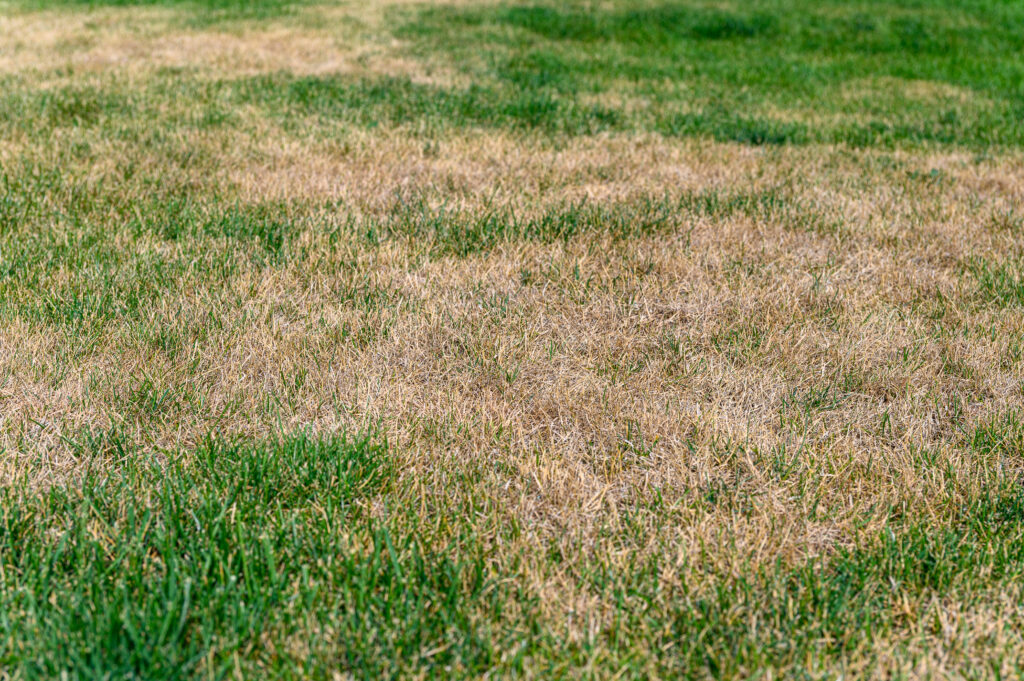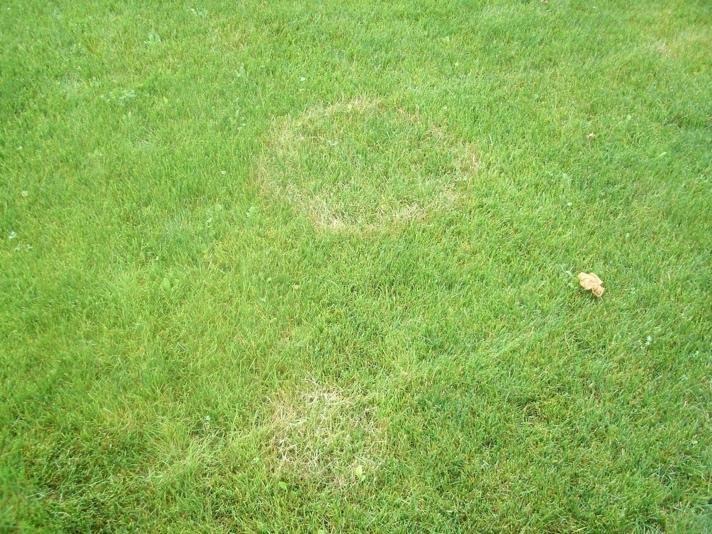
Short Answer: Necrotic ring spot and summer patch are two root-zone fungal diseases that hit Utah County Kentucky bluegrass lawns hard in June and July, and both are typically mistaken for drought damage because they look like patches that watering does not fix. Necrotic ring spot makes circular straw-colored rings that often have green grass in the center (frog-eye pattern). Summer patch makes irregular yellow-then-bronze patches that turn straw-brown. The treatment changes everything once you know which one you have: improved root health, watering corrections, soil pH work, and targeted fungicides applied at the right depth. Watering more makes both diseases worse.
If you live anywhere from Lehi down through Provo, Orem, Spanish Fork, and Payson, your lawn is almost certainly Kentucky bluegrass. It is the dominant turf species across Utah County and across most of the Wasatch Front, because bluegrass handles our cold winters, recovers well from the alkaline-loving weeds we deal with, and forms the dense, dark green canopy most homeowners want. The downside: bluegrass in Utah County faces two specific fungal diseases that almost no other grass type deals with at the same intensity. Both show up in June.
If you have rings or patches forming on your Utah County lawn right now, and watering more is not helping, this guide is for you. We will walk through how to tell necrotic ring spot from summer patch, why they get confused with drought, and what realistic treatment looks like for both.
Why These Diseases Hit Utah County So Hard
Three things about Utah County conditions create the textbook environment for necrotic ring spot and summer patch.
First, the alkaline soils. Utah County soil pH typically runs 7.5 to 8.2 across most properties, sometimes higher in areas with heavy calcium carbonate. Both diseases prefer alkaline soils. The fungi are present in nearly every Utah County lawn at low levels year-round and only become a visible problem when conditions support active infection.
Second, the irrigation pattern. Most Utah County lawns are watered with sprinkler systems on city water, and many systems water shallow and frequent rather than deep and infrequent. That pattern keeps the upper soil moist and warm, which is exactly the root-zone environment both diseases want.
Third, the heat-and-humidity timing. Both diseases are most active when soil temperatures climb into the 65 to 80 degree range, which in Utah County happens consistently from mid-June through August. Add a few warm humid nights from afternoon thunderstorms off the Wasatch, and the diseases take off.
The result: necrotic ring spot and summer patch are two of the most common Kentucky bluegrass diseases we treat across Utah County, and both peak in late June and July.
Necrotic Ring Spot: The Frog-Eye Pattern
Necrotic ring spot has a signature look that becomes easy to recognize once you have seen it a few times.
The disease starts as small circular patches of dying grass, often six inches to a foot across. As the patches expand outward, the center often recovers because the new grass growing back is not immediately infected. The result is a ring of straw-brown grass with a green center, which gardeners call the “frog-eye” pattern. Multiple rings often appear across a lawn, sometimes overlapping into figure-eight shapes.
The disease attacks the roots and the lower crowns of the bluegrass plant. When you grab a tuft of grass from an active ring and pull, the grass comes up easily because the roots are gone. Looking at the base of the affected plants, you see dark, rotted root tissue instead of healthy white roots.
Necrotic ring spot is a multi-year problem on Utah County lawns. The fungus can persist in the soil for years, and the same areas often show ring activity year after year unless you address the underlying conditions.
Summer Patch: Irregular and More Aggressive
Summer patch presents differently. Instead of clean frog-eye rings, you see irregular patches that start yellow, fade to bronze, and finally turn straw-brown. The patches are often elongated, not always circular, and they expand quickly during heat waves.
Like necrotic ring spot, summer patch attacks the roots and crowns. The grass in active patches pulls up easily, and the base of the plants shows dark rotted tissue.
The biggest visual difference between the two: summer patch rarely shows the green-center pattern. Whole patches turn brown without recovery in the middle. The patches are also more aggressive in hot weather; a one-foot patch in late June can become a four-foot dead zone in early July if conditions stay favorable.
Summer patch tends to hit the hottest, driest, most stressed parts of the lawn first: south-facing slopes, areas near concrete and asphalt that reflect heat, and zones with compacted soil. Necrotic ring spot can hit anywhere, but often shows up in older, denser bluegrass stands with thick thatch.
Why Watering More Makes Both Worse
This is the single most important point in this guide. The homeowner’s instinct when patches appear is to water more. With both of these diseases, more water accelerates the damage.
Both fungi thrive in warm, moist soil. Increasing irrigation frequency keeps the upper soil constantly damp and warm, which is exactly the disease’s preferred environment. The patches expand faster on heavily watered lawns than on moderately watered ones.
The correction is deep, infrequent watering. One inch of water per week, delivered in two soakings, in the early morning. The soil should be wet at the four-to-six-inch root zone after watering and should dry at the surface before the next cycle. That dry-surface period interrupts the disease’s spread.
The screwdriver test confirms whether you are watering correctly. Push a long screwdriver into the lawn the morning after watering. It should slide in four to six inches with light pressure. If it stops at two inches, water longer. If it slides in eight inches with no resistance, you are watering too much.
What Realistic Treatment Looks Like
Both diseases respond to a combined approach that addresses the underlying root health and uses targeted fungicide where appropriate.
1. Correct the watering. Deep and infrequent, morning only. This single change reduces disease pressure significantly within two weeks.
2. Address the soil pH where possible. Most Utah County soils run alkaline enough that the practical fix is acidifying with elemental sulfur at moderate rates. This is a slow, long-term improvement, not a one-application fix. Sulfur applications in the fall over multiple years gradually lower pH into the 6.5 to 7.5 range that bluegrass prefers.
3. Reduce thatch. Both diseases live in thick thatch layers. A fall core aeration with light topdressing of compost helps over time. Spring dethatching can spread the disease if done at the wrong time; fall is safer.
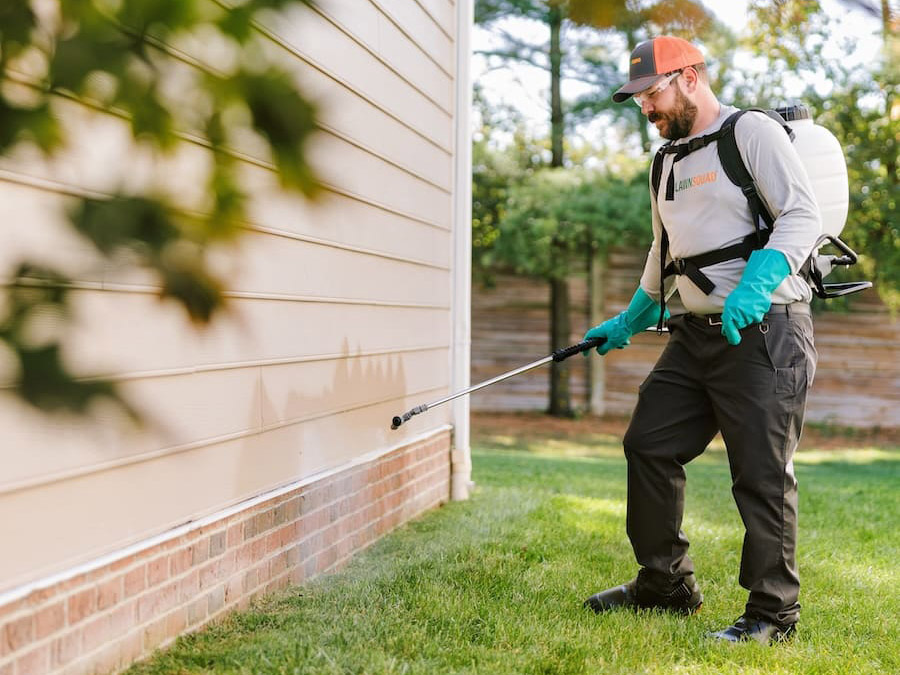
4. Targeted fungicide on active disease. For lawns with significant disease pressure, a soil-drench fungicide application reaches the root zone where the fungus lives. Surface sprays do not work for these diseases because the fungus is six inches down. Active ingredients labeled for necrotic ring spot or summer patch (azoxystrobin, propiconazole, fluoxastrobin, or combination products) work when applied as a heavy drench, typically in May or early June for prevention and into June for curative work.
5. Improve root health. Light, balanced fertility (avoid heavy nitrogen during disease pressure), iron supplementation to push color without forcing growth, and biostimulant products with humic acid all support the lawn’s ability to grow new roots ahead of the disease. We see meaningful recovery in lawns on a comprehensive program within six to eight weeks.
What Recovery Looks Like and How Long It Takes
Realistic expectations matter. Both diseases damage the root system, and recovery is a multi-month process even when treatment is done well.
The first sign of improvement is that patches stop expanding. That happens within two to three weeks of watering corrections and fungicide application. The next sign is that the patches begin filling in from the edges, where healthy grass starts spreading by rhizomes into the dead zone. That takes four to eight weeks.
Complete fill-in often requires fall overseeding. We overseed affected areas in early September with bluegrass varieties bred for improved disease resistance, sometimes blending in a small percentage of tall fescue for additional resilience. The overseeded grass roots in through October and the lawn looks much better by the following spring.
For chronic-disease yards, year-after-year management is the realistic picture. We do not eliminate the disease in one season. We manage it down to a level where the lawn looks consistently good through summer.
What to Do Next
If you have rings or patches on your Utah County lawn right now, and watering more is not helping, June is the right month to get a real diagnosis and treatment plan in place. The longer the disease feeds on the roots, the more recovery work fall will require.
Lawn Squad of Utah County serves homeowners across Utah County.
Call us at 385-336-6785 or request a free quote at lawnsquad.com. Our VitaminLawn program is built specifically for Utah County Kentucky bluegrass lawns, the alkaline soils that make our region distinctive, and the heat-and-irrigation pattern that drives most of the disease pressure we see. Most Utah County homeowners on a comprehensive disease program see meaningful improvement within one season and significantly better lawns by the second.