
Short Answer: Yellow St. Augustine in late June across the Palm Beaches usually comes from one of three causes. Iron chlorosis (newest blades pale yellow with green veins, common on our alkaline coastal soils) is the most frequent. Nitrogen deficiency (entire blades pale, older blades worst) is second. Disease, especially take-all root rot and gray leaf spot, is third (irregular patches, distinct lesions, thinning canopy). The right fix depends on which one it is. Iron sprays for chlorosis, balanced fertility for nitrogen, fungicide and cultural fixes for disease. Below is the field diagnostic we use across Boca Raton, Delray Beach, and West Palm Beach.
You pull out of the driveway in Boca Raton or Lake Worth Beach late one June morning and notice your lawn looks paler than it did two weeks ago. The blades are not brown. They are not crispy. They are just yellowish, kind of washed out, especially in patches near the irrigation heads or along the sidewalk. The neighbors’ lawns look greener. Yours did too, a month ago.
This is one of the most common calls we get in late June across the Palm Beaches, and it is also one of the most commonly mistreated. Homeowners assume it is a fertilizer problem, throw down a heavy dose of nitrogen, and watch the lawn either green up briefly and yellow again, or actively get worse. That is because there are three completely different causes of yellow St. Augustine in our area, and only one of them is solved by more nitrogen. Here is how to tell them apart.
Cause 1: Iron Chlorosis
Iron chlorosis is the most frequent cause of yellow St. Augustine in the Palm Beaches, and it is a direct consequence of our soil. The sandy, alkaline, limestone-influenced soils that run from Boca Raton up through Palm Beach have a pH that often sits between 7.5 and 8.2. At that pH, iron in the soil binds chemically into forms the grass cannot pull up through its roots.
The plant has iron in the soil right next to it. It just cannot use it. That is chlorosis.
The visual signature is specific and worth memorizing. The newest, youngest blades at the top of each shoot turn pale yellow first. The older, lower blades stay greener. If you bend down and look at a single yellow blade, you will often see darker green veins running lengthwise on a pale yellow background. That interveinal yellowing is the giveaway. It is not random. It is iron-specific chlorosis from a textbook.
Chlorosis often shows up worst in spots where the soil pH is highest, which on Palm Beach properties tends to be near the foundation, along driveways and pool decks where concrete leaches lime, and around new construction or recent landscaping projects.
Cause 2: Nitrogen Deficiency or Nutrient Imbalance
Nitrogen deficiency looks different. When a St. Augustine lawn runs low on nitrogen, the older, lower blades yellow first, because the plant moves mobile nitrogen out of older tissue to feed new growth. The whole blade turns a uniform pale yellow or yellow-green, not the interveinal pattern of iron chlorosis. Growth slows. Mowing frequency drops. The lawn looks tired and uniform across the area rather than spotty.
Nitrogen deficiency in the Palm Beaches usually means one of two things. Either it has been more than eight weeks since the last fertilizer application, or recent heavy rain (we get plenty in late June) has leached nitrogen out of the sandy soil profile faster than expected.
The fix is a balanced fertilizer application at modest rates, ideally a slow-release product so the next rain event does not flush it all into the storm drain. Florida-friendly fertilizer regulations vary by municipality across our service area, so check what is allowed in Boca Raton, Delray Beach, or your specific city before applying. Several Palm Beach County municipalities have summer phosphorus or rate restrictions, and following them protects both your lawn and your local waterway.
Cause 3: Disease (Take-All Root Rot, Gray Leaf Spot, Large Patch)
Disease-driven yellowing looks different from both nutrient causes because it tends to be patchy, irregular, and progressive. The yellowing is not uniform across the lawn. It shows up in specific areas, often a few feet across, that expand week to week.
Take-all root rot is the disease we see most often on yellowed St. Augustine across the Palm Beaches. It is caused by a soil fungus that attacks the roots and stolons. Above ground, you see yellow patches that thin out, often with the runners coming up easily when you tug on them because the roots are gone. The patches expand outward and can merge.
Gray leaf spot causes yellowing too, but the giveaway is the lesions on individual blades. If you pick a single blade from a discolored area and hold it up to the light, gray leaf spot shows distinct tan or gray oval spots with darker borders. Iron chlorosis and nitrogen deficiency never produce lesions. That is the single fastest way to rule disease in or out.
Large patch (sometimes called brown patch in cool weather) appears as roughly circular yellow rings that turn brown in the centers. It is less common in the heat of late June than in cooler shoulder seasons, but irrigated, overfed lawns can still see it.
The Three-Step Field Diagnostic
Here is the walk we do on a yellow Boca Raton or Delray Beach lawn before recommending anything.
Step one: look at the pattern. Is the yellowing uniform across the whole lawn, or concentrated in irregular patches that have grown over time? Uniform points to nutrition. Patchy points to disease.
Step two: pick a single yellow blade and inspect it. Look for interveinal yellowing (iron). Look for whole-blade yellowing (nitrogen). Look for lesions or spots (disease).
Step three: check root attachment in a yellow area. Grab a section of stolon and pull gently. If the runners pull up easily and the roots are short or rotted-looking, take-all is the likely culprit. If the roots are intact and the lawn is just pale, you have a nutrient issue.
Two minutes of this walk usually tells you which of the three causes you are dealing with, and the treatment becomes obvious from there.
What to Apply, in Plain Terms
For iron chlorosis, a foliar iron product is fast and visible. Chelated iron sprays (look for products labeled FeEDDHA for alkaline soils, since other chelates lose effectiveness above pH 7.5) typically green up the lawn within five to seven days. Granular iron-plus-nitrogen products work too, watered in lightly. On Palm Beach alkaline soils, plan on iron supplementation two or three times a year. It is part of the program, not a one-time fix.
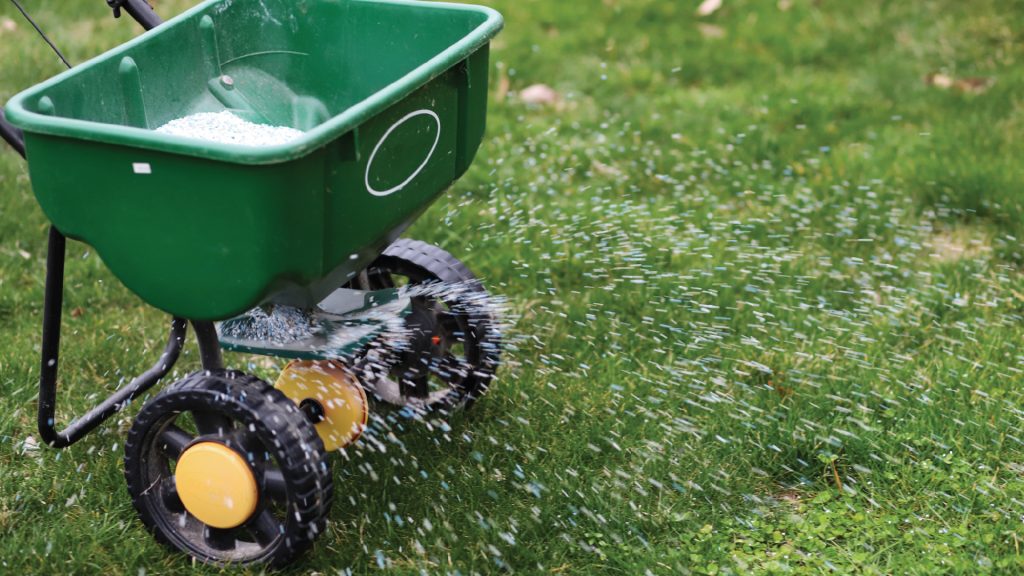
For nitrogen deficiency, apply a balanced slow-release fertilizer at half a pound of nitrogen per thousand square feet, water in lightly, and reassess in three to four weeks. Avoid quick-release urea on sandy soils during rainy season. It moves through too fast.
For take-all root rot, the fix is a combination. A labeled fungicide like azoxystrobin or thiophanate-methyl applied as directed, paired with cultural changes (raise the mowing height to four inches, water deeply but less often, reduce thatch where present). Recovery is slow with take-all. Three months is typical, and severe cases may need partial resodding.
For gray leaf spot, a labeled fungicide and a reduction in nitrogen often does the trick. High-nitrogen lawns are more vulnerable, which is one reason loading up on fertilizer when you see yellowing can backfire.
Why This Matters in Coastal South Florida Specifically
Our combination of alkaline sandy soil, salt influence, year-round growing temperatures, and heavy rainy-season rainfall makes Palm Beach lawns a unique nutritional environment. A program that works in Atlanta on red clay or in Indianapolis on loam will not work here.
Iron chlorosis is far more common in the Palm Beaches than in most of the country because the limestone bedrock and concrete-influenced soils we deal with keep pH high. Take-all root rot is more common here because warm soil temperatures and humidity favor the pathogen. Nitrogen runs out faster on sandy soil. All of these conditions interact, and a yellow lawn often has two of these factors at play at once.
That is why a soil test is worth the modest cost if you have a chronic yellowing problem. A test from the University of Florida Extension or a private lab gives you pH, micronutrient levels, and a clearer baseline for whatever treatment you choose. Without it, you are guessing.
What to Do Next
If your lawn is yellowing and you would rather not spend the next two weekends running diagnostics, that is what we do for a living. We can walk your property, identify the cause within minutes, recommend the right treatment, and execute it on the same visit when conditions allow.
Lawn Squad of The Palm Beaches serves Boca Raton, Boynton Beach, Coconut Creek, Deerfield Beach, Delray Beach, Lake Worth Beach, Lake Worth, Palm Beach, Pompano Beach, and West Palm Beach.
Call us at 561-621-9217 or request a free quote at lawnsquad.com. Our VitaminLawn program is built specifically for South Florida St. Augustine, Bermuda, and Zoysia lawns on alkaline coastal soils, with iron supplementation, salt management, and disease monitoring built into the schedule. Most homeowners on the program stop seeing the June yellowing cycle entirely after the first full season, because we address the soil chemistry instead of just chasing the symptom.