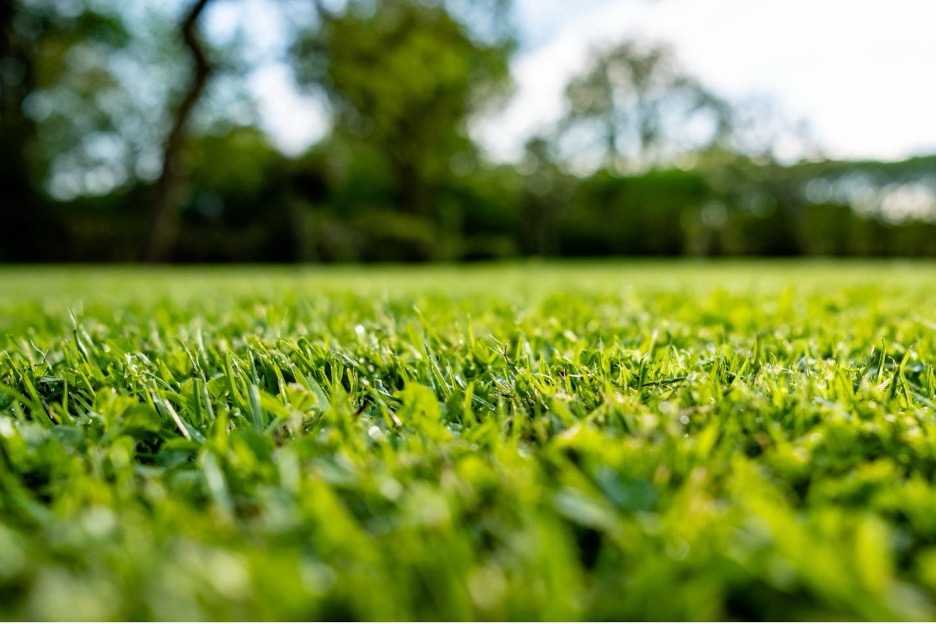
Short Answer: June is the month North Atlanta Bermuda and Zoysia lawns hit their peak growth, and the work you do now decides what the yard looks like in August. The weekly priorities are: mow Bermuda at 1 to 1.5 inches and Zoysia at 1.5 to 2.5 inches, every five to seven days; shift to deep infrequent watering at one inch per week split into two cycles; apply nitrogen at half a pound per thousand square feet around mid-month; watch for fire ant mounds, armyworm activity, and the first signs of brown patch on Zoysia; and avoid pre-emergent reapplications now since the temperature is too high. Across North Fulton, Cherokee, Forsyth, and Gwinnett, the lawns that thrive through July heat are the ones that get the June fundamentals right.
Walk out onto your Roswell, Alpharetta, or Cumming lawn at seven in the morning in early June, and you can feel summer arriving in the air. The Bermuda is putting out runners visibly week over week. The Zoysia is filling in spots that looked thin in April. The red clay underneath holds last night’s rain just below the surface, and the cicadas are starting up by mid-morning. This is the month the warm-season grasses we grow across North Atlanta are designed for.
We see two kinds of homeowners across North Fulton, Cherokee, Forsyth, and Gwinnett in early June. The first is the homeowner who treats June like a coast month, figuring the lawn is on autopilot now that it is green. The second is the one who realizes the lawn responds to what they do this month more than any other, and they want a clear plan. This checklist is for that second group. Here is the week-by-week we run on North Atlanta lawns through June.
Week 1: Set Your Mowing Cadence
Warm-season grass in June grows fast. A Bermuda lawn that needed mowing every ten days in April needs it every five to seven days now. A Zoysia lawn (especially Emerald or Zeon varieties common in upscale subdivisions across Milton and Johns Creek) grows more slowly but still ramps up in June.
Mowing height matters as much as frequency. Common Bermuda holds best at 1.5 inches. Hybrid Bermuda varieties like TifTuf and Tifway tolerate down to 1 inch but look better at 1 to 1.25. Zoysia varieties want 1.5 to 2.5 inches depending on cultivar, with the Meyer and Empire varieties on the higher end. The rule that holds for both species: never remove more than a third of the leaf blade in a single mowing.
If you have been mowing at 2 inches over the winter and you want to drop to 1 inch for summer, do it across two or three mowings rather than all at once. A sudden scalp shocks the lawn and opens it up to weed pressure. Sharpen the blade now if you have not already. A dull blade tears the runner tips on Bermuda, which leaves a brown haze across the lawn the day after you mow.
Week 2: Calibrate Your Watering for Georgia Red Clay
North Atlanta red clay is a different watering puzzle than sandy coastal soils. Clay holds moisture, but it also seals up at the surface and rejects water if you put it down too fast. The mistake we see all over Cherokee and Forsyth is the homeowner who turns the irrigation on for forty minutes and watches most of the water run down the driveway because the clay surface sealed.
The fix is cycle-and-soak. Run each irrigation zone for ten to fifteen minutes, let it sit for thirty minutes so the surface can absorb, then run another ten to fifteen minutes. Do that one or two times a week, totaling one inch of water across the week. Set a tuna can or rain gauge in a representative zone and measure how long the system needs to put down half an inch.
Time of day matters: 4 a.m. to 8 a.m. is the window. Evening watering on humid June nights is the single biggest driver of brown patch on Zoysia and dollar spot on under-fertilized lawns. The Bermuda will take an evening cycle without complaint, but you set up disease problems across mixed neighborhoods where the Zoysia neighbor is irrigated at night.
Mid-June: The Nitrogen Application That Sets Up July
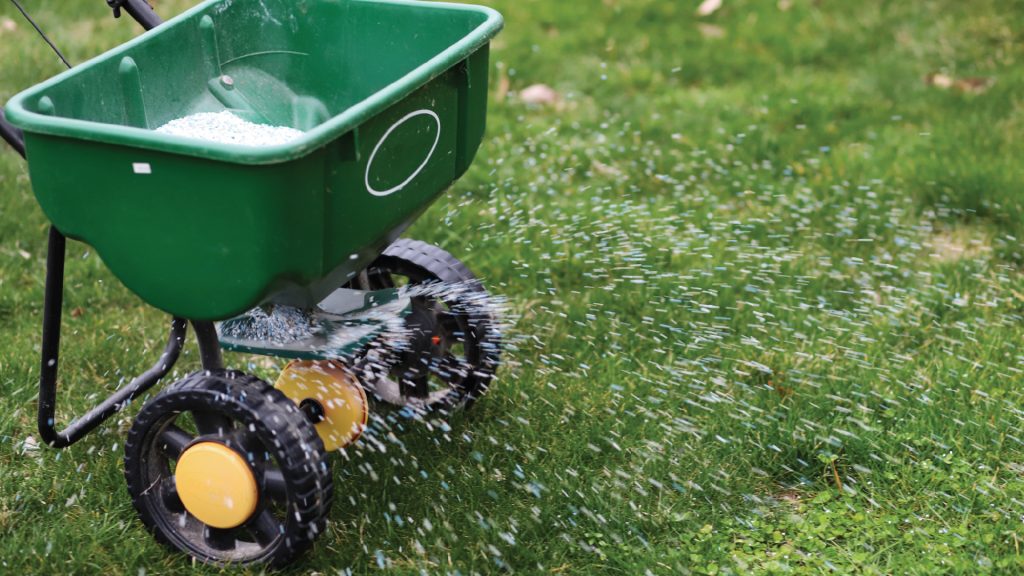
Bermuda and Zoysia in our region peak nitrogen demand in June and early July. A modest application around mid-month, half a pound of actual nitrogen per thousand square feet from a slow-release source, pushes the kind of dense, deep-rooted growth that crowds out crabgrass and holds color through July heat.
Avoid heavy nitrogen on Zoysia. Zoysia takes less nitrogen than Bermuda across the season. Total annual nitrogen on a Zoysia lawn in North Atlanta should run around 2 to 3 pounds per thousand. Bermuda can take 3 to 5 pounds per thousand spread across the season. Splitting that into monthly applications from June through August beats one big spring dump.
If you applied a heavy pre-emergent product in March or April that included nitrogen, factor that into your June math. Over-feeding Bermuda in June produces lush top growth that the root system cannot fully support when July heat arrives, and lush growth invites disease. Modest and steady beats heavy and lumpy.
Pest Watch: Fire Ants, Armyworms, and Mole Crickets
Three pests deserve attention on North Atlanta lawns in June. Fire ants are the most obvious. Mounds appear after every heavy rain, often along driveways, in the open lawn, or near retaining walls. A broadcast bait application using a product like hydramethylnon or methoprene covers the whole property and is more effective than mound-by-mound treatment for properties with significant pressure. Bait applications work best when applied in cool morning hours, on a dry lawn, on a day with no rain forecast for 24 hours.
Fall armyworms used to be a late-summer pest in North Georgia, but the last several seasons have brought outbreaks starting in mid-June. The damage moves fast. A homeowner in Canton can lose half a Bermuda lawn in seventy-two hours if a hatch arrives unnoticed. Look for chewed, scalloped leaf edges and small green or tan caterpillars under the surface in the morning. The treatment is straightforward (bifenthrin or chlorantraniliprole) but it has to happen within days of detection.
Mole crickets are less common in North Atlanta than in coastal Georgia, but they show up on sandier sites and on newer construction lawns where sod was laid on imported sand fill. Look for irregular tunneling raised just under the surface and small soft spots in the turf. If you see them now, a curative product applied in June heads off damage that would otherwise show up in late summer.
Disease Watch: Brown Patch on Zoysia, Dollar Spot on Mixed Lawns
The combination of warm humid nights and morning dew that defines a North Atlanta June is the exact recipe for brown patch on Zoysia. The disease shows as circular patches three to ten feet across, with a yellow-brown ring at the active edge. Inside the patch the grass may still be partially green but thinning.
The first defense is cultural. Push watering to early morning, raise the mowing height to the upper end of the cultivar’s range, and avoid heavy nitrogen in June if you have had brown patch in past years. If brown patch is already showing, a fungicide rotation (azoxystrobin or propiconazole) timed to the first symptoms typically holds it. Waiting two weeks to act usually doubles the affected area.
Dollar spot is more common on mixed Bermuda and tall fescue properties (which exist all over older Roswell and Sandy Springs neighborhoods) than on pure Bermuda. Silver dollar sized bleached patches that cluster together are the signature. A modest nitrogen bump and morning-only watering usually resolves it without fungicide on home lawns.
Weeds: Spot Treat, Do Not Blanket Spray
By mid-June, summer annual weeds like crabgrass, goosegrass, and chamberbitter are visible if your pre-emergent thinned out. Resist the urge to do a broadcast post-emergent over the whole lawn in 90-degree heat. Bermuda tolerates most selective herbicides reasonably well, but Zoysia is more sensitive to MSMA-style products and to temperature-amplified herbicide damage.
Spot-treat what you see. For crabgrass that escaped pre-emergent, quinclorac on Bermuda or fenoxaprop on cooler mornings (under 85 degrees) is the typical choice. For chamberbitter, a three-way broadleaf applied to actively growing weeds works best. For nutsedge (which loves the wet spots in red clay), a halosulfuron or sulfentrazone product is targeted and effective.
Do not re-apply pre-emergent in June. Soil temperatures are too high for the spring chemistry to add value, and you risk binding up nitrogen and nutrients the lawn needs right now. Save the next pre-emergent for late August or early September when fall germinators (poa annua, henbit, chickweed) start their cycle.
What Not to Do in June
- Do not aerate. Core aeration in June stresses warm-season grass during its growth push. Save aeration for late spring or early fall when the lawn can recover quickly.
- Do not dethatch. Bermuda thatch is real on heavily fertilized lawns, but mid-summer is the wrong time to address it. Wait until next May.
- Do not scalp. Sudden short mowing in June heat causes recovery problems and opens the lawn to weed pressure.
- Do not overwater in response to one hot week. Frequent shallow watering builds shallow roots that fail in July.
- Do not skip the fire ant treatment. The mounds get worse, not better, through summer.
What to Do Next
If the weekly checklist sounds like more time than you want to spend on this, or if you would rather have someone else make the timing and product calls, we are here for that. June is the month our customers in North Atlanta see the biggest payoff from professional service because the timing windows are tight and the consequences of mistakes show up fast.
Lawn Squad of North Atlanta serves homeowners across North Metro Atlanta.
Call us at 678-250-6490 or request a free quote at lawnsquad.com. Our VitaminLawn program is calibrated for North Georgia red clay, the Bermuda and Zoysia varieties common across our service area, and the disease and pest pressure that comes with our humid summer pattern. Most customers see the strongest result of the year showing up in late June and July, when the neighbors who skipped the fundamentals are starting to lose ground.