Short Answer: Take-all root rot is one of the most damaging diseases on St. Augustine lawns across South Miami. It attacks roots underground first, often showing as yellow patches that spread slowly and grass that pulls up easily. Standard fungicides offer limited control. Effective management requires lowering soil pH (because the disease thrives in alkaline conditions common in South Florida soils), addressing thatch and compaction, careful nitrogen management, and sometimes specialized fungicide applications. Recovery is slow. Prevention is far easier than treatment. Here is the practical guide for properties across Pinecrest, Coral Gables, South Miami proper, and our broader service area.
If your South Miami St. Augustine lawn has yellowing patches that keep expanding, with grass that pulls up easily because the roots are gone, you may be looking at take-all root rot. It is one of the most destructive diseases on St. Augustine across South Florida, and one of the most difficult to treat once established.
Across our service area covering Pinecrest, Coral Gables, South Miami proper, and surrounding communities, take-all root rot affects a substantial percentage of established St. Augustine lawns. Many homeowners deal with it without knowing what they have, attempting treatment after treatment that does not address the actual disease.
Here is what to look for and what actually works.
What Take-All Root Rot Looks Like
The visible signs vary as the disease progresses:
Early stage: yellow patches that may look like nutrient deficiency. The patches are typically irregular in shape and progress slowly over weeks rather than days.
Mid stage: thinning grass within the yellowed areas. Pull on a handful of grass and it comes up easily because the roots are decayed. Healthy St. Augustine pulls up only with significant force, taking soil and roots with it. Take-all damaged grass slides out of the soil with the roots already gone.
Late stage: bare patches as the dead grass thins out completely. By this point, secondary problems (weeds, soil erosion, drainage issues) often compound the disease damage.
Affected stolons (the runners that connect St. Augustine plants) often have black or rotted areas at nodes. Healthy stolons are uniform green or tan.
Why It Thrives in South Miami
Several factors make take-all common in our service area:
Alkaline soils. South Florida soils typically run alkaline, often pH 7.5 to 8.5. Take-all thrives in alkaline conditions and struggles in acidic soils.
High humidity year-round. The fungus is active whenever soil temperatures and moisture cooperate, which is most of the year in our climate.
Heavy thatch. St. Augustine produces thatch faster than most warm-season grasses, and thatch holds moisture that supports disease activity.
Nitrogen-pushed lawns. Excessive nitrogen creates soft growth that the disease prefers and produces thatch faster.
Compacted soils common in older neighborhoods or in areas with foot traffic.
Heat stress that weakens the lawn during summer months when the disease is most active.
Why Standard Fungicides Often Fail
Take-all is a soil-borne disease that attacks roots below the soil surface. Foliar fungicides applied to leaves do not reach the active disease zone. Systemic fungicides have variable results depending on product, timing, and underlying soil conditions.
Even with the right fungicide, treatment alone rarely solves the problem long-term if soil conditions are not corrected. The disease persists in the soil and recurs as soon as treatment stops.
What Actually Works
Effective management requires a multi-front approach:
Soil acidification. Lowering soil pH from alkaline toward neutral or slightly acidic dramatically reduces disease activity. Elemental sulfur applied at recommended rates over several seasons gradually shifts pH. Soil testing every 6 months tracks progress.
Thatch reduction. Annual aeration and dethatching as needed reduce the moist thatch layer where the disease establishes.
Balanced fertility. Reduce nitrogen during summer when the disease is most active. Increase potassium, which supports root health and disease resistance. Manganese is sometimes recommended specifically for take-all suppression.
Watering practices. Deep infrequent morning watering. Allowing the lawn to dry between cycles reduces disease activity.
Targeted fungicide applications. Specialized soil-applied fungicides can reduce disease pressure when applied correctly, especially as part of a broader management approach.
Recovery Timelines
Take-all recovery is slow. Even with optimal management, expect a multi-year project to bring a heavily affected lawn back to full health.
Year 1: stop the active spread and begin soil correction. Visible improvement is modest.
Year 2: noticeable density improvement as the disease retreats. Damaged areas may need plugging or sodding.
Year 3: typically the year the lawn is fully back if corrections have been consistent.
Properties that try to skip steps or rush the process generally see the disease return within 6 to 12 months.
Replacing Severely Damaged Areas
Areas where take-all has destroyed the grass entirely will not recover on their own. St. Augustine plugs or sod must be installed.
Critically, the soil conditions that allowed take-all must be corrected before replanting. Installing fresh sod into untreated alkaline soil produces another generation of disease within a year. Soil correction takes precedence over visible recovery.
Variety Considerations
Some St. Augustine varieties are more susceptible to take-all than others. Older varieties like Floratam show more disease pressure than newer cultivars like Floratine, ProVista, or CitraBlue, which have better disease resistance.
For properties where take-all has been recurring, considering a more disease-resistant variety during renovation can substantially reduce future problems.
What Doesn’t Work
Over-fertilizing to push the lawn through the disease. Adds the soft nitrogen-pushed growth the disease prefers.
Heavy watering to revive yellowing patches. Wet soil amplifies disease activity. The grass cannot use water it does not have roots to absorb.
Treating with weed-and-feed products. Most do nothing for the disease and some may worsen the situation.
Replacing damaged areas without correcting underlying soil conditions. The replacement grass becomes diseased within a year.
Ignoring the disease and hoping it stops on its own. It does not. Untreated take-all spreads year over year.
Diagnosis Confirmation
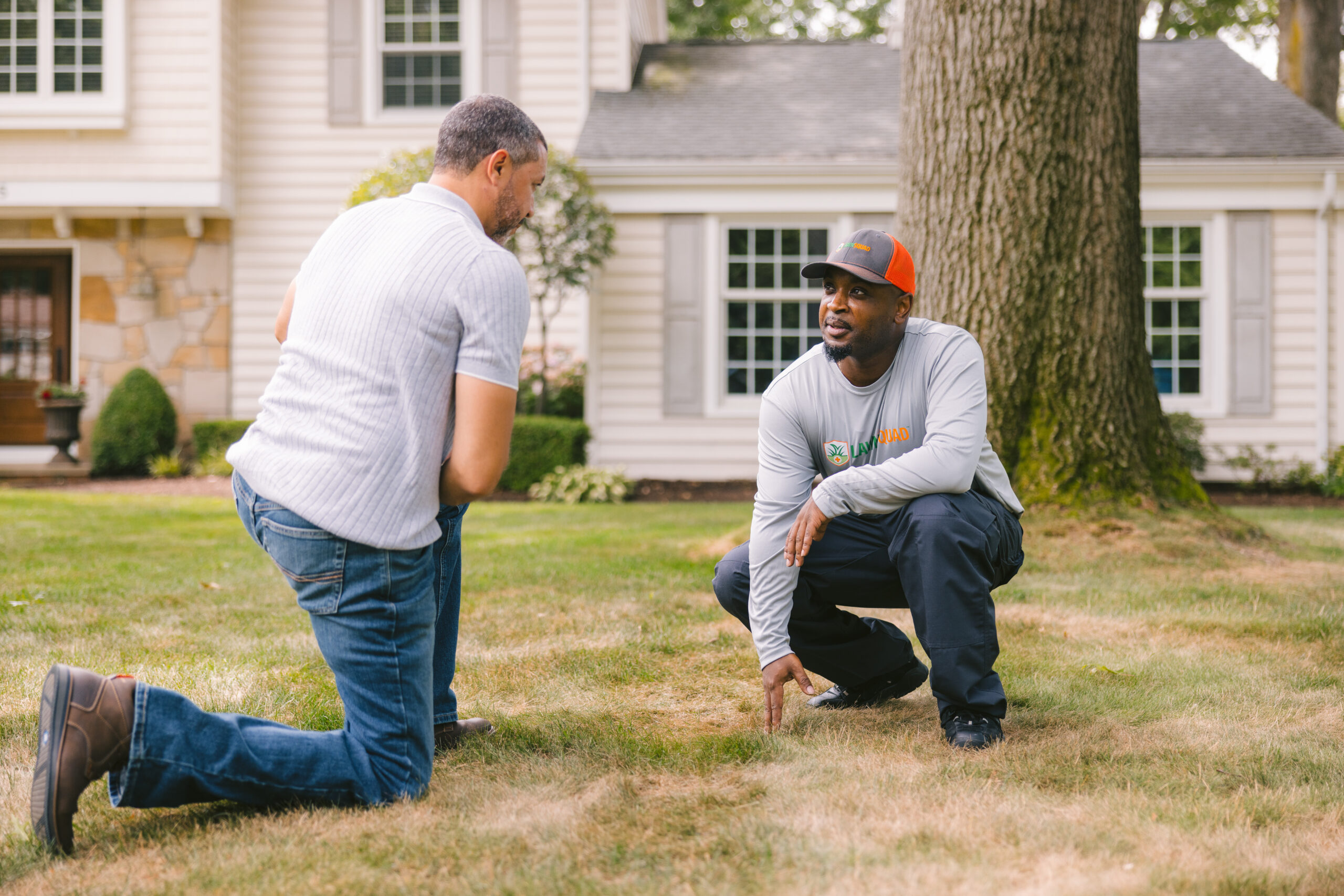
The diagnosis can be confirmed visually by experienced eyes in most cases, but soil and tissue samples sent to a diagnostic lab provide certainty for severe cases. Other diseases (gray leaf spot, large patch) can produce somewhat similar symptoms but respond to different treatments.
Misdiagnosis is common. Homeowners frequently treat for the wrong disease or for fertilizer deficiency when take-all is the actual problem. Professional diagnosis early in the process saves significant time and cost.
Prevention
Far easier than treatment. Properties with healthy St. Augustine that have not yet developed take-all benefit from:
Annual soil testing and pH management.
Annual aeration to reduce thatch and compaction.
Balanced fertility programs that avoid excess nitrogen.
Deep infrequent morning watering.
Mowing at proper height (3.5 to 4 inches for St. Augustine).
Sharp mower blades that produce clean cuts rather than torn grass.
South Miami Specifics
Several factors make take-all particularly common in our area:
Alkaline limestone-based soils throughout much of South Miami.
Year-round growing season that keeps the disease active longer than in cooler climates.
Older St. Augustine varieties on many established properties.
Heavy summer rainfall combined with humid evening conditions.
Mature properties with significant thatch buildup that has not been actively managed.
What to Do Next
If your South Miami St. Augustine lawn is showing the symptoms of take-all root rot, the sooner we get to work the better the outcome. We walk properties across Pinecrest, Coral Gables, South Miami, and our broader service area to confirm the diagnosis, evaluate underlying conditions, and put together a multi-year program that actually addresses the disease rather than masking the symptoms. If you would rather have someone else handle the timing decisions, product selection, and application for your South Miami lawn, we are here for that.
Visit lawnsquad.com to find Lawn Squad of South Miami and request a free quote. Our VitaminLawn program is built specifically for the grass types, soils, and weather patterns in our service area. Most homeowners see noticeable improvement within the first two applications.