Short Answer: Chinch bug damage on a Birmingham lawn typically shows up as irregular yellow patches that turn straw-brown, usually starting in the hottest, sunniest parts of the yard during June through August. The damage looks a lot like drought stress, but watering does not bring it back. To confirm chinch bugs, part the grass at the edge of a damaged patch and look for tiny black-and-white insects (adults) or small red nymphs on the soil surface. Early identification makes treatment much simpler and less expensive. Here is what Birmingham homeowners should watch for, how to tell chinch bug damage from drought, and what to do when you find it.
You walk into the front yard one hot week in June or July. The grass near the driveway is yellowing. You bump up the irrigation. A week later, the yellow patches have turned straw-brown and they are spreading. You try the hose. Nothing. That is the moment a lot of Birmingham homeowners realize they are dealing with something besides drought.
In our part of Alabama, chinch bugs are one of the most underdiagnosed summer lawn pests. They are small, they hide near the soil line, and their damage looks convincingly like heat stress. But once you know what to look for, they are not hard to identify, and catching them early is the difference between spot treatment and full renovation.
What a Chinch Bug Actually Is
Chinch bugs are small sap-sucking insects in the Blissidae family. The species that causes problems across Birmingham lawns is the southern chinch bug (Blissus insularis), which is a major pest of St. Augustine grass. Adults are about 1/5 of an inch long, black with white wings folded on their backs. Nymphs (the immature form) are bright red to reddish-orange with a light band across the body, and they look small enough that most people miss them entirely unless they are looking carefully.
Chinch bugs feed by inserting a straw-like mouthpart into grass blades and stems and drawing out sap. As they feed, they inject a toxin that stops the water-conducting tissue of the grass. The result is that the grass plant cannot move water to its leaves even if the soil is moist. That is why chinch bug damage does not respond to watering. The plant is thirsty at the cellular level, not because there is no water available.
Which Birmingham Lawns Are Most at Risk
Chinch bugs have strong preferences. The yards where we find them most often in Birmingham share several features:
- St. Augustine grass. This is their preferred host by a wide margin. If you have a St. Augustine lawn, chinch bugs are your number one summer pest.
- Zoysia lawns, secondarily. Chinch bugs will feed on Zoysia, especially Meyer, though damage tends to be less severe than on St. Augustine.
- Bermuda lawns occasionally. Less common but not rare, especially in heat-stressed areas.
- Full sun, south or west exposure. Chinch bugs love heat. They thrive in the hottest, driest spots of the yard. Strips of grass along concrete driveways and sidewalks are classic hotspots because the concrete radiates heat.
- Lawns with thatch buildup. Chinch bugs take shelter in the thatch layer. A lawn with a quarter-inch of thatch or more is more hospitable to chinch bugs than a freshly aerated lawn.
- Over-fertilized lawns. Heavy nitrogen produces lush, thin-walled grass that chinch bugs feed on preferentially.
If your Hoover or Vestavia Hills lawn has St. Augustine running along a south-facing driveway with some thatch buildup, you are in prime chinch bug territory.
What the Damage Looks Like, Week by Week
Week 1 (initial feeding). A small patch of grass begins to look slightly off-color, more yellow-green than its surroundings. Most homeowners do not notice this stage.
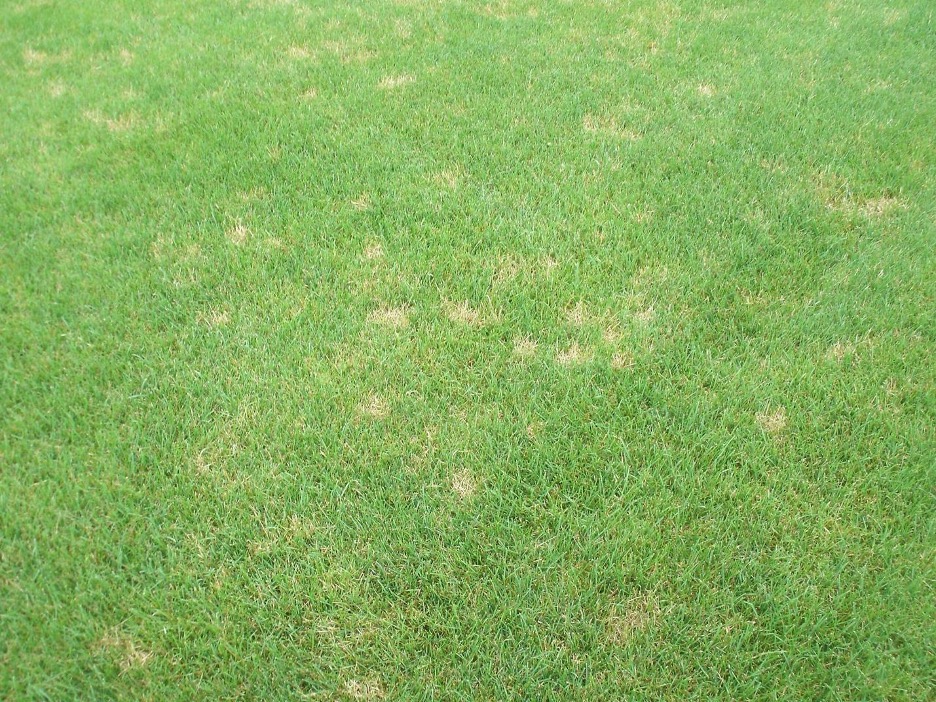
Week 2. The patch turns clearly yellow. It often appears first along the edge of a driveway, sidewalk, or foundation where grass is already heat-stressed. Patches are typically irregular in shape, 6 inches to 2 feet across.
Week 3. Yellow patches turn straw-brown in the center. The edges continue to yellow and spread outward. Watering does not reverse the browning.
Week 4 and beyond. Patches merge. Brown areas can cover 20 to 40 percent of a lawn if untreated. The damage spreads outward from the original hotspot because chinch bugs migrate to the healthy grass at the edges of damage.
The tell: chinch bug damage spreads. Drought damage stabilizes when it rains. If your brown patches are getting bigger over 2 to 3 weeks despite rain or irrigation, chinch bugs are the likely cause.
The Soap Flush Test: How to Confirm
The most reliable DIY confirmation is the soap flush test. Here is how we do it in the field:
- Mix 1 to 2 tablespoons of lemon-scented dish soap in a gallon of water.
- Pour the mixture slowly over a 2-foot square area at the edge of a yellowing patch (not in the dead center, but where yellow meets green).
- Wait 3 to 5 minutes. The soap irritates the insects and drives them to the surface.
- Watch the grass and soil surface carefully. You will see small black-and-white adults and smaller red nymphs crawling out.
If you see 15 to 20 or more chinch bugs per square foot, that is a damaging population level. Below 10 per square foot, the lawn can usually tolerate them, especially if conditions are not favorable to rapid breeding.
How to Tell Chinch Bug Damage From Other Problems
Drought stress looks similar but responds to watering. Chinch bug damage does not.
Brown patch disease shows distinct ring patterns with darker borders, typically in cooler, more humid conditions (early summer or fall). Chinch bug damage does not show ring patterns and peaks in the hottest, driest weeks.
Grub damage causes grass to pull up easily like loose carpet because grubs eat the roots. Chinch bug damage grass is still rooted, just dying from the top down.
Dog urine damage is small (usually 8 to 12 inches across), round, with a dark green halo of lush growth around a dead center. Chinch bug damage is larger, irregular, and lacks the halo.
Fertilizer burn follows the pattern of the spreader. If your brown patches are in stripes, that is not chinch bugs.
Treatment Options
Once chinch bugs are confirmed, treatment is straightforward but timing matters.
Insecticides. Several labeled insecticides work well against chinch bugs. Bifenthrin, lambda-cyhalothrin, and carbaryl are the most common active ingredients in residential products. A single well-timed application usually knocks down the population dramatically. Two applications 2 weeks apart may be needed for heavy infestations.
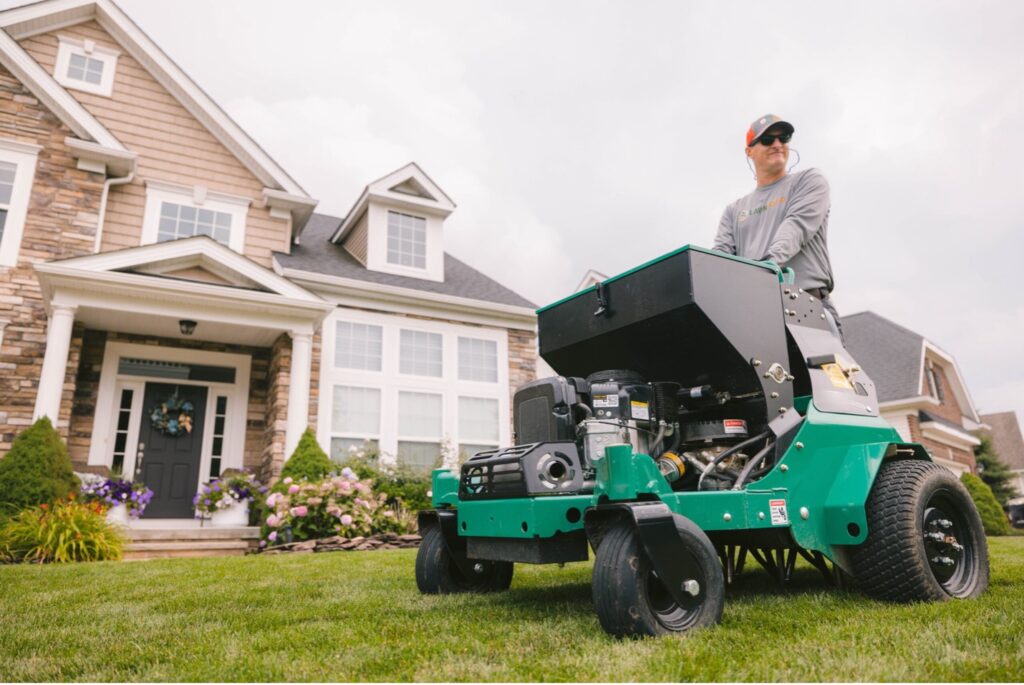
Cultural practices. Lowering thatch through aeration reduces chinch bug habitat. Cutting back heavy nitrogen reduces the lush growth they prefer. Deep, infrequent watering reduces surface stress without creating a heat-trap microclimate in shallow-watered lawns.
Beneficial insects. Big-eyed bugs (which look a little like chinch bugs but are beneficial) prey on chinch bugs naturally. Broad-spectrum insecticides kill them too, so over-spraying can make the problem worse in the long run. This is one reason we try to use targeted treatments rather than blanket applications.
Recovery and Renovation After Chinch Bug Damage
After treatment, the next question is how much of the damaged lawn will recover on its own.
Grass that is yellow but not yet fully brown usually recovers within 3 to 4 weeks with proper watering once the chinch bugs are gone. Grass that is fully straw-brown and has been dead for more than 2 weeks will not recover. Those areas need to be plugged, sodded, or (for Bermuda and Zoysia) allowed to fill in from the edges as stolons grow back in.
For St. Augustine lawns in particular, damaged patches rarely recover on their own and usually need to be sodded. That is one of the reasons early detection matters so much with chinch bugs. The cost gap between a $60 preventive-style treatment and a $600 sod renovation is large.
Prevention Going Forward
The strongest defense against chinch bugs is a healthy, properly maintained lawn. The actions that reduce chinch bug risk on Birmingham lawns are also the actions that produce a better lawn in general:
- Aerate annually or every other year to reduce thatch buildup
- Moderate nitrogen applications and rely more on slow-release products than heavy quick-release feedings
- Water deeply and infrequently rather than daily shallow watering
- Mow St. Augustine at 3.5 to 4 inches, Zoysia at 1.5 to 2 inches, Bermuda at 1 to 1.5 inches
- In known problem yards, a preventive surface insect application in late May or early June can stop chinch bugs before they establish
What to Do Next
If you are seeing yellowing or browning in your Birmingham lawn right now and are not sure whether it is drought, disease, or chinch bugs, we can come out and diagnose it at no cost. A 15-minute soap flush test and a walk of the lawn usually gives us a clear answer.
Lawn Squad of Birmingham serves Alabaster, Bessemer, Birmingham, Calera, Chelsea, Helena, Homewood, Hoover, Indian Springs, Inverness, Maylene, Montevallo, Mountain Brook, Pelham, Pinson, Trussville, and Vestavia Hills.
Call us at 205-573-1921 or visit lawnsquad.com. Surface insect control is included in our VitaminLawn Pro and Elite tiers, which is the most reliable way to stay ahead of chinch bugs in our Alabama heat. For lawns that have already crossed the line from prevention to active damage, we can build a recovery plan that fits your yard and your budget.