
Short Answer: VitaminLawn is our proprietary lawn care program, customized for the grass types, soils, and climate pressures specific to North Raleigh-Greenville. It combines pre-emergent crabgrass control, balanced fertilization, broadleaf weed control, fire ant prevention, surface insect control, and optional disease control and aeration, with product selection tuned to our red clay soils and transition-zone climate. It works because we adjust the plan to your actual lawn rather than using a national template. Below is what is in it and why that matters for lawns from Wake Forest to Rocky Mount to Greenville.
If you have shopped lawn care in eastern North Carolina, you have probably heard the same pitch from three different companies. “Customized lawn care program.” Fair. But what does “customized” actually mean, and why does it matter for a North Carolina lawn?
Our area sits in the transition zone, where both warm-season and cool-season grasses can thrive, often on the same property. Red clay dominates our soil. Humid summers drive disease pressure. Fire ants and chinch bugs are constant. A national program cannot handle all of that without real adjustment. Here is how VitaminLawn does.
What VitaminLawn Is Built Around
Every VitaminLawn plan in our area is built on four specifics:
- Your grass type. North Raleigh-Greenville lawns are typically Bermuda (sun), Zoysia (increasingly popular in newer developments), or Fescue (shade and older neighborhoods). Many are mixed, with Bermuda in sunny sections and Fescue in shaded backyards. Each responds differently to fertility and disease pressure.
- Your soil. Eastern Carolina red clay dominates. It compacts, drains slowly, and has variable pH. Coastal plain lawns near Greenville and Washington can have sandier profiles that leach nutrients faster.
- Your local pest pressure. Fire ants, chinch bugs, armyworms, and grubs are consistent. Mole crickets appear in sandier coastal areas. Each peaks at different times.
- Your disease pressure. Brown patch on fescue in summer humidity. Large patch on zoysia in spring and fall. Gray leaf spot and dollar spot on stressed lawns.
The Core of the Program
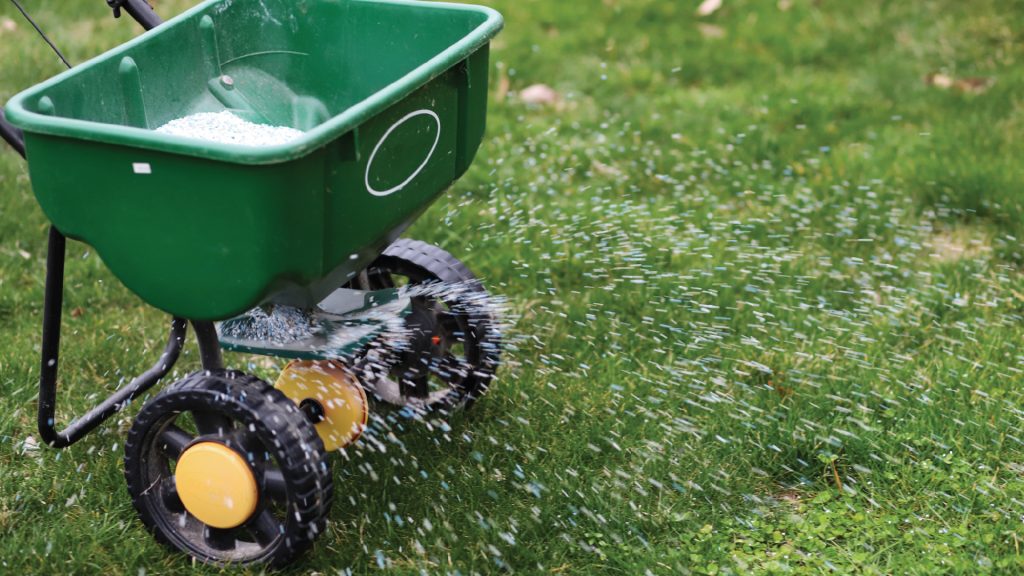
Pre-emergent crabgrass control applied in late February or early March, with a split-rate second application in April to cover our long germination window.
Balanced fertilization with broadleaf weed control timed to grass type and season. For Bermuda, strong nitrogen at green-up. For Zoysia, moderate spring feeding with attention to large patch. For Fescue, light spring feeding and heavy fall feeding.
Surface insect control (Pro and Elite) for chinch bug, armyworm, and sod webworm pressure through summer.
Fire ant prevention (Elite) with broadcast bait application in spring.
Disease control (Elite) for brown patch and large patch when pressure warrants.
Fall aeration (Elite) because our red clay compacts hard and core aeration is the only way to relieve it mechanically.
Soil testing (Elite) to guide pH correction, lime applications, and micronutrient decisions.
Why “Customized” Actually Matters Here
Three real examples:
A Wake Forest lawn with mixed Bermuda and Fescue needs two different treatment plans on the same property. Bermuda in the sunny front wants strong nitrogen at green-up. Fescue in the shaded back wants light spring feeding and heavy fall feeding. Applying a single program to both shortchanges one or the other.
A Rocky Mount or Tarboro lawn with sandier soil leaches nutrients faster than Raleigh clay lawns. More frequent lighter applications work better than fewer heavy ones. Standard programs often under-feed sandy lawns.
A Greenville lawn near coastal plain may deal with higher humidity disease pressure than inland. Preventive fungicide and reduced spring nitrogen on Fescue make a meaningful difference.
What Each VitaminLawn Tier Actually Includes
Essential (6 visits) is the foundation. Pre-emergent and balanced fertilization and weed control through the growing season. Fits a healthy established lawn with minimal pressure.
Pro (8 visits, most popular) adds surface insect control, bonus treatment, and unlimited service call-backs. Most North Raleigh-Greenville homeowners land here.
Elite (13 visits) adds fire ant prevention, disease control, core aeration, soil testing, and root stimulant. For homeowners who want the best possible result or for lawns that have struggled with pest, disease, or compaction issues.
How We Actually Build Your Program
Here is what happens after you request a quote:
- We visit the property, measure actual turf square footage
- Identify grass type or types (many lawns are mixed)
- Note sun and shade patterns, compaction, and any active issues
- Ask about history: previous service, recurring problems, HOA requirements
- Build a customized plan and price, specific to your lawn
- Send back a clear written quote with no pressure to sign
What to Do Next
If you want a VitaminLawn plan built for your specific North Carolina lawn, we will measure and plan at no cost.
Lawn Squad of North Raleigh-Greenville serves Bailey, Bethel, Bunn, Castalia, Chocowinity, Conetoe, Edenton, Elm City, Falkland, Farmville, Fountain, Franklinton, Greenville, Grimesland, Hamilton, Hassell, Hobgood, Jamesville, Knightdale, Louisburg, Macclesfield, Merry Hill, Nashville, Oak City, Pinetops, Raleigh, Robersonville, Rocky Mount, Rolesville, Sharpsburg, Speed, Spring Hope, Stokes, Tarboro, Wake Forest, Washington, Wendell, Williamston, Wilson, Windsor, Winterville, Youngsville, and Zebulon.
Call us at 984-243-2925 or request a free quote at lawnsquad.com. Our VitaminLawn program is built for transition-zone North Carolina grasses, red clay soils, and humid summer disease pressure.