The short answer: Proper lawn irrigation in Westchester County means watering deeply and infrequently — typically two to three times per week during dry stretches — early in the morning, so your cool-season grass develops the deep, resilient root system it needs to handle summer heat, resist disease, and stay healthy through every season.
Westchester homeowners tend to either underwater their lawns during July and August heat waves or run irrigation systems on fixed schedules that make no adjustment for rainfall, temperature, or the actual needs of their turf. Both habits cause real damage — one leads to drought stress and thinning, the other to fungal disease, shallow roots, and weed pressure that is far harder to manage than it needs to be.
The good news is that watering a cool-season lawn in Westchester correctly is not complicated once you understand a few fundamental principles. Small adjustments to timing, frequency, and application depth make a bigger difference than almost any other change you can make to your lawn care routine.
Quick overview:
- Timing: Water between 4 and 10 a.m. — grass dries through the day and disease risk stays low
- Frequency: Two to three times per week during dry periods, not daily light watering
- Depth: Apply enough to wet the soil 4 to 6 inches deep, encouraging roots to grow downward
- Seasonal adjustment: Reduce or suspend irrigation during cool, wet stretches — Westchester gets meaningful rainfall year-round
Keep reading to learn exactly how to dial in your irrigation approach for a healthier, more drought-tolerant Westchester lawn.
Why Irrigation Habits Matter More Than Most Westchester Homeowners Realize
Water is the most controllable variable in your lawn’s health — and the one most often managed by habit rather than intention.
Cool-season grasses in Westchester — tall fescue, Kentucky bluegrass, and perennial ryegrass — are built to handle the region’s climate, including periodic summer dry spells. But how you water determines whether those grasses develop the deep root systems that make them genuinely resilient, or stay shallow-rooted and dependent on constant supplemental irrigation just to survive.
Shallow, frequent watering keeps grass roots concentrated in the top inch or two of soil — the zone that dries out fastest, heats up most in summer, and provides the least stability during drought. Deep, infrequent watering trains roots to follow moisture downward into cooler, more stable soil layers. A lawn with roots reaching 4 to 6 inches deep can go several days without irrigation without showing stress. A lawn watered lightly every day wilts almost immediately when the sprinklers are skipped.
Beyond root development, irrigation habits directly drive some of the most frustrating and expensive lawn problems in Westchester County:
- Evening watering leaves grass blades wet overnight, creating the warm, moist conditions that fuel brown patch, dollar spot, and other fungal diseases that are extremely common across the county in summer
- Overwatering saturates soil, suffocates roots, drives thatch buildup, and creates conditions that favor weeds like ground ivy and annual bluegrass over turf grass
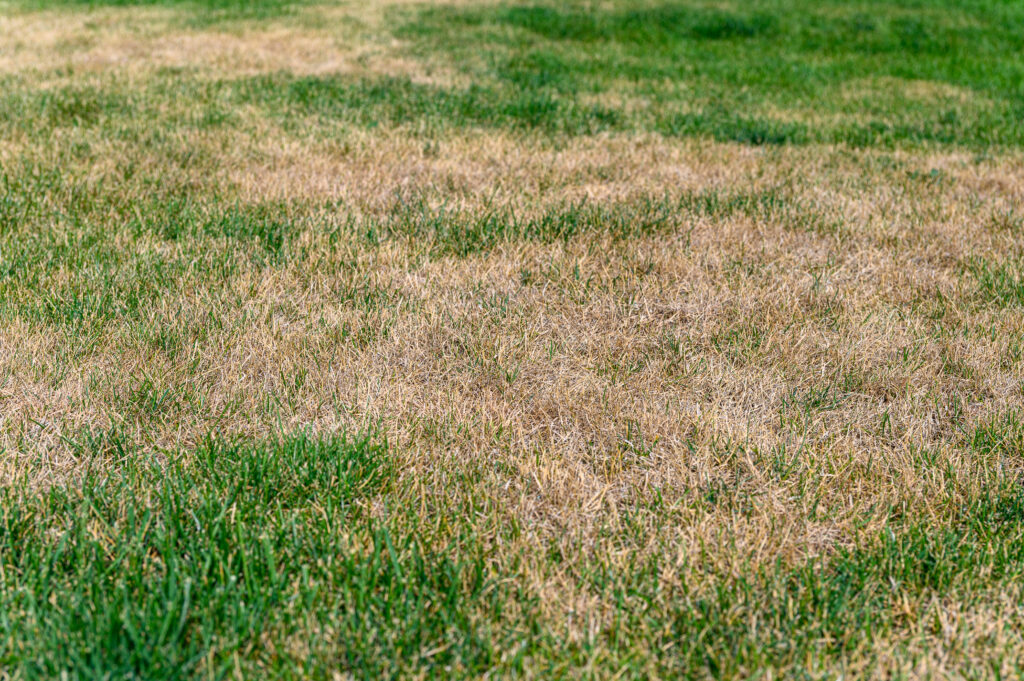
- Underwatering during summer stress pushes cool-season grass into drought dormancy that creates thin, weak areas vulnerable to weed invasion and slow to recover in fall
- Fixed irrigation schedules that ignore rainfall waste water, increase costs, and frequently alternate between overwatering and underwatering depending on the week
Getting irrigation right does not require expensive equipment or constant monitoring. It requires understanding what your grass actually needs — and when.
Understanding Westchester County’s Climate and How It Affects Irrigation Needs
Unlike South Florida or the Southwest, Westchester County receives meaningful rainfall throughout the year. Annual precipitation averages around 46 to 50 inches, distributed reasonably evenly across all four seasons. This means supplemental irrigation is a complement to natural rainfall — not a replacement for it.
The key variable is summer. While Westchester gets adequate annual rainfall overall, July and August frequently bring extended dry stretches of one to three weeks with limited precipitation. Temperatures regularly climb into the 85 to 95°F range, dramatically increasing evapotranspiration rates and the lawn’s water demand precisely when rainfall is least reliable.
Cool-season grasses respond to this summer stress in a predictable way: they slow growth, sometimes go partially or fully dormant, and conserve energy until conditions improve. Understanding this natural response helps you make better irrigation decisions rather than fighting the lawn’s biology.
Spring and Fall
Spring and fall in Westchester are typically the most forgiving irrigation seasons. Cooler temperatures reduce evapotranspiration, rainfall is generally more reliable, and cool-season grasses are in their active growth periods. Most lawns need little supplemental irrigation during a normal spring or fall, and running irrigation systems on summer schedules during these seasons leads directly to overwatering problems.
Summer
Summer is when irrigation management matters most. Deep watering during dry stretches maintains root depth and prevents the complete dormancy that leads to turf thinning. The goal is not to keep the lawn aggressively green through every July heat wave — it is to maintain enough root health that the lawn recovers quickly when cooler, wetter conditions return.
Winter
Irrigation systems in Westchester County need to be properly winterized before the first hard freeze — typically in late October to mid-November. Water remaining in pipes and heads freezes and expands, causing cracked pipes, broken heads, and valve damage that is expensive to repair in spring. Professional winterization via air blow-out is the standard approach across the county.
How Much Water Does Your Westchester Lawn Actually Need?
The general guideline for cool-season turf in Westchester is one to one and a half inches of water per week during the active growing season, combining rainfall and supplemental irrigation. During peak summer heat, demand increases and the upper end of that range becomes more relevant.
But that number means little without knowing how much your irrigation system actually delivers per cycle — and how much recent rainfall has contributed.
The Tuna Can Test
Measuring your system’s actual output takes about 15 minutes and is one of the most useful things you can do to understand your irrigation program:
- Place five or six empty tuna cans or straight-sided containers in different spots across an irrigation zone
- Run the zone for its normal cycle time
- Measure the depth of water collected in each can
- Average the results
If your average is significantly above or below your target application depth, adjust run times accordingly. Uneven collection across cans reveals coverage gaps, misaligned heads, or pressure problems worth addressing.
Using a Rain Gauge
A simple rain gauge mounted in your yard takes the guesswork out of accounting for natural rainfall. When the week’s rainfall total is at or above one inch, supplemental irrigation can be skipped entirely. When rainfall falls short, you know exactly how much your system needs to make up the difference.
The Screwdriver Test
Before running irrigation, push a 6-inch screwdriver into your lawn. If it slides in easily with minimal resistance, the soil has adequate moisture and irrigation can wait. If it meets firm resistance, the root zone is dry and irrigation is warranted. This simple test prevents unnecessary watering during weeks when rainfall has been adequate even if your calendar says it is time to water.
The Best Time of Day to Water in Westchester
Water between 4 a.m. and 10 a.m. This is one of the most important irrigation decisions you make — and one of the easiest to implement with a programmable controller.
Morning watering accomplishes two things simultaneously. It delivers water to the root zone before the heat of the day drives evaporation losses, making your irrigation more efficient. And it allows grass blades to dry completely as temperatures rise through the morning, dramatically reducing the overnight leaf wetness that drives fungal disease outbreaks.
Avoid evening and nighttime watering entirely. Grass that stays wet from dusk through the warm summer night creates near-ideal conditions for brown patch — the most destructive lawn disease in Westchester County. A single season of evening irrigation habits can introduce fungal infections that require multiple professional treatments and weeks of recovery to resolve. Switching to morning watering is free, immediate, and prevents a problem that costs real money to fix.
Avoid midday watering during summer heat as well. High temperatures and afternoon winds cause significant evaporation, meaning a meaningful portion of what you apply never reaches the root zone. Midday irrigation is inefficient and can briefly stress grass blades through rapid temperature change in extreme heat.
Deep Watering vs. Light Watering: Why It Matters So Much
The single most impactful change most Westchester homeowners can make to their irrigation program is switching from daily light watering to deep, infrequent watering cycles.
Daily light watering — 10 to 15 minutes per zone every morning — keeps the top inch of soil perpetually moist. Grass roots have no reason to grow deeper because moisture is always available near the surface. The result is a shallow root system that is:
- Highly vulnerable to drought stress when irrigation is interrupted
- Susceptible to summer heat damage as surface soil temperatures rise
- Prone to disease from the continuously moist surface environment
- Dependent on irrigation even during relatively mild dry stretches
Deep, infrequent watering — longer cycles two to three times per week that wet the soil to 4 to 6 inches — encourages roots to follow moisture downward. The soil surface dries between irrigation events, which discourages fungal disease and many surface-rooting weeds while training roots toward the deeper, more stable soil layers.
How to transition from daily to deep watering: Reduce frequency gradually over one to two weeks rather than stopping daily irrigation abruptly during summer heat. Cutting immediately from daily watering to twice-weekly cycles during a heat wave stresses a lawn that has become dependent on frequent surface moisture. A gradual transition allows root systems to adjust.
Irrigation System Maintenance for Westchester County Lawns
An irrigation system that runs on schedule is only valuable if it is working correctly. Broken heads, clogged nozzles, and pressure problems waste water, create dry spots, and produce the uneven coverage that leads to thin, weedy areas — and in Westchester, a single broken rotor head can go unnoticed for weeks while leaving a dead patch in your lawn.
Spring Startup
When you reactivate your system in spring — typically April in Westchester County — run each zone manually and walk through it while it operates. Check for:
- Heads not popping up — often caused by debris blocking the riser or a damaged head
- Broken or cracked heads — common after a harsh winter freeze cycle
- Misaligned rotors — frequently knocked out of position by snowplows, foot traffic, or frost heaving
- Heads watering driveways, sidewalks, or structures — pure waste that should be corrected immediately
- Pressure irregularities — zones that mist rather than spray clearly, or rotors that do not complete their full rotation, often indicate pressure problems
Monthly Checks During the Season
A quick monthly walk-through while the system runs catches developing problems before they cause lasting lawn damage. Pay particular attention to areas where dry spots are appearing — these almost always trace back to a coverage gap or malfunctioning head.
Smart Controllers and Rain Sensors
If your irrigation controller does not adjust automatically for rainfall, you are either overwatering or underwatering depending on the week. Smart irrigation controllers connect to local weather data and adjust run schedules based on actual evapotranspiration rates, rainfall totals, and temperature — eliminating the inefficiency of fixed schedules.
At minimum, a properly functioning rain sensor suspends irrigation after significant rainfall. New York State recommends rain sensors on all automatic irrigation systems. If yours is not functioning, replacing it is a low-cost upgrade with immediate impact on water efficiency and lawn health.
Fall Winterization
Proper winterization before hard freezes arrive is non-negotiable in Westchester County. The standard approach is a professional air blow-out that clears all water from pipes, valves, and heads before freezing temperatures cause damage. Schedule winterization for late October to mid-November, before nighttime temperatures drop consistently below freezing. Attempting to winterize after a hard freeze has already occurred often means discovering damage in spring.
How Irrigation Connects to the Rest of Your Lawn Care Program
Irrigation does not operate in isolation — it directly affects how well every other aspect of your lawn care program performs.
Fertilization: Nutrients need water to dissolve and move through the soil to the root zone. A light quarter-inch of irrigation after granular fertilizer application activates the product. However, heavy irrigation immediately after application — or a significant rainstorm — can push soluble nutrients below the root zone or cause runoff before grass can absorb them.
Pre-emergent herbicides: These products require water to activate and form an effective barrier in the soil. Apply a quarter inch of irrigation within 48 hours of a pre-emergent application if rain is not expected, then avoid heavy irrigation or soil disturbance for two weeks to preserve the barrier.
Post-emergent herbicides: Foliar herbicide applications need dry conditions to work. Avoid irrigation for at least four to six hours after treatment — 24 hours is ideal. Watering too soon washes product off leaf surfaces before it can absorb.
Disease management: As discussed above, evening irrigation is one of the primary drivers of fungal disease in Westchester. Correcting watering timing is often as important as fungicide treatment when brown patch or dollar spot are recurring problems.
Weed pressure: Overwatering creates conditions that favor certain weeds — particularly ground ivy, annual bluegrass, and other moisture-loving species. When these weeds are persistent despite herbicide treatment, irrigation habits are worth examining as a contributing factor.
Recognizing Watering Problems in Your Westchester Lawn
Signs Your Lawn Is Underwatered
- Blue-gray color: Cool-season grass shifts from green toward blue-gray when drought-stressed
- Footprints that linger: Healthy turf springs back quickly; drought-stressed turf holds impressions for several minutes
- Folded grass blades: Many cool-season grasses fold blades lengthwise to conserve moisture under stress
- Slow recovery from mowing: Drought-stressed turf takes longer to bounce back after each cut
- Expanding thin or bare patches: Prolonged drought stress kills grass and opens areas to weed colonization
Signs Your Lawn Is Overwatered
- Fungal disease outbreaks: Brown patch, dollar spot, and red thread all thrive in consistently wet conditions
- Spongy feel underfoot: Saturated soil compresses easily and may indicate root suffocation
- Persistent puddles or runoff: Water that does not soak in within an hour indicates saturated or compacted soil
- Ground ivy and annual bluegrass pressure: Both weeds favor consistently moist conditions
- Excessive thatch buildup: Overwatered lawns tend to accumulate thatch faster than properly irrigated ones
- Pale, washed-out color despite fertilization: Nutrients leaching below the root zone can cause deficiency symptoms that mimic under-fertilization
Common Irrigation Mistakes Westchester Homeowners Make
Running the Same Schedule From May Through October
A Westchester lawn in cool, rainy May needs a fraction of the water it needs during a July heat wave. Fixed schedules that do not adjust for season, temperature, and rainfall waste water and alternate between overwatering and underwatering throughout the year. Invest in a smart controller or commit to manually adjusting your schedule monthly.
Watering Every Day
Daily light watering is the most common irrigation mistake in Westchester. It produces shallow roots, wet surface conditions favorable to disease, and a lawn that cannot tolerate even brief interruptions to its irrigation schedule. Two to three deep cycles per week produces a fundamentally healthier lawn.
Skipping Spring System Startup Checks
A head broken by frost heaving or a winter freeze that went unnoticed all spring means one zone has been running incorrectly for months — either flooding an area or leaving a dry spot that slowly declines. Spring startup inspection catches these problems before they cause lasting damage.
Forgetting to Winterize
Cracked pipes and broken heads from water that froze in an unwinterized system are among the most common and preventable irrigation repairs in Westchester County. Schedule your blow-out before the first hard freeze — not after.
Watering During or After Significant Rainfall
If Westchester received an inch of rain yesterday, your lawn does not need irrigation today. A functioning rain sensor handles this automatically, but manually skipping irrigation after significant rainfall is one of the simplest ways to improve lawn health and reduce water bills.
Professional vs. DIY Irrigation Management
DIY irrigation management is practical for attentive homeowners willing to check their system monthly, adjust schedules seasonally, and invest in basic tools like a rain gauge and soil moisture meter.
Best for: Hands-on homeowners with time to monitor their system and lawn conditions regularly, comfortable making controller adjustments and performing basic head repairs.
Professional irrigation management brings expert system evaluation, precision adjustments, seasonal programming, and the spring startup and fall winterization services that protect your investment year-round.
Best for: Homeowners with complex systems, properties with persistent dry spots or disease problems tied to irrigation habits, and anyone who wants reliable, efficient performance without the ongoing management burden — particularly the critical spring startup and fall winterization services that Westchester’s climate demands.
Your Westchester County Irrigation Quick-Reference Guide
| Factor | Recommendation |
|---|---|
| Watering frequency | 2–3 times per week during dry periods |
| Application depth | 1–1.5 inches per week total (rain + irrigation) |
| Best time to water | 4 a.m. – 10 a.m. |
| Avoid watering | Evening, nighttime, or during/after significant rain |
| Soil moisture check | Screwdriver test before each cycle |
| Rain sensor | Recommended; verify it is functioning each spring |
| Spring startup | April — full zone inspection before activating |
| Fall winterization | Late October – mid November — professional blow-out |
| Smart controller | Highly recommended for Westchester’s variable rainfall |
The Bottom Line
Watering your lawn correctly in Westchester County comes down to a few core principles applied consistently — and the willingness to adjust based on actual conditions rather than a fixed calendar.
Key principles to carry with you:
- Water deeply two to three times per week, not lightly every day
- Always water in the early morning — never in the evening
- One to one and a half inches per week total, accounting for rainfall
- Use the screwdriver test and a rain gauge to water based on need, not schedule
- Inspect your system every spring and winterize professionally every fall
- Evening watering is the leading cause of preventable fungal disease in Westchester — changing this one habit pays dividends immediately
When your irrigation program works with your lawn’s natural needs rather than against them, everything else — fertilization, weed control, disease prevention — becomes more effective and more efficient.
Let Lawn Squad Help You Get Irrigation Right in Westchester
Every property in Westchester County has unique irrigation needs based on its soil type, sun exposure, grass variety, topography, and existing system design. What produces a beautiful lawn on one property may be creating problems on the property next door.
Lawn Squad technicians evaluate your lawn’s actual conditions and identify when irrigation habits are contributing to weed pressure, disease outbreaks, or turf decline — giving you targeted recommendations that address root causes rather than symptoms.
Lawn Squad programs include:
- Lawn health evaluations that identify irrigation-related problems
- Fertilization timed and applied to work with your watering schedule
- Weed and disease programs that account for moisture-driven pressure
- Recommendations for irrigation adjustments that improve every aspect of your lawn care
- Integrated seasonal programs combining fertilization, aeration, overseeding, and weed control
Stop guessing at your sprinkler schedule and start growing a lawn that genuinely thrives through every Westchester season.
Contact Lawn Squad today at 914-581-9014 or visit https://lawnsquad.com/contact-us/ to get your free quote and build a healthier Westchester County lawn from the ground up.