Short Answer: For North Shore Massachusetts and southern New Hampshire lawns, April priorities are: clean up snow mold and winter damage, apply crabgrass pre-emergent when soil temperatures hit 55 degrees (usually late April to early May here, later than inland), start mowing at 3.5 inches, apply only a light first fertilizer, and begin pH correction with lime on our chronically acidic soils. Below is the week-by-week plan we follow across Newburyport, Exeter, Beverly, Haverhill, Hampton, and the rest of our coastal service area.
You walk out one cool April morning onto your Newburyport, Salem, or Exeter lawn. The snow has finally given up. Gray matted patches where the drifts lingered longest. Road salt damage along the curb. Thin areas where voles tunneled under the snow. And you know the growing season on the North Shore is short, so every week of April counts.
The North Shore has one of the shorter, more intense growing seasons of any Lawn Squad service area. Our coastal location keeps spring cool longer than inland Massachusetts, which shifts our entire spring timeline later. Here is the week-by-week plan we walk every North Shore customer through.
Week 1 of April: Walk, Clean, and Observe
Before doing anything active, walk the lawn. Here is what to look for:
- Gray or pink matted snow mold patches, especially on the north side of the house and anywhere snow piled deepest
- Vole trails: shallow tunnels through the grass near landscape beds and foundations
- Road salt damage: brown, crunchy strips along sidewalks and the curb
- Standing water or compacted areas along walking paths
- Early weed pressure along driveway edges and sunny spots
Gently rake matted snow mold patches so air can reach the crowns. Clear fallen branches and road grit. Do not power-rake or dethatch aggressively. North Shore lawns are still fragile in early April and heavy raking tears up healthy grass along with debris.
Do not mow yet. The ground is still cold and wet, and mowing wet soil compacts it further.
Week 2 to Mid-April: Watch Soil Temperature Closely
Crabgrass germinates at 55 degrees soil temperature. On the North Shore, that threshold typically lands late April to the first week of May, later than inland Massachusetts because of our coastal cool air.
Signals we watch:
- UMass Extension soil temperature data for Essex and Rockingham counties
- Forsythia bloom finishing
- Magnolia and redbud opening
- Daytime highs consistently in the mid 60s
When two or three of these align, the pre-emergent goes down. On the coast, that is often a full two weeks later than inland Lawn Squad locations like Central Massachusetts. Apply too early and the pre-emergent barrier degrades before the crabgrass actually germinates.
Week 3 of April: The First Real Mow
By the time your Kentucky bluegrass, fescue, or rye is 3.5 to 4 inches tall, it is time for the first real mow of the year.
Our rules for the North Shore:
- Set mower blade to 3 to 3.5 inches. Not lower.
- Never remove more than one-third of the blade in a single pass.
- Sharp blade. Dull blades tear blade tips and leave a gray-brown tint within a day.
- Mow dry if at all possible. Wet soil plus mower tires equals compaction.
This is also the week to pull a soil sample and send it to the UMass Soil and Plant Nutrient Testing Lab or your lawn care company. Most North Shore soils come back with pH between 5.0 and 5.8. Results guide your lime application later in spring or fall.
End of April: Light First Feeding and Weed Spot Treatment
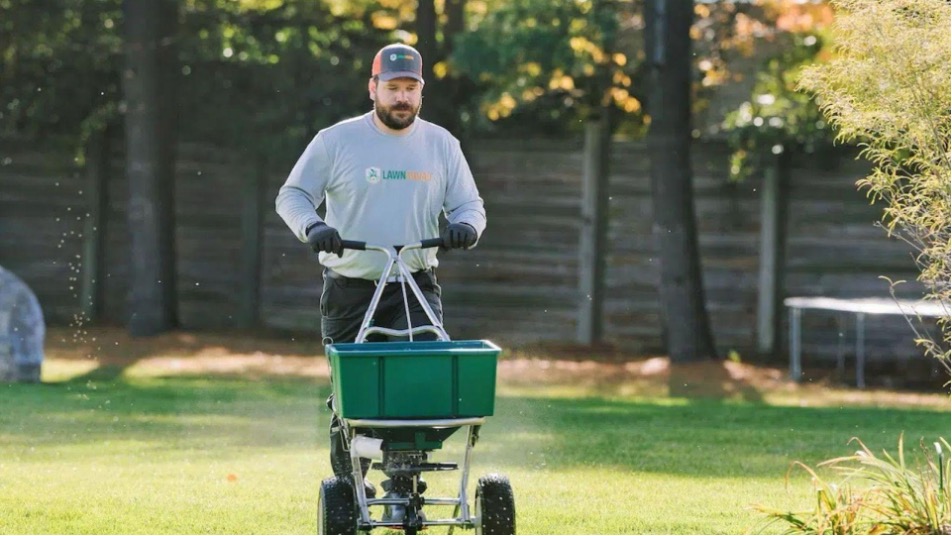
Once the grass is visibly growing (you have mowed once or twice), apply a light slow-release fertilizer. Heavy nitrogen now pushes top growth before roots have recovered from winter, and it sets up disease pressure in summer.
Save heavy feeding for September and October. Fall is when New England cool-season lawns build their root reserves, not spring.
For broadleaf weeds (dandelion, clover, wild violet, ground ivy), spot-treat. Most April North Shore lawns do not have enough weed pressure to justify a blanket application.
Lime Application: Do Not Skip
North Shore soils are chronically acidic. Mature oak, pine, and hemlock canopy drops tannic acids onto the soil. Glacial till is naturally acidic. Rainfall leaches calcium and magnesium out over time. The result: soil pH that locks up fertilizer nutrients even when you are applying them correctly.
If last fall’s soil test showed pH below 6.0 and you did not apply lime, now is acceptable for a light spring application. Fall is preferred but spring lime is better than none. Plan on 20 to 50 pounds per 1,000 sq ft depending on the soil test recommendation.
What Not to Do in April on the North Shore
- Do not power-rake aggressively. Save that for fall aeration, which is what our compacted soils really need.
- Do not fertilize heavy in spring. Fall is the critical feeding time for cool-season New England lawns.
- Do not apply pre-emergent and overseed the same week. Pre-emergent blocks new grass seed too.
- Do not scalp. Never drop your mower below 3 inches.
- Do not skip the soil test. Lime decisions without a test are guesswork.
What to Do Next
If you would rather have someone else watch the soil temperature, apply pre-emergent in the right late-April window, and handle the full season’s lime, aeration, and feeding, we are here for that.
Lawn Squad of North Shore serves Amesbury, Atkinson, Beverly, Boxford, Byfield, Chester, Danville, East Hampstead, East Kingston, Essex, Exeter, Fremont, Georgetown, Groveland, Hamilton, Hampstead, Hampton, Hampton Falls, Haverhill, Ipswich, Kingston, Manchester, Merrimac, Newbury, Newburyport, Newfields, Newton, Newton Junction, North Hampton, North Salem, Plaistow, Prides Crossing, Rowley, Salem, Salisbury, Sandown, Seabrook, South Hamilton, Stratham, Topsfield, Wenham, West Boxford, West Newbury, and Windham.
Call us at 617-468-4557 or request a free quote at lawnsquad.com. Our VitaminLawn program is built specifically for North Shore acidic soils, cool-season grasses, and our short intense growing season.