
Short Answer: When a Birmingham Bermuda or Zoysia lawn turns brown in July despite regular watering, drought is rarely the real cause. The six most common culprits we see across Hoover, Vestavia Hills, Trussville, and the rest of our service area are: shallow watering that promotes shallow roots, soil compaction sealing water out of the root zone, heavy thatch that intercepts water before it reaches the soil, brown patch or dollar spot fungus exploiting humid nights, chinch bug feeding in sunny stress-prone areas, and nitrogen-driven heat scorch from late-spring fertilizer applications. The right diagnosis turns on a screwdriver test, a tug test, and a careful look at the pattern and color of the affected area before you reach for the hose.
Every July we get the same call from Birmingham homeowners. “I am watering, and the lawn is still going brown.” Sometimes it is the front strip in Hoover where the irrigation runs every morning. Sometimes it is the entire back yard in Mountain Brook that looked perfect on Memorial Day and now has tan patches the size of a coffee table. Sometimes it is one section of an otherwise green Trussville Bermuda lawn that just will not snap out of it.
The instinct is always the same: water more. And in our central Alabama climate, that instinct is usually wrong. By the time a Bermuda or Zoysia lawn is browning in July with a working sprinkler system, the cause is rarely a lack of water at the surface. The cause is something between the sprinkler and the roots that is keeping the water from working, or something using the heat-stressed lawn as an opportunity.
Here are the six causes we walk through with homeowners every summer, in the order we typically rule them out. Each one has a different fix, and watering more makes some of them noticeably worse.
1. Shallow Watering Has Built You Shallow Roots
A sprinkler running fifteen minutes every morning feels like generous watering. It is actually the most damaging schedule you can run on a Birmingham Bermuda lawn in July. Light frequent water keeps only the top inch of soil moist, and Bermuda roots respond to where the water is. If the moisture stays in the top inch, that is where the roots stay. When a 95-degree afternoon dries the top inch out faster than the system can replace it, the lawn browns. The roots have nowhere to go because they never went deeper.
The fix is deep and infrequent. One inch per week, total, in one or two cycles. Try a screwdriver test: jam a long screwdriver into the lawn after a watering cycle. It should slide easily six to eight inches down. If it stops at three inches, you are not getting water to the root zone the lawn actually needs. Reset the irrigation to two cycles a week of about half an inch each, between 4 and 8 a.m., and give the roots a reason to chase moisture downward.
2. Compacted Clay Is Refusing the Water
Birmingham sits on red and yellow clay subsoils across most of Jefferson and Shelby counties. Clay seals when it is dry, especially after foot traffic, mower wheels, and the freeze-thaw cycles of winter compact the surface. When you turn the sprinkler on a sealed clay surface, half the water runs off before it ever soaks in. The grass below it is genuinely thirsty even though you are watering.
Test it: pull a soil core with a screwdriver or a section of pipe in the brown area and a green area side by side. If the brown area resists the screwdriver in the top three inches, compaction is the issue. The fix is core aeration in late spring through early summer for warm-season grass, while it is actively growing and can fill in the holes. We commonly aerate Birmingham Bermuda and Zoysia in late May or June for this reason. If you missed that window and a section is browning out from compaction, hand-aerate the worst patches with a garden fork and water again.
3. Thatch Is Catching the Water Like a Sponge
Bermuda is a thatch builder. Zoysia is a worse thatch builder. After two or three years without mechanical de-thatching, a Hoover Bermuda lawn can carry an inch and a half of thatch between the soil and the green canopy. Thatch is hydrophobic when dry. Water hits it, runs across it, and never reaches the soil. The grass roots, which live in the soil below the thatch, get nothing.
Diagnose by cutting a four-inch square wedge out of the lawn with a serrated knife, like a piece of pie. Look at the side of the wedge. If you see more than half an inch of brown, fibrous material between the green leaves and the dark soil, thatch is in the picture. The long-term fix is verticutting in spring or core aeration in late spring. The midsummer fix is uncomfortable: keep watering deeply, and accept that part of the water is being wasted until you can mechanically address the thatch in the right season.
4. Brown Patch or Dollar Spot Is Exploiting Humid Nights
Birmingham summer nights stay warm and humid. When the lawn does not dry off between evening dew and morning sun, fungal disease moves fast. Brown patch on Zoysia and on St. Augustine looks like circular or irregular tan patches one to several feet across, often with a darker ring of newly infected grass on the outer edge. Dollar spot on Bermuda and Zoysia shows up as silver-dollar-sized straw-colored spots that can merge into larger areas.
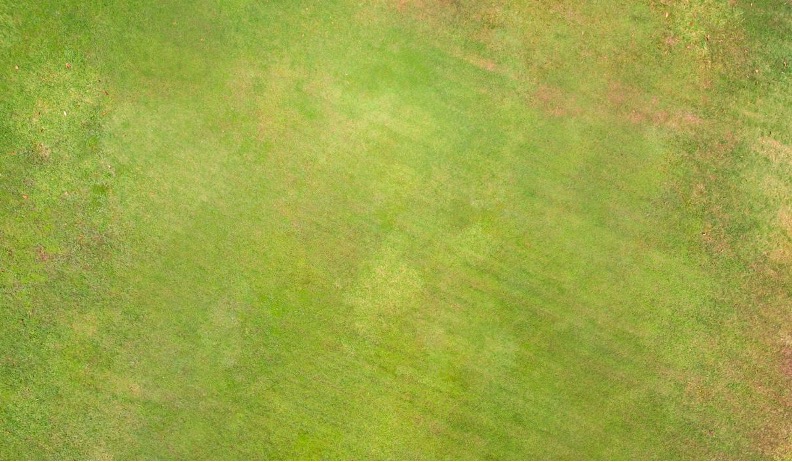
The pattern tells you it is disease. Drought stress is uniform across the affected area. Fungus has edges, rings, or distinct circles. If you walk the lawn at first light and the leaf blades show a cottony white fuzz where the patches are forming, that is mycelium and confirms the fungus diagnosis. Watering more makes this worse. The fix is to water only in the early morning so blades dry quickly, raise the mowing height a touch on Zoysia, and apply a labeled fungicide if the area is expanding faster than a few feet per week.
5. Chinch Bugs Are Feeding on Hot, Sunny Sections
If the browning patch is in full sun, along a driveway or south-facing wall, and is expanding outward week over week without responding to watering, chinch bugs deserve a look. They feed on Bermuda and St. Augustine across our service area starting in late June and peaking in July and August. The damage looks exactly like drought, which is why so many Birmingham homeowners pour more water on it while the chinch bugs feed undisturbed.
Test for them with a metal coffee can with both ends cut out, pushed into the soil at the edge of the brown area, then filled with water. Wait five minutes. If chinch bugs are present, they float to the top. We covered the full procedure in our June chinch bug post. The fix is a targeted bifenthrin or lambda-cyhalothrin application keyed to where the bugs actually are, applied with enough water volume to push the product down into the thatch where they live.
6. Late-Spring Nitrogen Is Burning In July Heat
The last cause is one homeowners rarely suspect because they did the work in good faith. A heavy nitrogen feeding in late May or early June pushes a flush of soft, succulent growth. When July hits with three days of 95-degree highs and full sun, that soft growth scorches at the tips. The lawn turns a yellow-brown across broad areas, the tips of the leaf blades curl, and the color does not return with watering because the damage is at the cellular level on the leaf blades themselves.
The fix is patience and restraint. Stop fertilizing until the heat breaks. Mow at the recommended height (1 to 1.5 inches on common Bermuda, 1.5 to 2.5 inches on Zoysia) and let the lawn produce new growth at a slower, sustainable rate. By the second week of August the scorched tissue mows out and the underlying green canopy fills back in. The lesson for next season is to split nitrogen applications smaller and more frequent, and to back off heavy applications once nighttime lows climb past 70 degrees.
How to Read Your Brown Patches and Pick the Right Fix
Once you know the six causes, the diagnosis comes down to pattern recognition. Here is the rough decision tree we use on Birmingham lawn calls:
- Uniform brown across the whole lawn, screwdriver stops at three inches: shallow roots and possible compaction. Water deeper, aerate next opportunity.
- Circular or ringed patches, fluffy fuzz visible at dawn: fungal disease. Reduce night moisture and treat with fungicide.
- Expanding patches in full sun near hardscape: chinch bugs. Float test, then targeted insecticide.
- Yellow-brown tipped blades across broad areas after a recent fertilizer application: nitrogen scorch. Stop feeding and mow it out.
- Brown areas where wedge test shows thatch over half an inch: thatch interception. Long-term verticutting plan.
- None of the above and the soil is genuinely dry six inches down: actual drought. Increase to one inch per week in two cycles.
The good news is that Bermuda and Zoysia are tough warm-season grasses. Once you correct the actual cause, recovery in central Alabama July is fast. Most lawns we work on show visible green up within two weeks of fixing the underlying issue.
What to Do Next
If you are watering and the lawn is still browning, the answer is rarely more water. It is almost always one of the six causes above, and the right test tells you which one in about fifteen minutes.
Lawn Squad of Birmingham serves Alabaster, Bessemer, Birmingham, Calera, Chelsea, Helena, Homewood, Hoover, Indian Springs, Inverness, Maylene, Montevallo, Mountain Brook, Pelham, Pinson, Trussville, and Vestavia Hills.
Call us at 205-573-1921 or request a free quote at lawnsquad.com. Our VitaminLawn program addresses the soil, nutrition, and disease pressure that drive most of the July browning we see on Birmingham Bermuda and Zoysia lawns, with a customized plan for the specific challenges of your yard rather than a one-size-fits-all routine.