Why Do Northern Kentucky Lawns Get Their Worst Disease Pressure in Late Summer?
Short Answer: Because the ingredients all peak at once. Turf diseases need a susceptible grass, a warm night, and leaves that stay wet for hours, and the Ohio River valley supplies the last two generously. Cool air settles into the valleys after dark, fog forms, and dew sits on the blades well past sunrise. Tall fescue, our workhorse grass, is the primary target. Brown patch thins the stand from the leaf down, gray leaf spot can kill it outright, and both peak in the same stretch when most homeowners are planning to seed. Correct the watering, the mowing, and the airflow first.
Step out early on an August morning in Newport or down along the bottoms near Silver Grove and you can see the problem before you understand it. The whole yard is soaked at seven in the morning even though it has not rained in four days. Your shoes are wet to the laces. There is a haze sitting over the river, and by the time the sun clears the bluff and burns it off, the grass has been damp for ten or eleven hours straight. That is a fungus greenhouse, and it runs every night from July into September.
Homeowners tend to take these outbreaks personally, as though the lawn failed a test they set. It did not. This corner of Kentucky simply hands tall fescue a harder assignment in August than almost anything else it faces all year.
Why the Valley Holds Moisture Longer Than the Ridge
Disease specialists talk about a triangle: a pathogen, a host plant, and an environment that favors the pathogen. The pathogens live in your soil and thatch year round, doing nothing. The host is whatever you planted. The environment is the only leg you can move, and here the environment does its own thing.
After sundown, cooler and denser air slides downhill and pools in the low ground along the river and in the creek bottoms that cut back into the hills. That is why fog forms over the water and in the hollows first. Where the air is cool and still and saturated, dew forms early, forms heavily, and hangs on late. Meanwhile the daytime highs stay in the eighties and the nights refuse to drop below the upper sixties. Long leaf wetness plus warm nights is the exact recipe.
This is also why two lawns four miles apart behave differently. A flat lot in a low pocket near Melbourne can run several hours longer of leaf wetness than an exposed hilltop in Fort Mitchell that catches the breeze. If your yard sits low, backs onto woods, or is boxed in by privacy fence and mature trees, you are on the wrong side of that difference and you should manage accordingly.
Brown Patch: The One You Diagnose at Sunrise
Brown patch is the disease we see most on Northern Kentucky tall fescue, and it announces itself when night temperatures settle in above the upper sixties and stay there.
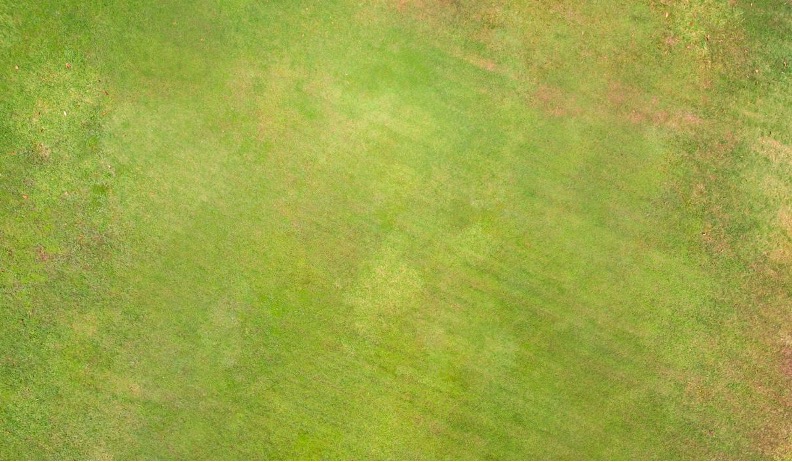
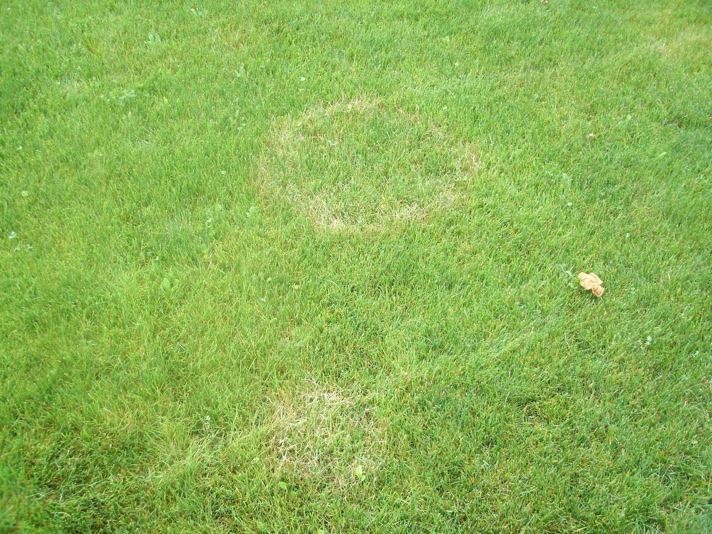
What you see from the deck is roughly circular areas of tan, sunken looking grass, anywhere from dinner plate size to several feet across, sometimes running together into irregular blotches. The trick is to go out at first light while dew is still on. At the advancing edge of an active patch you will often find a narrow band of grayish purple, water soaked turf, sometimes with fine cobwebby strands. That band is the giveaway, and it disappears within an hour of the sun hitting it, which is why so many people never see it.
Pull a single blade and look at it in your palm. Brown patch lesions are irregular tan blotches with a distinct dark chocolate colored border, as if someone drew around them with a fine marker. The important thing about this disease is that it feeds on leaf tissue and generally leaves the crown alive. The lawn thins and looks terrible, but most of it regrows once the weather turns. Panic is not required.
Gray Leaf Spot: The One That Actually Kills Fescue
Gray leaf spot is a different animal and deserves more respect. It is most severe in the hottest, most humid stretch of the season and it hits tall fescue and perennial ryegrass hard, with new seedlings by far the most vulnerable.
Instead of neat circles, gray leaf spot tends to produce an irregular, spreading wash of thinning turf that can look scorched, as though a flame passed low over it. Individual blades show small oval lesions, gray or ash colored in the middle with a dark brown margin and often a yellow halo around the whole thing. Infected leaf tips twist and shrivel. On a badly hit lawn it can move across a yard remarkably fast, and unlike brown patch it can take the plants with it rather than just the leaves.
If you have a lawn that has thinned out badly in late summer more than one year running, and the damage did not come back the following spring, gray leaf spot belongs on the suspect list.
Dollar Spot and What It Is Telling You
Dollar spot deserves a mention because it is common and because it is a message rather than a crisis. It shows up as small bleached spots roughly the size of a silver dollar to a coffee cup, often with white cottony webbing visible in early dew. On individual blades the lesion is a straw colored band across the leaf with reddish brown edges, pinched in like an hourglass.
Dollar spot correlates strongly with underfed turf. When we see it on a lawn in Latonia or Crittenden, the first question is usually about the fertility program rather than the fungicide cabinet, because a modest, correctly timed feeding often quiets it down on its own.
The Corrections That Do More Than a Fungicide
Watering is the biggest lever you own. Run irrigation in the pre dawn hours so it overlaps with dew that was going to be there anyway, and the leaves dry as soon as the sun is up. Watering in the evening effectively doubles the wet period and is the single most reliable way to make August worse. Water deeply and only a couple of times a week rather than lightly every day.
Second, be careful with nitrogen in midsummer. Lush, fast growing fescue leaf tissue is more susceptible to brown patch, so a heavy summer feeding on a disease prone lawn can make matters worse. Save the real feeding for fall, which is when it pays anyway.
Third, mow tall with a sharp blade, and avoid mowing an actively diseased lawn while it is wet if you can help it. Fourth, open the yard up where you reasonably can. Limbing up low branches and thinning a crowded fence line increases air movement and shortens the dew period measurably.
Fungicides do have a place, particularly on high value lawns with a documented gray leaf spot history and on new fall seedings. They work best applied preventively, on a schedule, before symptoms appear. Applied after the fact they stop the spread but do not repair what is already dead.
What This Means for Your Fall Seeding Plan
Here is the practical intersection. Our seeding window in Northern Kentucky opens in the second half of August, and disease pressure is often still running when it does. Fresh fescue seedlings are the most susceptible tissue in the entire lawn, so seeding into a yard that has a history of gray leaf spot without a protection plan is how homeowners in Covington and Erlanger end up doing the same job twice.
The sequence we recommend is simple. Identify what you actually had this summer. Fix the water schedule and the mowing height first, because those carry into next year. Then seed, and on a lawn with real disease history, plan for preventive protection over the establishment period or push the seeding into early September when nights have cooled.
What to Do Next
If your lawn has thin, off colored areas right now and you are not sure which of these you are looking at, call us at 859-222-7335 or request a free quote at lawnsquad.com. A first visit is diagnostic. We look at patch shape and pattern, pull blades and read the lesions, check thatch depth, and ask about your watering schedule, which is often where the answer sits. Disease and drought and insect feeding all look similar from the porch and quite different up close, and telling you which one you have costs you nothing.
Expect a realistic timeline. Once conditions break and the corrections are in place, brown patch damage on established tall fescue typically shows visible recovery within three to four weeks. At thirty days you should see green filling in from the edges of the old patches. At ninety days, into November, a lawn that also received fall fertilization and seed generally looks better than it did before the outbreak, because autumn is when cool season grass rebuilds. Areas lost to gray leaf spot usually need seed rather than patience.
Our Lawn Disease Control service covers preventive and curative treatment, and our VitaminLawn program keeps fertilization and weed control timed for the tall fescue and bluegrass that grow on this side of the river and for the limestone influenced soils under it. We serve Alexandria, Bellevue, Burlington, California, Covington, Crittenden, Dry Ridge, Erlanger, Florence, Fort Mitchell, Fort Thomas, Hebron, Independence, Latonia, Melbourne, Morning View, Newport, Petersburg, Silver Grove, Union, Verona, and Walton. Each location is independently owned and operated, and our work carries a satisfaction guarantee.