Short Answer: Cool season grass in Bucks and Montgomery Counties spends July and August in survival mode. Temperatures in the upper 80s and low 90s combined with high humidity push Kentucky bluegrass and perennial ryegrass into semi dormancy, and the heavy clay and shale soils under most lawns here compact enough that roots cannot reach the moisture they need to ride it out. Add brown patch, summer patch, grubs, and mowing too short, and the lawn thins a little more every year. The repair happens in September and early October, not in July.
Summer Here Is Harder on Cool Season Grass Than It Looks
Kentucky bluegrass, perennial ryegrass, and fine fescue evolved for cool, moist climates. They photosynthesize most efficiently when air temperatures are between 60 and 75 degrees and soil temperatures stay under about 70. From late June through August, Bucks and Montgomery Counties routinely deliver the opposite: daytime highs in the upper 80s and low 90s, overnight lows that stay in the 70s, and dew points high enough that the leaf surface never really dries.
Under those conditions the grass plant burns more carbohydrate than it produces. Root growth stops entirely and existing roots begin to die back. The lawn is not sick yet, it is simply spending down its reserves. Whatever thinned last August was already weakened before the first disease or insect showed up.
Clay, Shale, and Compaction Under Most of These Lawns
Soil is the second half of the problem. Much of Montgomery County sits on silt loams over schist and limestone, and a good deal of Bucks County sits on red shale with bedrock only a foot or two down in places. Both are dense, both hold water poorly once compacted, and neither gives roots an easy path.
On top of that, most homes built here in the last forty years have lawns growing on graded construction fill rather than native topsoil. Heavy equipment compacted the subsoil, a few inches of screened topsoil went over it, and sod or seed went on top of that. Roots reach the compacted layer at three or four inches and stop. A lawn rooted three inches deep has no reserve when a two week dry spell hits in August.
Mowing Height Is the Single Biggest Thing You Control
If a lawn in this area thins every summer and nothing else is obviously wrong, mowing height is usually the reason. Root depth tracks blade length closely. Grass cut at two inches simply cannot support the root system that grass cut at three and a half inches can.
Set the deck to three and a half or four inches from June through September. Yes, it looks shaggier than a golf course. It also shades the soil surface by several degrees, slows evaporation, blocks crabgrass seed from getting the sunlight it needs to germinate, and keeps enough leaf tissue that the plant can feed itself through the heat. Never remove more than a third of the blade in one cut, and keep the blade sharp. A dull blade tears the leaf tip, and torn tissue browns off and invites disease.
Brown Patch Is the July and August Disease
Brown patch, caused by Rhizoctonia solani, is the most common summer disease we see on tall fescue and perennial ryegrass in this region. It needs three things, and this area supplies all of them: nighttime temperatures above 68 degrees, extended leaf wetness, and available nitrogen.
It appears as irregular tan or brown patches, sometimes a foot across and sometimes covering large sections, and on heavy dew mornings you can see a smoky gray edge advancing across the turf. Individual blades show tan lesions with a darker border. It rarely kills the crown, so most lawns recover in fall, but a bad summer of brown patch leaves the stand thin enough that weeds take the space first. Watering in the evening and pushing nitrogen in midsummer are the two habits that make it worse.
Summer Patch on Older Bluegrass Lawns
Older bluegrass lawns, particularly in developments from the 1970s and 1980s, often show a different pattern: rings, crescents, and arcs of dead grass six inches to two feet across, usually appearing in the hottest and most compacted areas first. That is summer patch, a root and crown rotting disease that infects in late spring but does not show symptoms until high heat pushes the plant past what its damaged roots can supply.
Summer patch is worse on compacted soil, on lawns mowed short, on sunny slopes, and where soil pH has drifted upward. Because the infection happens months before the symptoms, spraying in August does not help. Managing it means aeration, correct mowing height, balanced fertility, and over time introducing resistant grasses through overseeding.
Grubs and Chinch Bugs Get Blamed Too Often
Every year homeowners here pull back dead turf expecting grubs and find nothing. Insects are real problems in this region, but they are not the default explanation for a thinning lawn.
White grubs, mostly Japanese beetle and oriental beetle larvae, feed on roots in late summer. The tell is turf that lifts like loose carpet with no roots holding it, usually in full sun areas, often with skunk or bird digging alongside it. Damage typically shows up from mid August into September. Chinch bugs work differently, feeding at the base of the plant in hot dry sunny strips, especially along driveways, sidewalks, and south facing banks, producing yellowing that looks exactly like drought stress and does not respond to water. Confirm which one you have before treating. Applying a grub product to a lawn with chinch bug damage wastes the season.
Watering Habits That Make It Worse
The most common irrigation mistake in this area is watering a little bit every day. Light daily watering keeps the top inch damp, which trains roots to stay shallow, keeps the leaf surface wet overnight when disease pressure is highest, and never wets the soil deeply enough to matter.
Aim for about one inch of water per week including rainfall, delivered in two applications rather than seven. On clay soils, run the zone in two or three shorter cycles with a pause between so the water soaks in rather than running off. Water early, between 4 a.m. and 9 a.m., so blades dry quickly once the sun is up. Put a rain gauge or a straight sided can in the lawn and measure. Most systems here deliver considerably less than people assume.
Crabgrass and Nutsedge Fill Every Gap
Thinning does not leave bare soil for long in this climate. Crabgrass germinates as soil temperatures pass the mid 50s in spring and thrives in exactly the hot open conditions that stress the good grass. Yellow nutsedge takes over low, poorly drained spots and areas with a leaking irrigation head, growing faster than the turf around it and standing above the cut line within days.
Both are symptoms as much as causes. A dense lawn mowed at four inches gets far less crabgrass than a thin lawn mowed at two, regardless of what preemergent went down. Fixing the density is the durable answer, and the herbicide program supports it rather than replacing it.
Why Fall Is When You Actually Fix This
September and early October are the best six weeks of the year for cool season grass in southeastern Pennsylvania. Soil is still warm from summer, which drives germination, but air temperatures have dropped into the range where the plant produces more energy than it spends. Disease pressure falls off. Weed competition drops. Rainfall usually improves.
That combination does not exist in spring, when soil is cold, and it certainly does not exist in July. A lawn seeded in mid September has six to eight weeks of establishment before growth stops, plus another full spring to mature before it faces heat. A lawn seeded in April faces its first summer at ten weeks old.
What a Repair Plan Looks Like Here
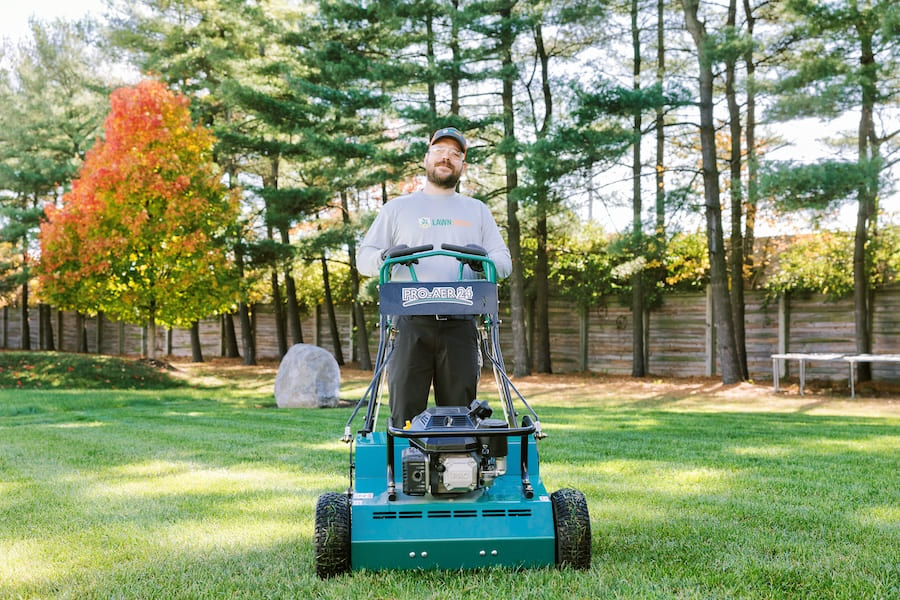
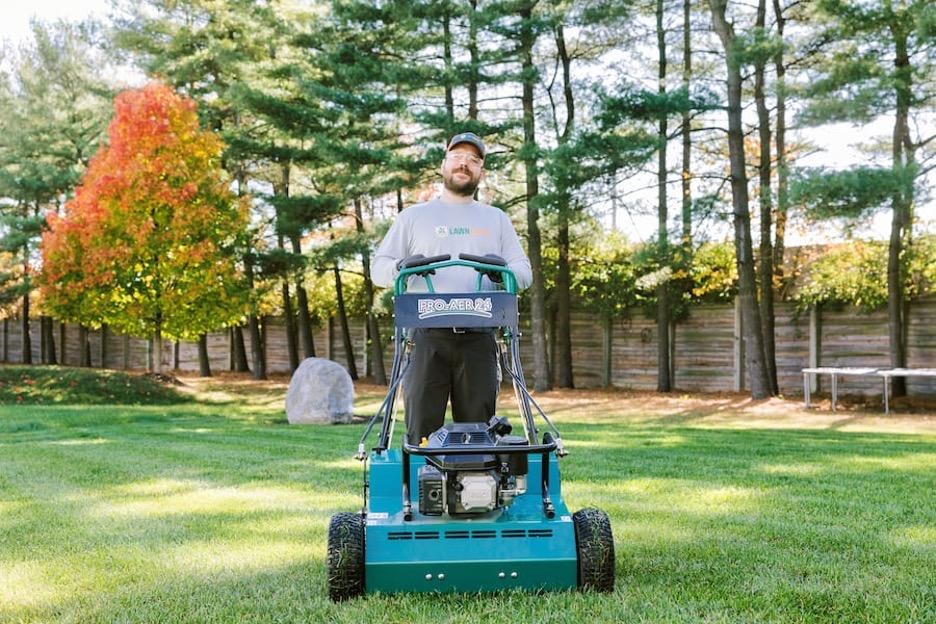
- Core aerate, ideally in two directions, to break the compacted layer under the topsoil. On clay this is the highest value thing you can do all year.
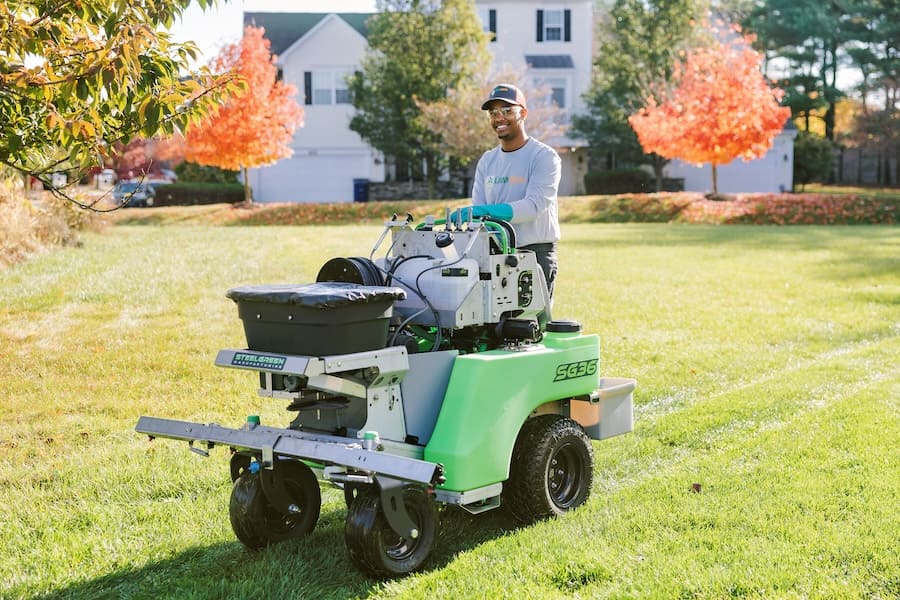
- Overseed with a quality turf type tall fescue blend for sun and heat tolerance, or a bluegrass and fine fescue mix in shaded areas. Match the seed to the site rather than buying one bag for the whole property.
- Apply a starter fertilizer at seeding, then a second fall feeding four to six weeks later to build root reserves.
- Test soil pH. Lawns across both counties commonly test between 5.0 and 5.8, and grass takes up nutrients poorly below about 6.0. Lime corrects it, but it moves slowly, so fall applications are the right timing.
- Keep new seed damp with light frequent watering for the first two to three weeks, then transition to deep infrequent watering.
- Hold off on broadleaf herbicide over new seed until the seedlings have been mowed two or three times.
What to Do Next
Walk the lawn this week and write down the two or three things that actually bother you about it, then work backward from the window rather than forward from today. Almost every fall mistake we see in Bucks and Montgomery Counties comes from starting with the calendar instead of with the lawn.
If you would rather have someone look at it with you, Lawn Squad of Bucks and Montgomery Counties offers a free quote. Call 833-816-7508 or find us at lawnsquad.com. Every Lawn Squad location is independently owned and operated, and our VitaminLawn fertilization and weed control program is built around the grass, soil, and conditions here rather than a national average.
A first visit is a walk of the property, a look at the thin areas, a check of mowing height and irrigation, and a straight conversation about what is realistic in the weeks left this season. At 30 days you should see color and density improve. At 90 days the lawn should be visibly thicker, with the root growth that carries it through winter.