
Short Answer: Crabgrass that returns every year despite pre-emergent applications usually has one of five underlying causes: pre-emergent timing that was off, coverage gaps in the application, a thin lawn that does not crowd out germination, soil disturbance breaking the herbicide barrier, or a heavy seed bank built up from prior years. Breaking the cycle requires addressing the underlying cause rather than just applying more product. Across Fairfield and New Haven Counties, here is the practical playbook for breaking the crabgrass cycle on your property.
If you have been fighting crabgrass year after year on your Fairfield or New Haven County lawn, you are probably starting to wonder if it is even worth the effort. Pre-emergent goes down. Crabgrass still comes up. Post-emergent gets applied. The lawn looks better for a few weeks. Then next spring, here it comes again.
The frustrating truth is that recurring crabgrass is not a sign that pre-emergent does not work. It is a sign that something specific in your lawn or your treatment program is not lining up. Across Stamford, Greenwich, Westport, New Canaan, Fairfield, New Haven, Madison, and our broader service area, here are the five reasons we see most often.
Cause 1: Pre-Emergent Timing Was Off
Pre-emergent must be applied before crabgrass germinates. Crabgrass germinates when soil temperatures cross 55 degrees consistently. In Fairfield and New Haven Counties, that timing is typically mid to late April depending on the year. In a warm spring, the window can open in early April. In a cool spring, it can stretch into early May.
If your pre-emergent application went down in early May this year and the soil was already 60 degrees on April 20 in your part of Fairfield County, the door was already open by the time the barrier went down. The crabgrass and goosegrass you are seeing germinated through that gap.
Some lawn care companies run on calendar schedules rather than soil temperature. They might apply pre-emergent on May 1 every year regardless of how the season is shaping up. In a warm spring, that timing is too late.
The fix is using a service that monitors soil temperature and adjusts timing. Or if you DIY, using a soil thermometer (cheap at any garden center) and applying when readings stay above 50 degrees consistently.
Cause 2: Coverage Was Incomplete
Pre-emergent works as a barrier in the soil. The barrier needs to cover the entire lawn surface. Gaps in coverage become crabgrass germination zones.
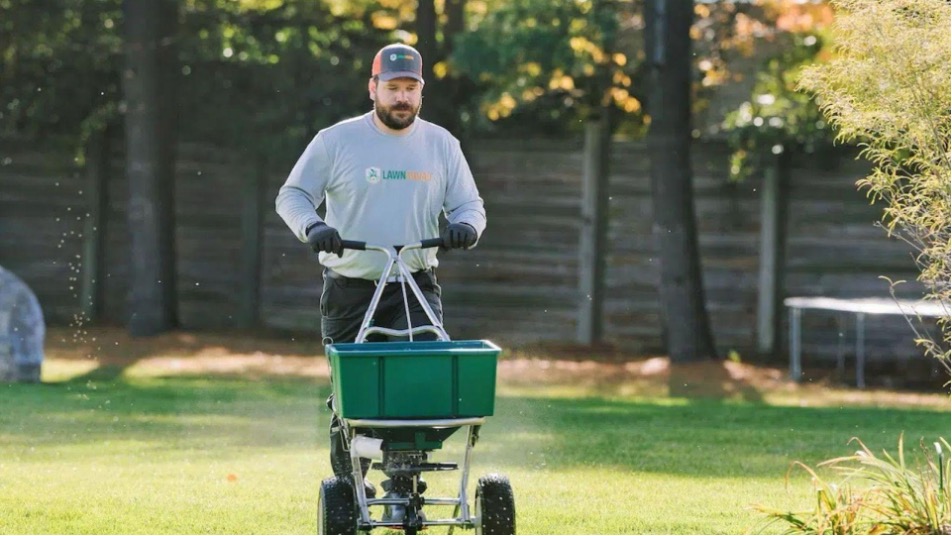
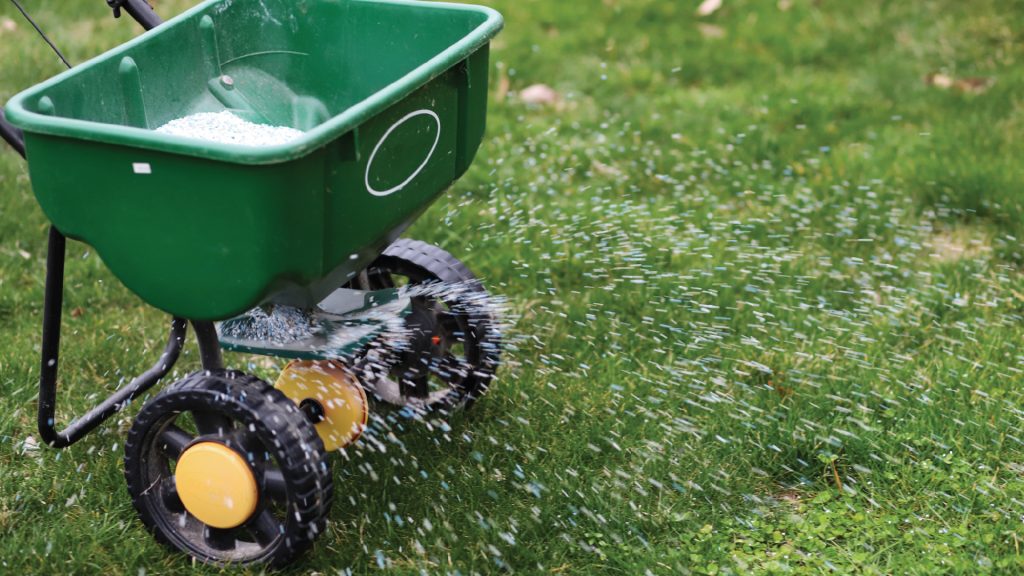
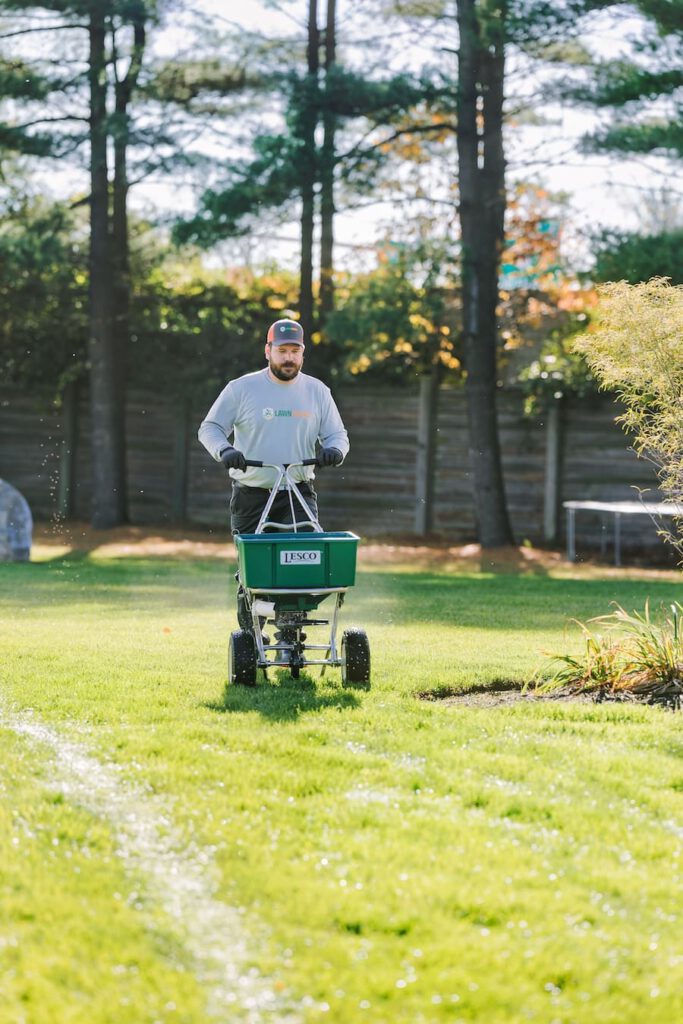
Coverage gaps come from spreader calibration issues, operator skips during application, or failure to overlap passes properly. Even an inch of skip between passes can become a crabgrass strip later.
The fix is professional application using calibrated equipment and overlap technique that ensures full coverage. DIY applications often have coverage issues that are invisible at the time but show up later as crabgrass.
Cause 3: The Lawn Is Too Thin
This is the underlying cause that most homeowners overlook. Crabgrass needs sun on bare soil to germinate. A dense, healthy lawn shades the soil and prevents most germination, even with imperfect pre-emergent.
Thin lawns expose soil. Exposed soil grows crabgrass. The pre-emergent might do a great job, but if your lawn is sparse, every gap in the pre-emergent barrier is a germination opportunity.
The fix is building density. Three habits matter most: mowing at the upper end of the recommended range (3.5 to 4 inches for cool-season grass), fertilizing on a complete program rather than skipping rounds, and watering deeply and infrequently to grow deep roots.
For severely thin lawns, fall aeration plus overseeding is the highest-value renovation work available. A thicker fescue stand resists crabgrass invasion year after year.
Cause 4: Soil Disturbance Broke the Barrier
Pre-emergent forms a barrier in the top inch of soil. Anything that disturbs that soil layer can break the barrier:
Aeration shortly after pre-emergent application.
Heavy raking or dethatching.
Construction or landscape work that disturbs soil.
Heavy rainfall washing soil and the herbicide layer.
Burrowing animals like voles or moles.
Pet activity that creates worn-down trails.
Once the barrier is broken, crabgrass seeds in the soil can germinate through the disturbance. The fix is timing other lawn services properly relative to pre-emergent (aerate in fall rather than spring after pre-emergent has worn off, etc.) and considering a split application that reinforces the barrier mid-season.
Cause 5: Heavy Existing Seed Bank
Lawns that have had heavy crabgrass for several years build up a soil seed bank. Some of those seeds remain viable for 3 to 5 years. Even with perfect pre-emergent every year, some seeds in deeper soil can germinate as soil disturbance brings them to the surface.
The good news is that consistent control over multiple years gradually depletes the seed bank. The first 1 to 2 years on a serious pre-emergent program may still see some breakthrough. Year 3 onward typically sees dramatic improvement as fewer viable seeds remain to germinate.
This is one reason to commit to a multi-year program rather than evaluating success on a single season.
The Compounding Effect
Many lawns have multiple causes operating at once. The pre-emergent timing is slightly off, the coverage has gaps, the lawn is somewhat thin, and the seed bank is heavy. Each cause individually might cause moderate breakthrough. Together they produce dramatic crabgrass returns.
The fix has to address all of them. Better timing alone is not enough if the lawn is thin. Improving density alone is not enough if pre-emergent is not being applied properly. The complete approach is what breaks the cycle.
What a Real Crabgrass Solution Looks Like
For Fairfield and New Haven County lawns with recurring crabgrass, our typical approach:
Year 1: Properly timed split-application pre-emergent (early and follow-up). Post-emergent for any breakthrough. Aggressive fertilization to build density. Aeration in fall. Overseeding.
Year 2: Continue pre-emergent program, monitor density improvements, address any remaining thin spots.
Year 3: Most lawns are visibly different by this point with significantly less crabgrass pressure.
Quick fixes do not exist for recurring crabgrass. Real solutions are multi-year and address the underlying conditions.
Common DIY Mistakes
Several things homeowners often try that do not work:
Applying more pre-emergent than the label specifies. This can damage the lawn without improving control.
Applying too late and hoping for the best.
Using consumer-grade products with weaker active ingredients than professional formulations.
Skipping post-emergent treatment when crabgrass does come through, letting it produce seed that joins the soil seed bank.
Mowing too short, which thins the lawn and gives crabgrass more germination opportunity.
What to Do Next
If you are tired of fighting crabgrass year after year on your Fairfield or New Haven County lawn, we walk properties across Stamford, Greenwich, Westport, New Haven, Madison, and our broader service area to identify what is going wrong and put together multi-year plans to break the cycle. If you would rather have someone else handle the timing decisions, product selection, and application for your New Haven and Fairfield Counties lawn, we are here for that.
Visit lawnsquad.com to find Lawn Squad of New Haven and Fairfield Counties and request a free quote. Our VitaminLawn program is built specifically for the grass types, soils, and weather patterns in our service area. Most homeowners see noticeable improvement within the first two applications.