Is It Disease, Chinch Bugs, or Drought? Diagnosing Brown St. Augustine in South Miami

Is It Disease, Chinch Bugs, or Drought? Diagnosing Brown St. Augustine in South Miami
Short Answer: Brown or yellow patches in South Miami St. Augustine can have several causes that look alike from the street: fungal diseases like large patch and take-all root rot, chinch bugs, drought stress, and iron deficiency on our alkaline soils. Each needs a different response. Chinch bug damage usually starts in hot, sunny, dry spots near pavement. Drought stress shows up first where irrigation misses. Large patch forms rings with orange edges in cool, wet weather. Take-all leaves dark, rotted roots. Iron deficiency causes yellowing between the veins. A close look before treating saves time and money.
If you are reading this, you are probably looking at a brown or yellow patch in your St. Augustine and wondering what caused it. Is it a fungus? Bugs? Not enough water? Too much? It is a frustrating question, because many lawn problems look almost identical from a few feet away.
Getting the answer right matters. Treating a chinch bug problem with fungicide, or a disease with insecticide, wastes money and lets the real problem keep spreading. Here is how to sort it out in South Miami lawns.
Why Diagnosis Is Tricky Here
Floratam St. Augustine, the most common lawn grass in South Miami, faces several common problems at once. Chinch bugs are active year-round in South Florida. The dry season brings drought stress where irrigation is uneven. Cool fronts can trigger fungal diseases. And our alkaline limestone soils make iron deficiency common. Any of these can cause yellowing or browning, and sometimes more than one is happening at the same time.
Chinch Bugs
Southern chinch bugs are small insects that feed on St. Augustine by sucking sap from the base of the plant. They are one of the most damaging pests of St. Augustine in Florida.
Chinch bug damage usually starts in the hottest, sunniest, driest parts of the lawn, often next to driveways, sidewalks, and curbs where pavement adds heat. It shows up as irregular yellowing that turns brown and spreads outward. The damaged grass looks dry and straw-like, not rotted. At the edge of the damaged area, where yellow grass meets green grass, you can often find the insects by parting the grass and looking closely at the soil surface, or by using the flotation method with a can pushed into the soil and filled with water.
Chinch bugs are most active in hot, dry weather, but in South Miami, they can cause damage much of the year.
Drought Stress
In the dry season, drought stress is common, especially where irrigation coverage is uneven. Drought-stressed St. Augustine first looks bluish-gray, with blades that fold or curl, and footprints that stay visible after you walk across the lawn. If it continues, the grass turns tan or brown.
Drought damage usually follows the irrigation pattern: dry spots between sprinkler heads, areas near walls and walkways where spray is blocked, and sections that get less coverage. It also shows up first on sandy or very thin soils over rock.
A simple test: water the area well and watch it over a few days. Drought-stressed grass usually begins to recover. Chinch bug or disease damage does not.
Large Patch
Large patch is a fungal disease that shows up during cool, wet weather. Look for roughly circular patches, often a few feet across, with an orange, bronze, or reddish ring at the edge where the disease is active. Leaf sheaths at the base of the plant pull away easily and look dark or rotted where they attach to the runner.
Large patch usually appears in shaded, low, or overwatered areas, not in the hottest, driest parts of the lawn.
Take-All Root Rot
Take-all root rot is a fungal disease that attacks the roots and runners. The lawn yellows and thins in irregular areas, roots are short, dark, and rotted, and runners pull up easily from the soil. Take-all is often worse in alkaline soil, which describes much of South Miami, and in areas that stay wet. It tends to develop slowly over a season or more.
Iron Deficiency
On alkaline soils, St. Augustine often turns yellow because it cannot take up enough iron, even though iron is present in the soil. Iron deficiency causes yellowing between the veins of the blades, often on the newest growth, while the grass is still alive and growing. It tends to be widespread or patchy rather than forming clear circles, and it does not cause the grass to die or pull up easily. An iron application usually improves color within days.
Other Look-Alikes
Dog spots are small, circular brown areas, often with a ring of dark green grass around them. Fairy ring forms arcs or rings of dark green or dead grass, sometimes with mushrooms. Mower scalping leaves brown areas on high spots. Each has its own pattern.
A Simple Diagnostic Checklist
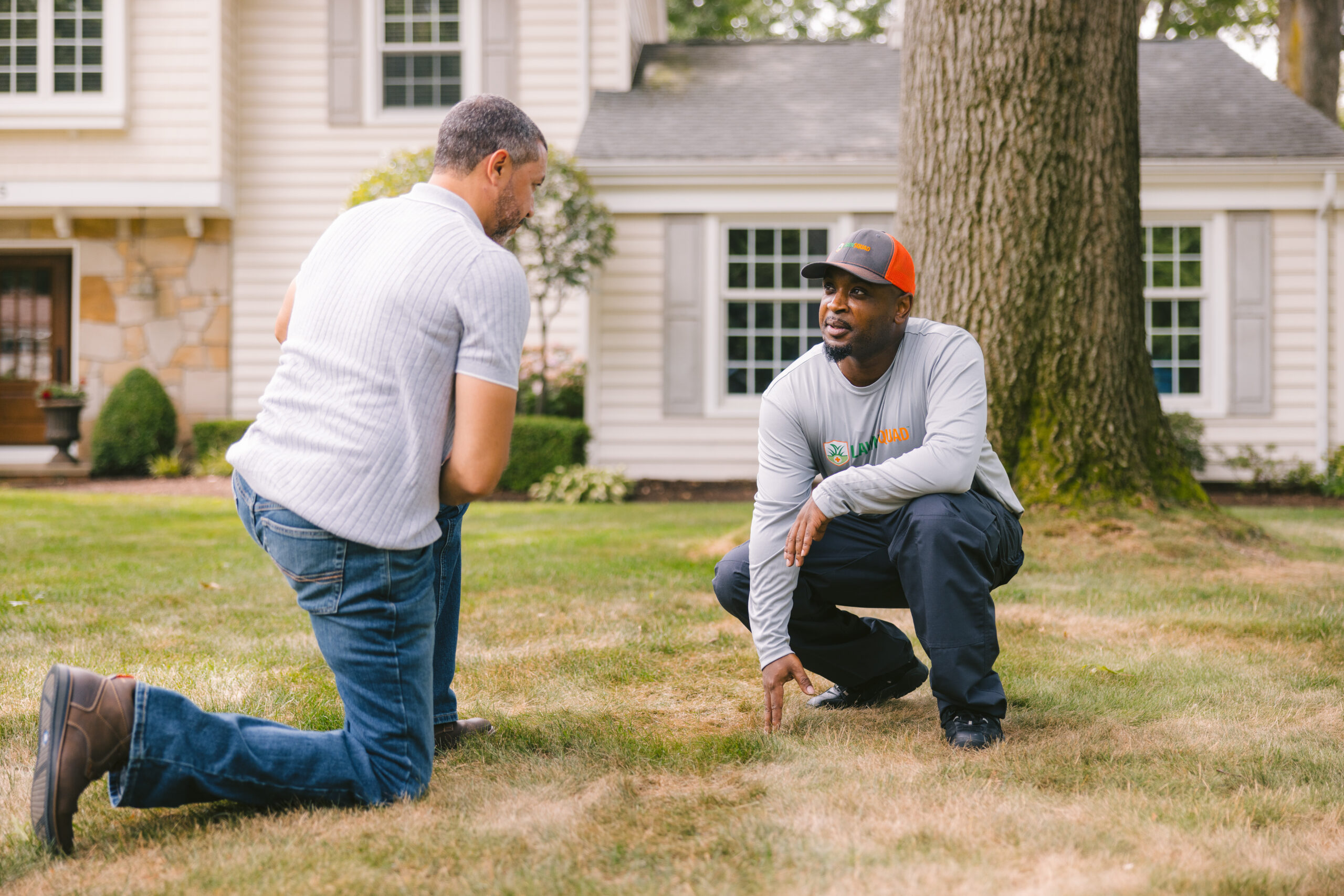
Here is what we have found works best when you find a brown or yellow area. Start with location: is it in a hot, sunny spot near pavement, or a shaded, wet area? Look at the shape: is it a circle with an orange edge, or irregular? Check the edges: are there tiny insects at the base of the grass where yellow meets green? Tug on the grass: does it pull up easily with dark, rotted roots? Look at the blades: is there yellowing between the veins? And think about timing: did it appear during a hot, dry stretch or a cool, wet one?
Why Getting It Right Matters
Each problem has a different fix. Chinch bugs need insect control and good cultural practices. Drought stress needs better irrigation coverage. Large patch and take-all root rot need moisture management and sometimes fungicides. Iron deficiency needs iron and micronutrients. Applying the wrong treatment wastes money and lets the real problem continue.
Good Habits Help With All of Them
A few practices reduce most of these problems. Water deeply and less often, early in the morning, and check that sprinkler coverage is even. Mow St. Augustine at about three and a half to four inches. Feed moderately after Miami-Dade’s rainy-season fertilizer ban lifts on November 1, following the county’s rules. Use iron and micronutrients on alkaline soil. Avoid heavy nitrogen, which favors both chinch bugs and some diseases.
Consider Resistant Varieties for Repairs
If part of your lawn needs to be replaced, ask about St. Augustine varieties with better tolerance to chinch bugs or shade. Matching the variety to the site reduces future problems.
Keep Products Away From Water
Whatever the diagnosis, keep insecticides, fungicides, and fertilizers away from canals, lakes, and storm drains. Many of South Miami’s waterways flow toward Biscayne Bay.
When to Get Help
Some cases are genuinely hard to sort out, especially when two problems overlap. A close inspection by someone who sees a lot of South Florida lawns can save time, and UF IFAS Extension’s diagnostic services can identify samples.
What the Right Diagnosis Looks Like
Imagine this. A brown area by the driveway that you thought was a fungus turns out to be chinch bugs, caught early at the edge of the damage. It gets treated, the irrigation is adjusted, and within a few weeks, the St. Augustine is filling back in. Meanwhile, the yellow area in the backyard turned out to be iron deficiency, and it greened up in days.
What to Do Next
When you find a brown or yellow patch, check its location, shape, and edges, tug the grass to look at the roots, and look for chinch bugs where yellow meets green. Water dry spots and watch for recovery, apply iron if the yellowing is between the veins, and get a closer look before treating anything you cannot identify.
If you would rather have someone else keep an eye on lawn disease in your South Miami yard, we are here for that. Lawn Squad of South Miami serves homeowners across South Miami and the surrounding Miami-Dade communities. Visit lawnsquad.com to request a free quote.
Here is what to expect. We will walk your lawn, look closely at any patches or thin areas, and talk through your watering, mowing, and fertilizing habits. Then we will explain what we think is happening, what we would treat, and what you can change to help. If your lawn does not need a treatment, we will tell you that honestly.

