The short answer: Healthy trees and shrubs in Central and Eastern Massachusetts require a year-round care program that combines timely fertilization, preventive pest and disease treatments, proper pruning, and seasonal protection against the stresses that New England’s climate delivers — from summer drought and humidity to harsh winter freezes and early spring insect emergence.
Most homeowners invest significant attention in their lawns while treating the trees and shrubs on their property as an afterthought. That approach is understandable — trees and shrubs change slowly, and problems often go unnoticed until they are severe. But the landscape plantings surrounding your home represent a substantial investment in both property value and curb appeal. A mature oak, a well-established ornamental border, or a row of healthy arborvitae adds far more to your property than any lawn treatment program alone.
The good news is that tree and shrub care in Central and Eastern Massachusetts follows a predictable seasonal rhythm. Understanding what your plantings need — and when — makes the difference between a landscape that thrives year after year and one that slowly declines despite your best efforts.
Quick overview:
- Fertilization: Trees and shrubs have specific nutrient needs that differ from lawn grass — feeding them correctly drives vigorous, disease-resistant growth
- Pest and disease management: Many of the most damaging insects and fungal infections in Massachusetts are highly treatable when caught early — and devastating when ignored
- Pruning: Timing and technique matter enormously — the wrong cut at the wrong time can harm more than it helps
- Seasonal protection: Winter damage, spring frost, and summer drought all take a toll on landscape plantings that proper care can minimize
Keep reading to learn exactly what Central and Eastern Massachusetts trees and shrubs need through every season.

Why Tree and Shrub Care Matters More Than Most Massachusetts Homeowners Realize
Trees and shrubs face a fundamentally different set of challenges than lawn grass. A struggling lawn can be overseeded and recover within a season. A mature tree damaged by disease, insects, or improper care may take years to recover — or may not recover at all.
Central and Eastern Massachusetts presents a particularly demanding environment for landscape plantings. The region’s variable climate swings from humid, hot summers to bitter cold winters with heavy snow and ice loads. Rocky, often acidic soils common across much of the area limit nutrient availability. And the region hosts a growing list of invasive pests — from the winter moth to the hemlock woolly adelgid — that have no natural predators here and cause rapid, severe damage if left unchecked.
At the same time, the landscapes of Central and Eastern Massachusetts are genuinely beautiful. Mature maples and oaks, flowering dogwoods and cherries, classic New England foundation plantings of rhododendrons and hollies — these plants define the character of homes across the region. Protecting that investment with a proactive care program is both practical and worthwhile.
Common Trees and Shrubs in Central and Eastern Massachusetts
Understanding which plants are most common in your landscape helps you anticipate their specific needs and vulnerabilities.
Shade and Ornamental Trees
Maple trees — including red maple, sugar maple, and Norway maple — are among the most common trees across Central and Eastern Massachusetts. They are generally hardy but susceptible to tar spot fungus, aphid infestations, and verticillium wilt. Sugar maples in particular are sensitive to soil compaction and drought stress.
Oak trees — red oak, white oak, and pin oak — are iconic New England landscape trees. They are long-lived and relatively pest-resistant but increasingly threatened by spongy moth (formerly known as gypsy moth) defoliation, oak wilt disease, and two-lined chestnut borer in stressed trees.
Dogwood is a beloved ornamental tree throughout the region but highly susceptible to dogwood anthracnose, a fungal disease that has devastated dogwood populations across the Northeast. Proper siting, adequate air circulation, and timely fungicide applications are critical for keeping dogwoods healthy in Massachusetts.
Birch trees — particularly white birch — are classic New England landscape trees but unfortunately highly prone to bronze birch borer infestation, especially when stressed by drought or poor soil conditions. Once a birch is infested with bronze birch borer, decline is rapid. Preventive treatments for at-risk trees are far more effective than curative approaches.
Crabapple and flowering cherry trees provide spectacular spring color but are susceptible to fire blight, apple scab, and tent caterpillars. A preventive spray program in spring dramatically reduces disease and pest pressure on these ornamentals.
Evergreen Trees
Hemlock is one of the most beautiful and widely planted evergreen trees in Massachusetts — and one of the most threatened. Hemlock woolly adelgid, a tiny invasive insect, has devastated hemlock populations across the state. Infested trees show white, cottony masses at the base of needles and decline rapidly without treatment. Preventive and curative treatments are available and highly effective when applied correctly.
White pine is the most common native pine in the region. It is generally hardy but susceptible to white pine weevil, white pine blister rust, and needle cast diseases. Established white pines tolerate drought reasonably well but decline under repeated stress.
Arborvitae is widely used for privacy screens and foundation plantings across Central and Eastern Massachusetts. It is susceptible to bagworm infestations, spider mites in hot weather, and winter browning from desiccation and salt spray. Deer browsing is also a significant problem for arborvitae in many areas of the region.
Spruce — including Colorado blue spruce and Norway spruce — are popular landscape trees but face increasing pressure from Rhizosphaera needle cast disease, a fungal infection that causes progressive needle loss from the inside of the canopy outward. Early treatment with preventive fungicide applications can halt progression and allow recovery over several seasons.
Flowering Shrubs
Rhododendron and azalea are foundational plants in Massachusetts landscapes. They thrive in acidic, well-drained soil — conditions that match much of the region’s natural soil profile — but are susceptible to lace bugs, root rot in poorly drained sites, and winter dieback from desiccation. Proper siting and soil pH management are as important as any spray program for these plants.
Boxwood has become one of the most popular landscape shrubs across the region but faces serious pressure from boxwood blight — a rapidly spreading fungal disease — as well as boxwood leafminer and boxwood psyllid. Proactive fungicide and insecticide programs are increasingly important for maintaining healthy boxwood plantings in Massachusetts.
Holly — including both American holly and inkberry — is well-suited to Massachusetts conditions and relatively pest-resistant. Leaf miners and scale insects are the primary concerns. Proper fertilization supports the vigorous growth that helps holly resist these issues.
Viburnum species are excellent native shrubs for Massachusetts landscapes but have been severely impacted by the viburnum leaf beetle, an invasive insect that can completely defoliate plants by midsummer. Early identification and treatment prevent the repeated defoliation that weakens and eventually kills affected shrubs.
Fertilization for Trees and Shrubs in Massachusetts
Trees and shrubs have different nutritional needs than lawn grass, and they absorb nutrients differently — primarily through feeder roots in the upper 12 inches of soil that extend well beyond the drip line of the canopy.
Why Landscape Plants Often Need Supplemental Fertilization
In a natural forest setting, nutrients cycle continuously as leaves and organic matter decompose on the forest floor. In a managed landscape, those leaves are raked up and removed, breaking the nutrient cycle. Lawn fertilizer applied nearby is formulated for grass, not woody plants, and is often taken up by the turf before it reaches tree and shrub root zones.
Massachusetts soils are frequently low in pH — more acidic than most landscape plants prefer — and often deficient in key micronutrients including iron and manganese, which become unavailable to plants when pH drops too low. Trees and shrubs showing yellowing leaves, sparse foliage, or poor annual growth often respond dramatically to a properly formulated fertilization program.
Soil Testing for Landscape Beds
Just as with lawn care, a soil test before fertilizing removes the guesswork. Testing reveals pH, macronutrient levels, and organic matter content — the information needed to build a targeted program rather than applying generic products that may not address your specific deficiencies.
Lime applications to raise pH in overly acidic beds are often the single most impactful intervention for rhododendrons, hollies, and other landscape shrubs that are showing signs of nutrient deficiency despite regular fertilization.
When and How to Fertilize
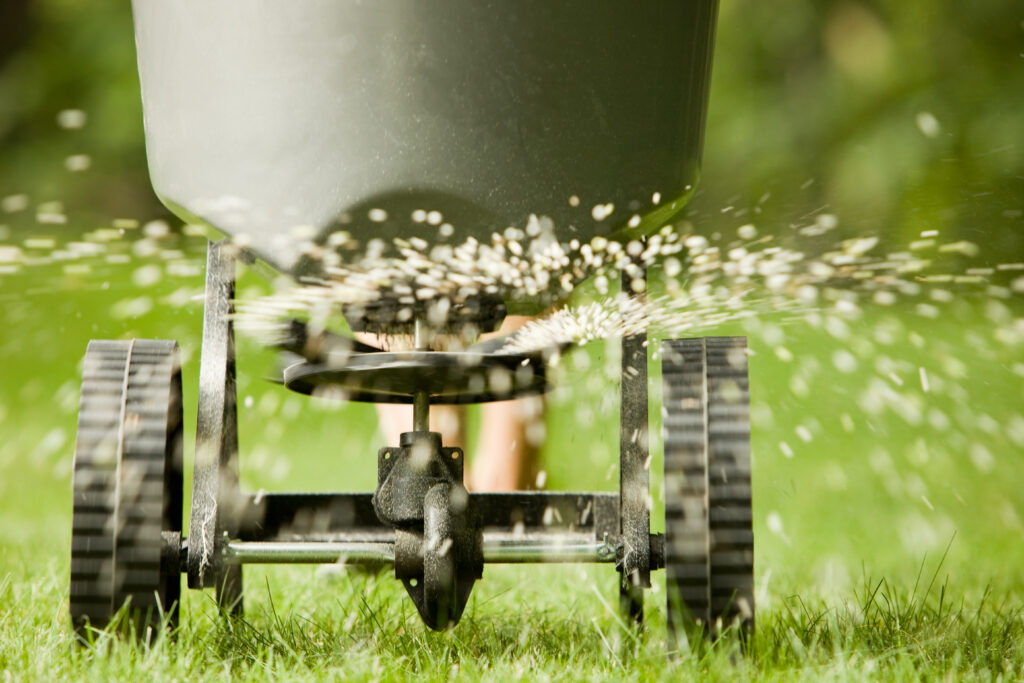
Deep root fertilization — injecting liquid fertilizer directly into the root zone under pressure — delivers nutrients precisely where trees and shrubs need them, bypassing the competition from lawn grass and delivering nutrition directly to feeder roots. This method is particularly effective for large trees and shrubs with established root systems.
Spring fertilization (April through May) supports the flush of new growth that sets the stage for the entire season. A slow-release, balanced formulation applied in early spring fuels leaf development and new shoot growth.
Fall fertilization (September through October) supports root development and carbohydrate storage heading into winter. Fall feeding improves winter hardiness and supports vigorous growth the following spring — particularly important for trees and shrubs recovering from drought stress, pest damage, or disease.
Avoid heavy nitrogen applications in late fall after plants have gone dormant, as this can push late-season growth that is vulnerable to frost damage.
Pest Management for Central and Eastern Massachusetts Trees and Shrubs
Insect pests are one of the primary threats to landscape plantings across the region, and several of the most damaging species are invasive insects with no natural predators in Massachusetts. Early identification and timely treatment are critical — many of these pests cause irreversible damage if allowed to build unchecked populations.
Winter Moth
Winter moth has become one of the most destructive pests of deciduous trees and shrubs in Eastern Massachusetts over the past two decades. The tiny caterpillars emerge in early spring — often before leaves have fully expanded — and feed aggressively on buds and new foliage of oaks, maples, apples, cherries, blueberries, and many other hosts.
Heavy infestations cause complete defoliation of affected trees. While a single defoliation rarely kills a healthy tree, repeated annual defoliation — which is common in areas with high winter moth pressure — severely weakens trees over time, making them susceptible to secondary pests and disease.
Timing is everything with winter moth control. Treatment must occur when caterpillars are small and actively feeding in early spring — typically late April to early May in Central and Eastern Massachusetts. Missing this narrow window means waiting until the following year.
Hemlock Woolly Adelgid
As described above, hemlock woolly adelgid is one of the most serious threats to landscape hemlocks in Massachusetts. The pest has a two-generation life cycle and is active primarily in fall and spring. Systemic insecticide treatments — applied as soil injections or trunk injections — provide excellent multi-year protection for valuable hemlock specimens.
Spongy Moth (Formerly Gypsy Moth)
Spongy moth caterpillars feed on the foliage of oaks, birches, and many other deciduous trees. Population cycles peak every several years, and during outbreak years, entire forests and landscapes can be completely defoliated. Preventive treatments during active outbreak periods protect high-value trees during the window when caterpillars are young and most vulnerable to treatment.
Bronze Birch Borer
Bronze birch borer targets stressed birch trees, boring into the cambium layer beneath the bark and girdling branches from the top of the tree downward. By the time visible symptoms appear — D-shaped exit holes, dying upper branches — infestations are well established. Preventive systemic insecticide treatments for birch trees showing any signs of stress are far more effective than attempting curative treatment after significant borer damage has occurred.
Viburnum Leaf Beetle
This invasive beetle skeletonizes viburnum foliage through both larval and adult feeding stages, potentially defoliating plants entirely by midsummer. Early spring treatment targeting newly hatched larvae provides the most effective control.
Scale Insects
Several scale insect species — including euonymus scale, pine needle scale, and oystershell scale — are common in Central and Eastern Massachusetts landscapes. Scale insects feed by sucking plant sap and can weaken or kill plants when populations build on stressed or unmanaged specimens. Dormant oil applications in early spring and targeted insecticide treatments during the crawler stage provide effective control.
Disease Management for Massachusetts Trees and Shrubs
Fungal diseases are the other major threat category for landscape plantings in Central and Eastern Massachusetts. The region’s humid summers create ideal conditions for many fungal pathogens to spread.
Apple Scab
Apple scab is a fungal disease that affects crabapples, apples, and related ornamentals throughout Massachusetts. It produces dark, scabby lesions on leaves and fruit, causing premature defoliation in severe years. Preventive fungicide applications beginning at bud break in spring — and continuing through the primary infection period — are the standard management approach. Planting disease-resistant crabapple varieties reduces long-term pressure significantly.
Dogwood Anthracnose
Dogwood anthracnose has devastated flowering dogwood populations across the Northeast. It produces leaf spots, twig dieback, and cankers on the main stem. Proper siting in sunny locations with good air circulation reduces disease pressure. Fungicide applications in spring during leaf expansion provide protection during the primary infection period.
Rhizosphaera Needle Cast
This fungal disease of spruce trees — particularly Colorado blue spruce — causes progressive needle loss from the inner canopy outward over multiple seasons. Affected trees eventually lose their characteristic full, dense appearance. Preventive fungicide applications timed to new needle emergence in spring halt the progression of infection. Multiple seasons of treatment are typically needed to allow full canopy recovery.
Fire Blight
Fire blight is a bacterial disease affecting apples, crabapples, pears, and related ornamentals. It causes a characteristic wilting and browning of shoot tips that gives infected branches a scorched appearance. There is no cure for active infections — management involves pruning out infected wood well below visible symptoms and preventive copper-based sprays during bloom.
Boxwood Blight
Boxwood blight has spread rapidly through Massachusetts in recent years and can devastate boxwood plantings quickly in warm, wet conditions. It produces circular leaf spots followed by rapid defoliation. Preventive fungicide programs during the growing season are essential for maintaining boxwood in high-risk landscapes.
Pruning: Getting It Right for Massachusetts Conditions
Pruning is one of the most commonly misunderstood aspects of tree and shrub care. Done correctly and at the right time, it improves plant structure, promotes flowering, and removes diseased or damaged wood. Done incorrectly, it creates wounds that invite disease and insects, removes the flower buds that homeowners are waiting to enjoy, and permanently disfigures plants.
Timing Guidelines
Spring-flowering shrubs — forsythia, lilac, rhododendron, azalea, and viburnum — set their flower buds in late summer and fall. Pruning these plants in late fall, winter, or early spring removes the buds before they bloom. Prune spring bloomers immediately after flowering to shape plants while preserving next year’s buds.
Summer-flowering shrubs — including hydrangeas that bloom on new wood, butterfly bush, and rose of Sharon — can be pruned in late winter or early spring before new growth begins. Note that hydrangea pruning timing depends on the specific variety — bigleaf hydrangeas bloom on old wood and should be pruned after flowering, while panicle and smooth hydrangeas bloom on new wood and tolerate spring pruning.
Shade trees are best pruned in late winter while dormant — late February through March in Central and Eastern Massachusetts. Dormant pruning minimizes stress, allows wounds to begin closing with spring growth, and reduces the risk of certain insect and disease problems that are attracted to fresh pruning wounds in the growing season. Oak trees should specifically be pruned only during dormancy to reduce oak wilt risk.
Evergreen trees and shrubs can be lightly shaped in late spring after new growth has expanded. Avoid heavy pruning of evergreens in fall — late-season pruning stimulates tender new growth that is highly susceptible to winter damage.
What Not to Do
- Never remove more than one-third of a shrub’s total mass in a single pruning
- Avoid topping trees — removing the central leader creates wounds, destroys natural form, and leads to weak regrowth that is structurally inferior and more pest-prone
- Do not use wound sealants on pruning cuts — research consistently shows they do not help and can actually trap moisture and disease organisms
- Never prune oaks between April and July when oak wilt transmission risk is highest
Winter Protection for Massachusetts Trees and Shrubs
Central and Eastern Massachusetts winters present real challenges for landscape plantings. Proper preparation in fall and early winter reduces damage and supports faster spring recovery.
Anti-Desiccant Sprays
Broadleaf evergreens — including rhododendrons, hollies, boxwoods, and mountain laurel — lose moisture through their leaves throughout winter even when frozen. When soil moisture is locked in frozen ground and unable to replenish what is lost, foliage desiccates and browns. Anti-desiccant sprays applied in late November and again in late February create a temporary protective coating on leaf surfaces that reduces moisture loss during the critical winter period.
Salt Damage Prevention
Road salt spray and salt-laden runoff cause significant damage to trees and shrubs along streets, driveways, and sidewalks across Central and Eastern Massachusetts. Burlap screening protects vulnerable plants from direct salt spray. Salt-tolerant plant species should be selected for locations adjacent to treated surfaces. Flushing soil near roadways with water in early spring helps dilute salt concentrations before spring growth begins.
Snow and Ice Load Management
Heavy snow and ice accumulations on arborvitae, juniper, and other upright evergreens can permanently split or splay branches, destroying the plant’s form. Gently brushing snow off evergreens after significant snowfall — brushing upward rather than downward to avoid snapping branches — reduces damage. Arborvitae and columnar junipers used as privacy screens benefit from being loosely wrapped with burlap or tied with soft twine before winter to prevent splaying under snow load.
Deer Protection
Deer browsing is a significant and growing problem across Central and Eastern Massachusetts, particularly in suburban areas bordering wooded land. Arborvitae, yew, rhododendron, and many other landscape plants are highly preferred deer food sources in winter when other forage is scarce. Physical barriers, repellent sprays applied before the ground freezes and reapplied after snow events, and plant selection favoring less palatable species all contribute to effective deer management.
Seasonal Tree and Shrub Care Calendar for Central and Eastern Massachusetts
| Season | Key Tasks |
|---|---|
| Early spring (Mar – Apr) | Winter moth treatment; dormant oil for scale; pruning of shade trees before bud break; fertilization |
| Spring (Apr – May) | Apple scab and dogwood anthracnose preventive sprays; hemlock adelgid treatment; prune spring bloomers after flowering |
| Summer (Jun – Aug) | Monitor for pest activity; treat viburnum leaf beetle, lace bugs, and borers; deep root fertilization |
| Early fall (Sep – Oct) | Fall fertilization; anti-desiccant preparation; assess winter moth egg masses |
| Late fall (Nov) | Anti-desiccant application; deer repellent; arborvitae wrapping; irrigation winterization |
| Winter (Dec – Feb) | Snow removal from evergreens; monitor for deer damage; plan spring treatment program |
Common Tree and Shrub Care Mistakes Massachusetts Homeowners Make
Ignoring Problems Until They Are Severe
Trees and shrubs decline slowly. A hemlock losing needles, a birch with a thinning canopy, or a spruce with inner needle loss may look manageable for a season or two before the situation becomes critical. Early identification and treatment save plants that would otherwise require removal and replacement.
Pruning at the Wrong Time
Pruning spring-flowering shrubs in fall or early spring removes the flower buds you are waiting to enjoy. Pruning oaks in spring and summer increases oak wilt risk. Taking a few minutes to confirm the right pruning window for each plant in your landscape prevents these avoidable mistakes.
Assuming Landscape Plants Feed Themselves
Trees and shrubs in managed landscapes do not receive the natural nutrient cycling of a forest environment. Without supplemental fertilization — particularly in Massachusetts’s commonly acidic, nutrient-limited soils — most landscape plantings gradually decline in vigor and become increasingly susceptible to pests and disease.
Planting the Wrong Plant in the Wrong Place
A rhododendron planted in heavy, poorly drained soil will struggle regardless of how much care it receives. An arborvitae planted where deer browse regularly will be a constant battle. Matching plant selection to site conditions — soil type, drainage, sun exposure, deer pressure — is the most impactful decision in landscape care and one that is made at planting time.
Skipping Winter Moth Treatment
Winter moth has become widespread enough across Eastern Massachusetts that many deciduous trees in the region face annual pressure. Missing the narrow treatment window in late April to early May means accepting defoliation for the season and the cumulative weakening that repeated defoliation causes.
Professional vs. DIY Tree and Shrub Care
DIY tree and shrub care is practical for basic tasks like mulching, light shrub pruning, and monitoring for visible pest and disease problems. Many homeowners manage routine maintenance effectively with the right knowledge and timing guidance.
Best for: Homeowners with smaller landscapes, straightforward plantings, and the time and willingness to monitor conditions closely and act quickly when problems appear.
Professional tree and shrub care brings expert identification of pest and disease issues, access to commercial-grade treatment products, and equipment capable of treating large trees and applying deep root fertilization that is not practical for homeowners to replicate. It also ensures that the narrow treatment windows for pests like winter moth and hemlock woolly adelgid are never missed.
Best for: Properties with mature or high-value trees, landscapes with a history of pest or disease pressure, homeowners who want comprehensive protection without the burden of monitoring and timing multiple treatment windows throughout the season.

The Bottom Line
Trees and shrubs are the backbone of your property’s landscape — providing shade, beauty, privacy, and real estate value that lawns alone cannot replicate. Protecting that investment in Central and Eastern Massachusetts requires a proactive, seasonal approach that addresses the specific pests, diseases, and climate challenges the region presents.
Key principles to carry with you:
- Winter moth treatment in late April is one of the highest-priority tasks for Eastern Massachusetts landscapes — missing the window means accepting damage for the season
- Hemlock woolly adelgid is treatable and manageable — but only if addressed before populations build to damaging levels
- Soil pH management is as important for trees and shrubs as fertilization — acidic Massachusetts soils frequently limit nutrient availability regardless of what is applied
- Prune at the right time for each plant — wrong-season pruning removes flower buds, creates disease entry points, and can do more harm than good
- Winter protection for broadleaf evergreens and vulnerable plantings prevents damage that takes multiple seasons to recover from
When your tree and shrub care program addresses these fundamentals consistently and seasonally, your landscape becomes healthier and more resilient with every passing year.
Let Lawn Squad Protect Your Central and Eastern Massachusetts Landscape
Every property in Central and Eastern Massachusetts has a unique combination of trees, shrubs, soil conditions, and pest pressures. A care program built around your specific landscape — rather than a generic schedule — protects the plants that matter most to you and catches problems before they become expensive to solve.
Lawn Squad’s tree and shrub care services are designed specifically for the pest, disease, and climate challenges of Central and Eastern Massachusetts.
Lawn Squad tree and shrub services include:
- Deep root fertilization timed for spring and fall feeding windows
- Winter moth, hemlock woolly adelgid, and other pest treatments timed to the correct treatment windows
- Preventive and curative fungicide programs for apple scab, dogwood anthracnose, Rhizosphaera needle cast, and boxwood blight
- Anti-desiccant applications for winter protection of broadleaf evergreens
- Soil pH testing and lime recommendations for nutrient-limited landscapes
- Integrated programs combining tree and shrub care with lawn fertilization, weed control, and pest management
Your trees and shrubs deserve the same attention as your lawn — and the right care program makes all the difference.
Contact Lawn Squad today at 978-267-3440 or visit https://lawnsquad.com/contact-us/ to get your free quote and start protecting your Central and Eastern Massachusetts landscape today.