
The short answer: Fertilizing a lawn in Westchester County means working with the natural growth cycle of cool-season grasses — feeding heavily in fall when roots are building, moderately in spring when growth resumes, and carefully in summer when heat stress makes over-fertilizing a real danger. Get the timing and rates right, and your lawn becomes thicker, greener, and more resistant to weeds, disease, and drought with every passing season.
Westchester homeowners have some of the most beautiful lawns in the country — and some of the most common fertilization mistakes. Too much nitrogen in July. A single spring application and nothing else. Fertilizing on a fixed calendar without accounting for what the lawn actually needs. These habits either waste money, damage turf, or both.
The good news is that cool-season lawn fertilization in Westchester is straightforward once you understand the seasonal rhythm your grass is built around.
Quick overview:
- Fall is the most important feeding season for cool-season grasses — not spring
- Summer fertilization requires restraint — too much nitrogen during heat stress invites disease and burn
- Soil testing removes the guesswork and tells you exactly what your lawn needs before you apply anything
- Slow-release nitrogen provides steady, even feeding that promotes healthy growth without the surge-and-crash cycle of quick-release products
Keep reading to learn exactly when, what, and how much to feed your Westchester lawn for the best results year after year.
Why Fertilization in Westchester County Is Different From What You Might Expect
Most homeowners think of spring as the primary fertilization season. You see the lawn greening up, growth picks up, and the instinct is to pour on the fertilizer to push things along. In Westchester County, that instinct — while understandable — leads to one of the most common lawn care mistakes in the region.
Cool-season grasses like tall fescue, Kentucky bluegrass, and perennial ryegrass — the turf varieties that thrive in Westchester’s climate — follow a growth cycle that is essentially the opposite of what most people assume. Their peak growth and root development periods are fall and spring, not summer. Summer is actually a period of stress and semi-dormancy for cool-season turf, when high temperatures slow growth and demand more from root systems than the plants can easily supply.
Feeding heavily in summer pushes lush, weak top growth during the period when your grass is least equipped to handle it. That soft, over-fertilized growth is exactly what lawn diseases like brown patch target. It also burns easily when heat and drought stress arrive.
Fall, by contrast, is when cool-season grasses in Westchester are building root mass, storing carbohydrates, and preparing for the demands of winter and the following spring growing season. A well-timed fall fertilization program does more for a Westchester lawn than any other single investment — producing deeper roots, better winter hardiness, earlier spring green-up, and improved resistance to weeds and disease throughout the year.
Understanding this cycle is the foundation of effective fertilization in Westchester County.
Know Your Grass Before You Fertilize
Westchester County lawns are almost exclusively cool-season turf, but the specific mix matters for fertilization decisions.
Tall fescue is the most common grass type across Westchester. It is a bunch-type grass that grows in clumps rather than spreading via stolons or rhizomes. Tall fescue has deep roots and moderate drought tolerance, responds well to fall fertilization, and benefits from annual overseeding since it does not fill in bare spots on its own.
Kentucky bluegrass produces a dense, fine-textured, dark green lawn that many Westchester homeowners prize. It spreads through underground rhizomes and repairs itself over time. Kentucky bluegrass has higher nitrogen requirements than tall fescue and responds beautifully to a consistent fall feeding program.
Perennial ryegrass establishes quickly and is often mixed with Kentucky bluegrass and fine fescues. It has moderate fertility needs and benefits from the same fall-focused fertilization approach as the other cool-season grasses.
Fine fescues (creeping red, chewings, and hard fescue) are the most low-maintenance of the cool-season grasses. They require less nitrogen than Kentucky bluegrass and tall fescue and can actually be harmed by over-fertilization. Lawns with significant fine fescue content should use lighter nitrogen rates than a pure Kentucky bluegrass lawn.
If you are unsure what grass types are in your lawn, a local lawn care professional can identify them during a site visit — and that identification should inform your fertilization approach.
Start With a Soil Test
Before applying any fertilizer, a soil test tells you what your lawn actually needs — and what it does not. Applying nutrients your soil already has in abundance wastes money and can create nutrient imbalances that harm rather than help your turf.
A soil test measures:
- pH: The single most important soil characteristic for nutrient availability. Most cool-season grasses in Westchester perform best at a pH between 6.0 and 7.0. Westchester soils tend toward acidity, and a pH that is too low prevents grass from absorbing nutrients even when they are present in adequate amounts.
- Phosphorus: Critical for root development and establishment. Many established Westchester lawns have adequate phosphorus, making additional applications unnecessary — and potentially problematic for local waterways.
- Potassium: Supports stress tolerance, disease resistance, and winter hardiness. Often deficient in Westchester soils, particularly after years of nitrogen-only fertilization programs.
- Organic matter: Indicates soil biology health and water-holding capacity.
Westchester County’s soils vary considerably — from the thin, rocky soils on hillsides in northern Westchester to heavier clay soils closer to the Sound shore communities. A soil test accounts for your specific conditions rather than applying a generic program.
Lime applications are one of the most impactful and most overlooked aspects of Westchester lawn care. Acidic soil is extremely common across the county, and no amount of fertilizer will produce a healthy lawn if pH is too low. If your soil test indicates a pH below 6.0, lime application should be your first priority — typically in fall, applied at the same time as aeration.
The Westchester County Lawn Fertilization Calendar
Early Spring — Late March to April
As soil temperatures climb above 50°F and your lawn breaks dormancy, a light, early-season fertilization helps support the flush of spring growth and recovery from winter stress. This is not the time for a heavy nitrogen application — it is a moderate feeding to get the season started.
Use a balanced fertilizer with a modest nitrogen rate. Slow-release formulations are preferable at this time of year because they feed gradually through the erratic temperature swings of a Westchester spring rather than pushing a sudden surge of growth.
If your soil test indicated a need for lime, early spring is a good secondary application window if fall application was not possible.
What to avoid: Heavy nitrogen applications in early spring push excessive top growth before root systems have fully recovered from winter. This lush, shallow growth is vulnerable to late frosts, disease, and the summer stress that follows.
Late Spring — May to Early June
A second spring application in May provides sustained nutrition through the remainder of the spring growing period. Potassium applied at this time supports stress tolerance heading into summer — think of it as fortifying your lawn before the difficult season ahead rather than pushing more top growth.
This is also the time to address any remaining bare or thin spots with overseeding if it was not completed in fall, understanding that germination success is lower in late spring than fall and that pre-emergent applications must be coordinated carefully.
What to avoid: Do not apply high-nitrogen fertilizer after late May. As soil temperatures climb toward summer levels, cool-season grasses begin slowing their growth and preparing for heat stress. Pushing nitrogen into this transition accelerates the problems summer brings.
Summer — June through August
Summer is the season for restraint in Westchester lawn fertilization. Cool-season grasses are not actively building roots or storing carbohydrates during summer — they are conserving energy and managing stress. Applying significant nitrogen during this period pushes soft, disease-susceptible top growth the plant is not equipped to support.
If your lawn is reasonably healthy and properly fertilized in spring and fall, it does not need significant summer feeding. A light application of a low-nitrogen, high-potassium fertilizer in early June can support stress tolerance — but heavy nitrogen should be avoided from late June through August.
If your lawn goes partially dormant during a hot, dry Westchester summer, that is normal and healthy. Do not try to push it out of dormancy with fertilizer. Allow it to rest and resume feeding in early fall when conditions improve.
What to avoid: Any high-nitrogen application during heat stress periods. This is the most common summer fertilization mistake in Westchester and a primary driver of brown patch outbreaks.
Early Fall — September
September is the beginning of the most important fertilization window of the year for Westchester lawns. Soil temperatures are still warm enough for active root growth, air temperatures are cooling toward the range cool-season grasses prefer, and rainfall is generally more reliable than summer.
An early fall application with a balanced fertilizer that includes meaningful nitrogen drives the flush of fall growth that thickens turf density, fills in summer-stressed areas, and sets the stage for a strong root-building period through October and November. This feeding also supports overseeding — the ideal time for which is early to mid-September in Westchester County.
If you are overseeding, apply starter fertilizer with higher phosphorus content to support new seedling root development rather than standard lawn fertilizer.
Late Fall — October to Mid-November
The late fall feeding — sometimes called “winterizer” fertilization — is the single most impactful application of the entire year for cool-season lawns in Westchester. Applied when top growth has slowed but roots are still active, this feeding is absorbed and stored by the plant through the root system rather than driving visible leaf growth.
The carbohydrates and nutrients stored from a late fall feeding:
- Fuel early spring green-up weeks before the first spring fertilization can take effect
- Improve winter hardiness and cold tolerance
- Support root development through late fall and into early winter
- Build the turf density that crowds out weeds the following season
Use a fertilizer with higher potassium content in addition to nitrogen for this application. Potassium is critical for winter hardiness and stress tolerance in cool-season grasses.
Timing matters: Apply before the ground freezes but after top growth has largely stopped for the season — typically mid-October through mid-November in Westchester County. Applying too early pushes late-season top growth that is vulnerable to early frost damage. Applying after the ground freezes means nutrients sit on the surface and risk runoff rather than being absorbed by roots.
Understanding Fertilizer Labels and Choosing the Right Product
Every fertilizer bag displays three numbers — the N-P-K ratio — representing the percentage of nitrogen, phosphorus, and potassium in the product.
- Nitrogen (N): Drives leaf growth, color, and density. The primary nutrient for most established lawns.
- Phosphorus (P): Supports root development and establishment. Less critical for established lawns; important for new seeding.
- Potassium (K): Builds stress tolerance, disease resistance, and winter hardiness. Often underemphasized in lawn fertilization programs.
A product labeled 28-0-6, for example, contains 28% nitrogen, 0% phosphorus, and 6% potassium. A winterizer product might be labeled 24-0-12, with a higher potassium ratio appropriate for late fall application.
Slow-Release vs. Quick-Release Nitrogen
Quick-release nitrogen (water-soluble urea and similar forms) produces rapid greening but a shorter period of feeding. It carries higher burn risk in summer heat and pushes a surge of growth rather than steady improvement.
Slow-release nitrogen (polymer-coated urea, methylene urea, and natural organic forms) feeds gradually over six to twelve weeks, producing even growth, reduced burn risk, and more efficient nutrient use. Slow-release products cost more per bag but typically require less frequent application and produce better results with less risk.
For most Westchester lawns, a fertilizer with at least 30 to 50 percent slow-release nitrogen is the right choice for the majority of applications. Quick-release products have a role in early spring when you want a faster response after winter dormancy, but slow-release formulations are generally superior for summer-adjacent and fall applications.
Organic vs. Synthetic Fertilizers
Organic fertilizers — derived from natural sources like feather meal, bone meal, and composted poultry products — release nutrients slowly as soil microbes break them down. They improve soil biology over time and carry virtually no burn risk. Their lower nutrient concentrations mean you need more product to achieve the same feeding rate, and they are generally more expensive per pound of actual nutrient.
Synthetic fertilizers provide precise, concentrated nutrition and are highly effective when applied correctly. They do not inherently improve soil biology but can be combined with organic matter amendments to address both fertility and soil health simultaneously.
Many professional lawn care programs use a blend approach — combining the consistency and precision of synthetic fertilizers with organic components that support long-term soil health.
How Fertilization Connects to the Rest of Your Lawn Care Program
Fertilization does not work in isolation. Its effectiveness is directly tied to the other practices that support or undermine it.
Soil pH and lime: Fertilizer applied to soil with a pH below 6.0 is significantly less available to grass roots. Lime applied to correct pH unlocks nutrients already in the soil and dramatically improves fertilizer efficiency. In Westchester’s commonly acidic soils, regular pH monitoring and lime application are as important as the fertilizer program itself.
Aeration: Core aeration in fall creates channels that move nutrients directly into the root zone rather than leaving them at the soil surface. Fertilizing immediately after fall aeration is one of the most effective practices in the Westchester lawn care calendar.
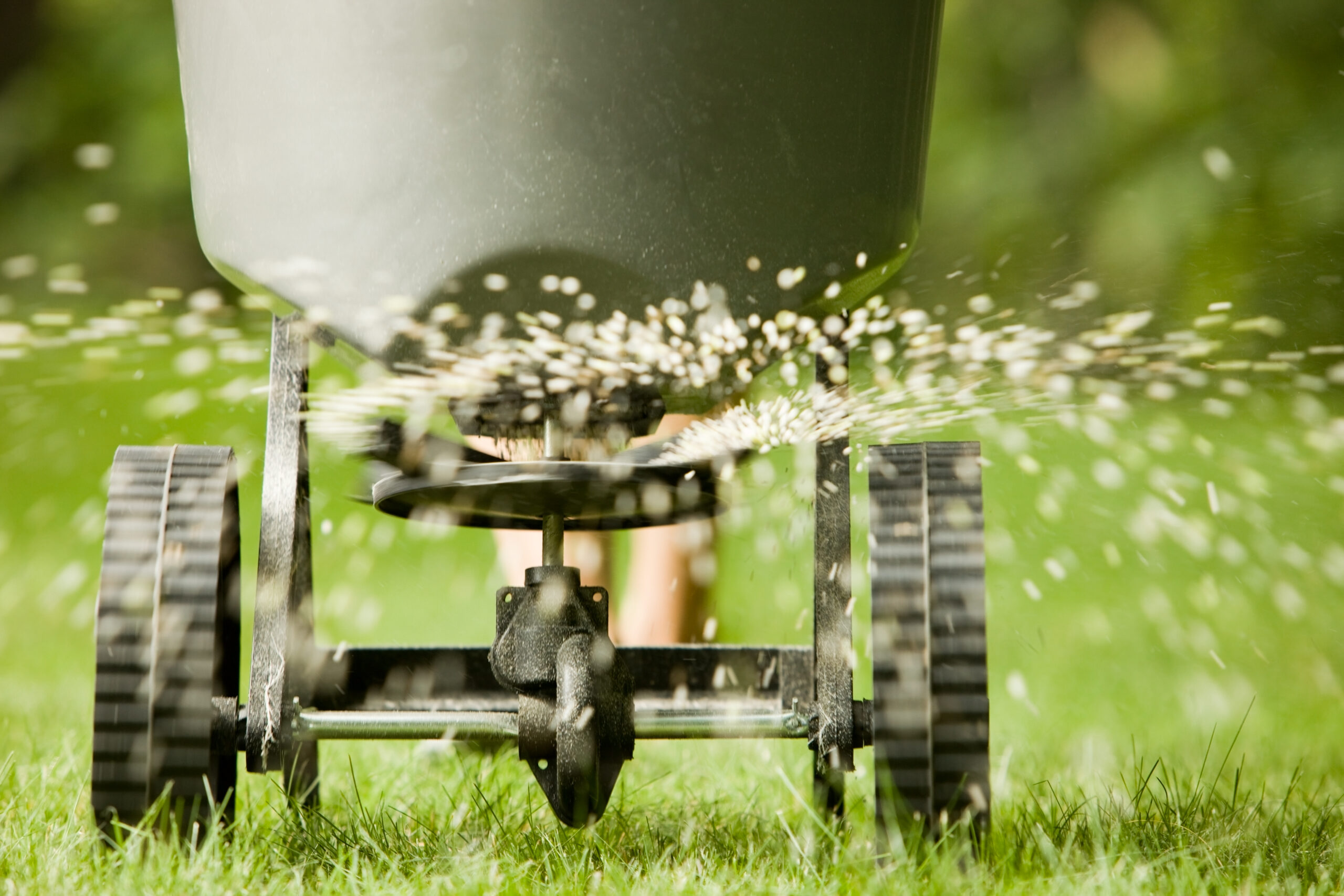
Irrigation: Fertilizer needs water to dissolve and move into the root zone. A light quarter-inch of irrigation after granular fertilizer application activates the product without washing it away. Drought-stressed turf also absorbs nutrients less efficiently — maintaining adequate soil moisture supports fertilizer uptake.
Mowing height: Grass mowed at the correct height (3.5 to 4 inches for tall fescue; 2.5 to 3.5 inches for Kentucky bluegrass) develops a larger leaf surface area that produces more energy through photosynthesis. Well-fed, properly mowed turf uses fertilizer more efficiently than stressed, scalped grass.
Weed control: Weeds compete directly for the nutrients you apply. A well-timed pre-emergent program combined with post-emergent broadleaf weed control ensures that fertilizer feeds your grass — not the weeds growing alongside it.
Common Fertilization Mistakes Westchester Homeowners Make
Fertilizing Heavily in Summer
Applying significant nitrogen during July and August pushes disease-susceptible soft growth during the period when cool-season grasses are least equipped to handle it. Brown patch outbreaks, fertilizer burn, and accelerated thatch buildup are the common results. Save the heavy feeding for fall.
Skipping the Late Fall Winterizer Application
Many homeowners wind down their lawn care calendar after Labor Day. The late October to mid-November fertilization is the most impactful application of the year — skipping it sacrifices the early spring green-up, winter hardiness, and root development that make spring lawn care dramatically easier.
Ignoring Soil pH
Applying premium fertilizer to acidic soil is like watering a plant through a screen — much of what you apply never reaches the grass. A soil test every two to three years and regular lime applications where needed make every other input in your program more effective.
Using Only Nitrogen and Ignoring Potassium
Many homeowners focus exclusively on nitrogen because it drives the visible green color and growth they want to see. Potassium — the third number on the fertilizer bag — is equally important for the stress tolerance, disease resistance, and winter hardiness that keep a Westchester lawn looking good through challenging conditions. A balanced program addresses all three macronutrients.
Applying Too Much Too Fast
More fertilizer is not better. Overapplication pushes excessive thatch buildup, increases disease susceptibility, and risks burning turf — especially with quick-release products during warm weather. Follow label rates and resist the urge to double up for faster results.
Fertilizing Before Rain or Irrigation and Then Getting Flooded
A light watering after granular fertilizer application is beneficial. A heavy rainstorm immediately after application washes soluble nutrients off the lawn and into storm drains before the grass can use them. Check the forecast before fertilizing and avoid applications immediately ahead of significant rain events.
Westchester County Fertilization Quick-Reference Calendar
| Timing | Application Focus | Key Nutrients |
|---|---|---|
| Late March – April | Light spring starter feeding | Moderate N, slow-release |
| May – early June | Late spring feeding; stress prep | Balanced N-K |
| Early June (optional) | Light summer stress support | Low N, higher K |
| September | Early fall feeding; overseed support | Balanced N-P-K or starter |
| October – mid November | Winterizer — most critical application | Higher N and K, slow-release |
| Fall (as needed) | Lime application | Correct pH to 6.0–7.0 |
The Bottom Line
Fertilizing a Westchester County lawn well is not about applying the most product — it is about applying the right nutrients at the right time in the right form for cool-season grasses that follow a very specific seasonal rhythm.
Key principles to carry with you:
- Fall is your most important fertilization season — not spring
- Avoid heavy nitrogen applications from late June through August
- Soil pH determines how well your fertilizer actually works — test it and address acidity with lime
- Slow-release nitrogen produces better, safer results than quick-release for most applications
- Potassium is as important as nitrogen for stress tolerance and winter hardiness
- Aerate before fall fertilization to drive nutrients directly into the root zone
When your fertilization program aligns with how cool-season grasses actually grow and store energy, the results compound season after season — producing a thicker, greener, more resilient lawn with every year that passes.
Let Lawn Squad Build the Right Fertilization Program for Your Westchester Lawn
Every lawn in Westchester County has its own soil chemistry, grass composition, and history. A fertilization program built around your lawn’s actual needs — informed by soil testing and adjusted for local conditions — outperforms any generic off-the-shelf approach.
Lawn Squad technicians assess your lawn’s specific fertility needs, test soil pH, and build a program timed precisely to Westchester County’s growing season — so every application works as hard as possible.
Lawn Squad programs include:
- Soil testing to guide fertilization decisions and identify pH correction needs
- Multiple fertilizer applications timed to Westchester’s cool-season grass calendar
- Slow-release nitrogen formulations for steady, even feeding with minimal burn risk
- Lime applications to correct soil acidity and unlock nutrients already in your soil
- Integrated programs that combine fertilization with weed control, aeration, and overseeding for maximum turf density
Stop guessing at what your lawn needs and start feeding it with precision.
Contact Lawn Squad today at 914-581-9014 or visit https://lawnsquad.com/contact-us/ to get your free quote and build a healthier, greener Westchester lawn from the ground up.