
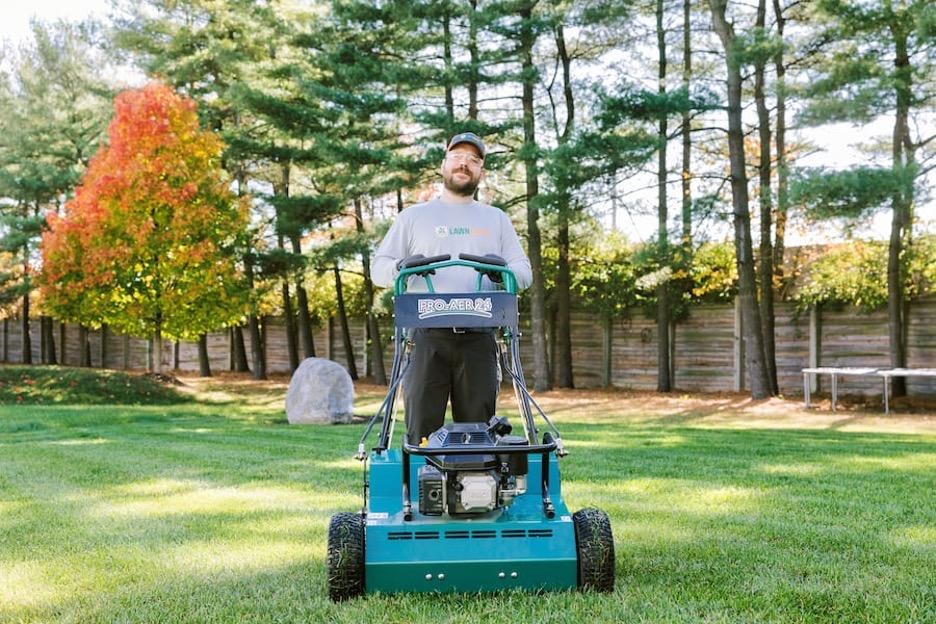
How Much Does Fall Lawn Aeration Cost in Aurora, IL?
Short Answer: Fall core aeration around Aurora generally runs somewhere between $125 and $300 for a typical residential lot, with most quotes landing in the middle of that range. The number moves with measured turf square footage, how many beds, trees, and fence gates a technician has to navigate, and whether the machine has to be carried through a narrow side gate. Bundling overseeding with the aeration usually brings the total into the $300 to $550 range, because quality cool season seed is a genuine material cost. Nearly every reputable company prices from measured lawn size rather than by the hour, so the most accurate figure comes from a quote on your actual property.
If you are reading this, you are probably standing in a yard that looked fine in June and looks tired now. Maybe the grass thinned along the walkway. Maybe water puddles in the same low spot every time it rains instead of soaking in. Somebody mentioned aeration, you looked it up, and the first thing you wanted to know was the one thing most lawn care websites will not tell you plainly. What does it cost?
That is a fair question and it deserves a real answer rather than a form to fill out. We talk with a lot of homeowners across Aurora and the surrounding Fox Valley every fall, and the ones who feel best about their decision understood the pricing before anybody showed up in a truck. So here is how aeration is actually priced, and how to tell whether the number in front of you is reasonable.
What You Are Actually Paying For
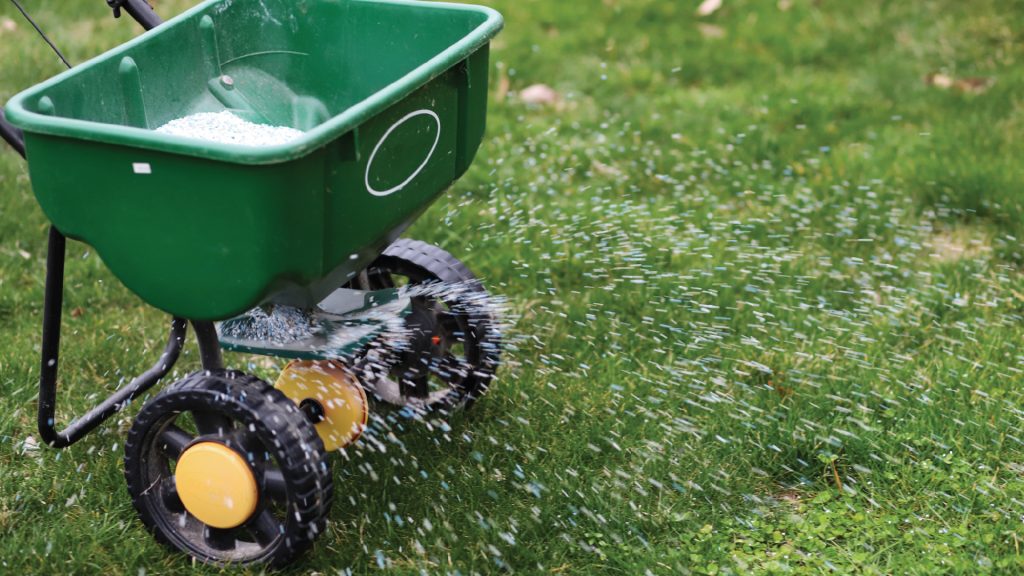
Core aeration is a machine pulling thousands of small plugs of soil out of your lawn and dropping them on the surface. Those plugs are usually about half an inch across and two to three inches deep, and the holes they leave behind are the whole point. Air, water, and fertilizer move straight down into the root zone instead of running across a compacted surface. Roots grow into the open channels. The plugs break down over a couple of weeks and return soil microbes to the thatch layer, where they help decompose it naturally.
So the price is covering a commercial aerator that weighs several hundred pounds, the fuel and wear that comes with running it, the labor to walk it across every square foot of turf, and the experience to know which direction to run passes and how many to make. It is a short visit on the calendar and a heavy one in terms of equipment.
The Ranges We See Around Aurora
For a standard residential lot in our area, aeration alone commonly falls between $125 and $300. Smaller in town lots tend toward the low end. Larger properties on the west and far east sides of Aurora, and homes on half acre and larger parcels toward the edges of Kane County, climb from there. Very large properties are often quoted per thousand square feet rather than as a flat number.
When overseeding is added, the total typically runs $300 to $550 for the same range of properties. That jump is not markup. Good cool season seed blends built for northern Illinois, meaning quality Kentucky bluegrass, perennial ryegrass, and turf type tall fescue, cost real money per pound, and a proper overseed rate is not a light dusting. A company quoting overseeding far below that range is usually either seeding thin or using a cheap blend heavy on annual ryegrass, which looks great for eight weeks and then dies.
The honest caveat is that these are ranges, not a price list. Two homes on the same street can differ by a hundred dollars because one has an open rectangle of turf and the other has four island beds, a swing set, and a dog run.
What Pushes an Aurora Quote Up or Down
Measured square footage is the biggest factor, and reputable companies measure rather than eyeball. After that it comes down to how hard the property is to move a machine across. A gate narrower than 36 inches means the aerator has to be tipped and muscled through, and that is labor. Steep slopes, retaining walls, and curved island beds all slow the work down.
Utility marking matters too. Irrigation heads, invisible dog fence wire, and shallow lighting cable are all things a two and a half inch tine will find. A good crew asks about these before starting and works around flagged areas, and properties with a lot of buried infrastructure take longer.
Why Aurora Soil Makes This Worth the Money
Most of the Fox Valley sits on heavy clay left behind by glaciers, and a lot of our subdivisions have an extra complication. When homes are built, topsoil gets scraped away, heavy equipment packs the subsoil down for months, and then a few inches of new soil and sod go down on top of that compacted layer. The lawn looks finished on day one. Underneath, roots hit a hard pan and stop.
Clay compacts more easily than sandy soil and holds that compaction longer. Add years of mowing, kids, dogs, and winter freeze and thaw cycles, and the pore space roots need keeps shrinking. That is the mechanism behind the symptoms homeowners describe to us most often. Water running off instead of soaking in. Grass that browns first in the same spots every August. A lawn that responds less and less to the same fertilizer that used to work. In sandy soil, skipping a year is not a big deal. Here it compounds.
Core Aeration Versus the Cheaper Alternatives
You will see liquid aeration advertised at a lower price, often under a hundred dollars. These are soil conditioning products, usually surfactant based, that help water penetrate and can loosen soil chemistry modestly over time. They are not nothing. They are also not a substitute for physically removing soil cores from compacted clay. We would rather you know that before spending the money than feel misled in April.
Spike aeration, whether from rented shoes or a tow behind roller, is the option we steer people away from. Spikes do not remove anything. They push soil sideways, which compresses the walls of each hole further. On clay that can leave you slightly worse off than before.
Renting a core aerator yourself is legitimate. A weekend rental typically runs $90 to $150 plus fuel, plus a way to haul several hundred pounds, plus a Saturday. Many homeowners run those numbers and decide the difference is not worth the weekend.
Where the Money Gets Wasted
Aeration is a poor investment in a few specific situations, and we would rather say so than sell a service that will not perform. Aerating a lawn that is more weed than grass mostly gives weed seed a better seedbed. In that case a fall broadleaf application first, then aeration and overseeding the following season, produces a better result for the same total spend.
Timing is the other place money disappears. Aeration done in the heat of July stresses cool season turf right when it is least able to recover. Done too late, after soil temperatures drop and growth stops, the holes simply sit open through winter. In our area the productive window runs from roughly late August through mid October, when soil is still warm enough for root growth and the grass is actively recovering.
The third waste is aerating without feeding, which is why aeration and a fall fertilizer application are usually scheduled close together.
Is Overseeding Worth the Extra Cost
For most Aurora lawns, yes, and the reason is biological rather than promotional. Kentucky bluegrass, which makes up much of the sod installed in our subdivisions, spreads by underground rhizomes and can fill small gaps on its own. Perennial ryegrass and tall fescue grow in bunches and cannot. As those plants age out or thin from summer stress, nothing moves in to replace them except weeds.
Overseeding right after aeration puts seed into open holes where it contacts soil, stays moist, and has a real chance of germinating. Seed broadcast onto an unaerated lawn mostly sits on thatch and feeds birds. The extra cost buys you the difference between seed that establishes and seed that does not.
Most homeowners we talk to are surprised that the payoff shows up the following April rather than in three weeks. Seedlings spend fall building roots, and the thicker, more uniform lawn arrives in spring.
What to Do Next
Start by walking your own lawn with a screwdriver. Push it into the soil in a few places when the ground is neither bone dry nor soaked. If it slides in with light pressure, compaction probably is not your limiting factor this year. If you have to lean on it, that is your answer, and it is the same field test we use.
When you request a quote, ask three things. Ask whether the price is based on measured square footage. Ask what seed blend is being used if overseeding is included, and what the application rate is. Ask how the crew handles irrigation heads and pet fence wire. Companies that answer those clearly are generally the ones that do the work carefully.
Here is what to expect from the visit itself. It usually takes under an hour on an average lot. The lawn will look rough for a week or two with plugs scattered across it, and leaving those plugs to break down naturally is correct rather than lazy. If you overseeded, light and frequent watering for the first two to three weeks matters more than anything else you do.
If you would rather have someone else handle the timing, the measuring, the seed selection, and the machine work for your Aurora lawn, we are here for that. Visit lawnsquad.com to find Lawn Squad of Aurora and request a free quote on your property. Our VitaminLawn program is built around the grass types, clay soils, and weather patterns we actually deal with here in the Fox Valley.