
Short Answer: When a Northern Kentucky lawn turns brown in July, the cause is almost always one of three things: heat dormancy (the plant shutting down on purpose), fungal disease (brown patch, dollar spot, or summer patch riding the Ohio River Valley humidity), or drought stress (the soil is dry, not the air). Walk the lawn at 7 a.m. with a screwdriver and a hand lens. Heat dormancy is uniform, tan, and crunchy with a firm crown. Drought shows footprints that hold for hours and a bluish gray cast before the tan. Disease shows defined patches, blade lesions, and morning mycelium. The fix is different for each, and guessing wrong in July on a Boone, Kenton, or Campbell county lawn can cost you the rest of the summer.
By the second week of July, the phone at our shop starts ringing with the same sentence. “My lawn was fine on Sunday and now it looks terrible.” The caller usually lives in Florence, Union, Burlington, Independence, Erlanger, Edgewood, Fort Mitchell, Crestview Hills, Crescent Springs, Park Hills, Newport, Bellevue, Dayton KY, or Fort Thomas. The lawn is some mix of Kentucky Bluegrass, Tall Fescue, and a little Perennial Rye, sitting on the limestone-influenced clay that defines Boone, Kenton, and Campbell counties. And the brown they see could be three completely different things.
This is a diagnostic walkthrough. We will show you how to tell heat dormancy from disease from drought without a microscope, then point you at the right fix for each.
Why July Looks the Way It Does in Northern Kentucky
Northern Kentucky sits in the cool-season transition zone, but the Ohio River Valley pushes us closer to a humid subtropical July than most of the cool-season belt. Air temperatures in the high 80s and low 90s are normal. Dew points crawl into the low 70s. Soil temperatures cross 80 degrees at the four-inch depth, past the threshold where Kentucky Bluegrass roots stop growing entirely. Tall Fescue tolerates the heat better but still slows meaningfully.
The river-valley fog is the part that catches people off guard. Properties in Bellevue, Dayton KY, Newport, and the riverfront stretches of Fort Thomas see morning fog that holds leaf wetness three to five hours longer than ridge properties in Union or Crestview Hills. That extra leaf wetness window is exactly what brown patch and dollar spot fungi need to germinate.
Add the limestone-influenced clay. NKY soils run naturally higher in calcium and pH than typical Mid-Atlantic transition zone soil. That higher pH locks up iron and some micronutrients, showing as a pale, hungry-looking lawn that is not actually nitrogen deficient. Knowing the soil chemistry matters when you read what brown means in July.
Step One: The 7 A.M. Walk
The best diagnostic time in July is the first hour after sunrise. Three things happen at that hour you cannot see at 11 a.m. Dew is still on the blades, mycelium (the white cobweb-like growth of active fungus) is still visible, and soil temperature has dropped enough overnight that any live root system has had a chance to pull water up.
Walk slowly. Note where the brown is. Uniform across the lawn or patchy? Circular and defined or irregular and gradient? Does the brown follow the slope, or ignore it? Are south or west exposures worse? Each answer narrows the diagnosis. Carry a long flat-blade screwdriver for the moisture test and your phone for dew-time photos.
Step Two: Heat Dormancy or Not
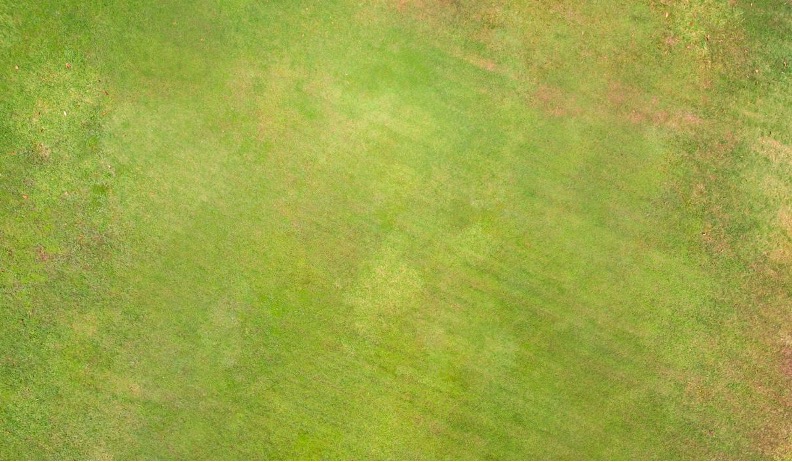
Heat dormancy is the plant shutting itself down to survive. Kentucky Bluegrass is famous for it. The blades brown off, the crown stays alive, and when temperatures and moisture return the plant pushes new growth from the crown within two to three weeks. It is the natural cycle, not an injury.
The tells for heat dormancy on an NKY lawn:
- The brown is uniform across large areas, not in defined patches. Whole sections look tan together.
- The crown at soil level is still firm and pale green or white when you pull a tuft and look at the base. Dead crowns are dark and mushy.
- The pattern matches the sun. South and west exposures dormant first, north exposures and shade still greener.
- No blade lesions, no mycelium, no smoke ring.
- The lawn was not recently scalped, fertilized heavy, or sprayed when it went tan.
If you see uniform tan, firm crowns, and a sun-driven pattern, that is heat dormancy. The fix is not to fix it. Mow high, hold the fertilizer, and water just enough to keep the crowns alive (about a half inch every two weeks). Pushing dormant Bluegrass with fertilizer in late July is one of the fastest ways to lose the lawn entirely.
Step Three: Drought Stress vs Dormancy
Drought stress and heat dormancy look similar at a glance but feel different to a screwdriver. Drought stress is the plant running out of water in the root zone. The lawn shows a sequence: first a bluish gray cast (the blades lose their fresh green and look dusty), then footprints that stay pressed for hours where you walked, then the tan color sets in.
Test it. Push the long screwdriver six inches into the soil in a brown area. If it goes in smoothly past four inches with moderate pressure, you have moisture in the root zone and the brown is not drought. If it stops at one or two inches and fights you, the soil is dry and dense, and drought is the likely driver.
The other tell is the slope and exposure pattern. Drought-driven brown follows the high ground and the south and west sides. Heat dormancy can do the same, but drought tends to show the footprint test and the bluish gray cast first, while dormancy goes straight to crunchy tan.
The fix for drought stress is one inch of water in a single deep cycle, applied between 4 and 8 a.m., then a week to watch. Do not chase it with daily light watering. That is how you train roots to stay shallow and make next month worse.
Step Four: Disease
July is peak disease season in Northern Kentucky. Three fungi do most of the damage on residential cool-season lawns here.
Brown patch (Rhizoctonia solani) is the big one on Tall Fescue. It shows as irregular patches six inches to several feet across, often with a dark smoke ring of mycelium around the edge in the first hour of morning. Within the patch, individual blades show tan lesions with thin dark borders, often near the leaf tip. The grass inside the patch lays down rather than standing up. Brown patch peaks in late July when nighttime lows stay above 68 and humidity holds high overnight. The river-fog properties along the Ohio see brown patch ten days to two weeks earlier than the ridge properties further south.
Dollar spot (Clarireedia jacksonii) shows up as silver-dollar to softball-sized bleached circles, often coalescing into larger patches. Look at individual blades through a hand lens for the signature hourglass-shaped lesion with a reddish-brown border. Dollar spot likes the Kentucky Bluegrass portion of an NKY lawn and shows up on heavy dew mornings when leaf wetness has held all night.
Summer patch (Magnaporthiopsis poae) is the one we see on older established Kentucky Bluegrass lawns, particularly in subdivisions that were sodded ten or more years ago and have been mowed short for years. It shows as frog-eye rings six inches to two feet across, with sunken centers where the grass dies completely and an outer ring of darker, struggling grass. Summer patch is a root and crown disease, not a leaf disease, so you will not see blade lesions. The damage is below ground.
The cultural side of disease management is the same regardless of which fungus: stop evening watering, raise the mowing height to 3.5 to 4 inches, sharpen the mower blade, and hold off on quick-release nitrogen. If pressure is heavy and the lawn is worth protecting, propiconazole or azoxystrobin are commonly labeled fungicides for the homeowner products available locally. Summer patch needs a preventive program starting in late spring, so by the time you see it in July you are managing for next year more than this year.
Step Five: When Two Things Are Happening at Once
It is common in NKY for a lawn to show heat dormancy on sun-baked ridges and brown patch in the shadier, fog-pocket low spots on the same property. The diagnosis is not always one answer. Walk the whole lawn and tag each area separately.
The big mistake on mixed-cause lawns is the homeowner who waters heavy because the front looks dry, tipping the shaded back lawn into a brown patch outbreak. Read each section before setting the irrigation.
FAQ
Will my Bluegrass come back from heat dormancy on its own? Yes, in almost every case. Once nighttime lows drop below 65 and the lawn gets an inch of rainfall, green pushes from the crowns within two to three weeks. The exception is dormant lawns scalped or driven on hard during dormancy, which can kill the crown outright.
Is it too late to fix brown patch I see in mid-July? No. Cultural changes made in the first ten days of seeing brown patch usually stop the spread. The damage already done fills in with the fall recovery cycle if crowns are alive.
Does NKY limestone soil make disease worse? Not directly, but the higher pH affects how some fungicides and iron applications behave. A real soil test from the Boone County Extension lab is worth more than a guess.
What to Do Next
If you would rather not spend July mornings with a screwdriver and a hand lens trying to tell three different problems apart, we can do the walk for you. Our crews diagnose the lawn, separate the dormant areas from the diseased areas from the drought areas, and put the right response on each.
Lawn Squad of Northern KY serves homeowners across Florence, Union, Burlington, Independence, Erlanger, Edgewood, Fort Mitchell, Crestview Hills, Crescent Springs, Park Hills, Newport, Bellevue, Dayton KY, Fort Thomas, and the surrounding Boone, Kenton, and Campbell county communities.
Call us at 859-222-7335 or request a free quote at lawnsquad.com. Our VitaminLawn program is built specifically for Northern Kentucky cool-season Bluegrass and Fescue lawns growing on Ohio Valley limestone clay, with the disease and pest watch tuned to the river-valley humidity and the soil chemistry that defines this region. July is when the right diagnosis decides whether August is a recovery month or a rescue mission.