Short Answer: Brown or off-color areas on a Knoxville lawn in July almost always trace back to one of three causes: heat dormancy (Fescue going into protective shutdown), fungal disease (brown patch on Fescue, large patch on Zoysia), or drought stress on shallow rocky soil. Heat dormancy spreads evenly across sunny Fescue areas and recovers when temperatures cool. Disease shows circles, rings, and active edges in humid weather. Drought follows the shape of slopes and high spots and recovers within 10 days of deep watering. Many East Tennessee yards have Fescue and Zoysia side by side, which means two grasses with two different problem profiles in the same yard.
July is when Knoxville lawns stop hiding their problems. Afternoon highs sit between 88 and 92 most days, and overnight lows are not dropping below 70. If your lawn was going to struggle this year, July is when it tells you. The question is what is causing the browning and what, if anything, you should do about it.
Most homeowners in our service area, from Knoxville and Farragut through Hardin Valley, Powell, Halls, Karns, Maryville, and out to the Sevierville edge, will see at least one suspicious area in the yard this month. The temptation is to react. We want to walk you through a slower, smarter approach. Diagnosis first, treatment second, and sometimes the right answer is to leave it alone.
Why East Tennessee Is Diagnostically Harder Than the Rest of the State
Knoxville sits in the transition zone, which sounds geographic but is really biological. North of us, cool-season grasses dominate. South of us, warm-season grasses dominate. We are the seam where both try to grow, and most yards in Knox County and the surrounding counties end up with a mix.
A typical East Tennessee property has Tall Fescue on the shaded north side, on slopes, and under trees, while the flat sunny front yard might be Bermuda or Zoysia that a previous owner installed for heat tolerance. That single property has two grasses with opposite biologies. Fescue is suffering in July because cool-season grass hates 90-degree days. Bermuda and Zoysia are thriving in the same conditions. If you treat the whole yard the same way, you make at least one side worse.
Add the elevation variation across the metro. We service properties from around 700 feet near the river up past 1,500 feet on the ridges toward Sevierville. That spread means different microclimates and different rainfall patterns thanks to the Appalachian rain shadow.
Step One: Identify Your Grass Before You Diagnose Anything
Walk the yard with a question in mind. Which grass am I looking at right now? If you do not know, here is a 30-second field check.
- Tall Fescue has wide, coarse blades with prominent veins and a slightly rough feel when you run a leaf between your fingers. It grows in clumps rather than spreading by runners.
- Bermuda has narrow blades and visible above-ground runners (stolons) that creep across the soil. It is the grass that invades flower beds.
- Zoysia has slightly wider blades than Bermuda, feels stiff, almost wiry, and forms a dense, springy carpet. It is the grass that turns straw-tan in winter but holds up to traffic in summer.
Check at least three more spots before deciding the whole property is one grass. We routinely walk Farragut yards where the front is Zoysia, the side yard is Bermuda, and the shaded back is Fescue. Three grasses, three diagnostic frameworks.
Cause One: Heat Dormancy on Fescue
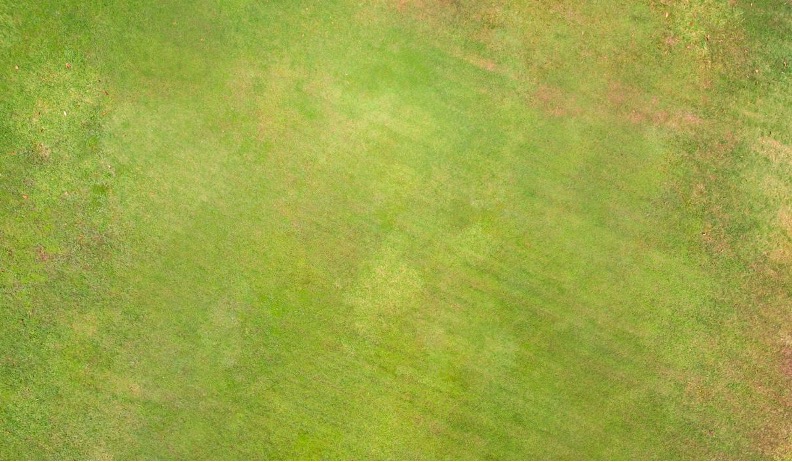
Heat dormancy is the protective shutdown that cool-season grass uses to survive temperatures it cannot tolerate. Fescue at 4 inches with a deep root system will stop growing, stop producing new blades, and let existing leaf tissue go off-color when daytime highs climb into the 90s and night lows stay above 70. The plant is alive. The crown is alive. The lawn just looks tired.
What heat dormancy looks like in Knoxville Fescue:
- Uniform pale green to tan color across sunny areas, with no defined patch edges
- Shaded areas under trees still look green by comparison
- The grass is not actively spreading damage, it is just static
- If you tug a blade, the crown stays firmly anchored and the base of the plant is still pale green inside
The fix is to leave it alone. Continue watering once a week at most, just enough to keep crowns alive (around half an inch). Do not fertilize. Do not apply herbicide. Mow only when you have to, and keep the deck at 4 inches. Heat-dormant Fescue recovers fully when nighttime temperatures drop back into the 60s in September. Trying to push it green in July is how you kill it.
Cause Two: Fungal Disease (Brown Patch and Large Patch)
Disease is the trickiest July diagnosis because we have two main fungal pathogens working on two different grasses in the same neighborhoods.
Brown patch on Fescue. Caused by Rhizoctonia solani, brown patch ramps up the moment overnight lows stay above 65 with high humidity. East Tennessee checks that box reliably from mid-June through August. The patches are 6 inches to 3 feet across, often roughly circular, and have a darker smoke ring at the leading edge that is easiest to see in early morning dew. Inside the patch, individual blades have small tan lesions with chocolate-brown borders. The damage spreads outward over days.
Large patch on Zoysia. This is the Knoxville signature problem we see more than other Tennessee markets. Also caused by Rhizoctonia, but a different strain, large patch hits Zoysia primarily in the transition months (spring greenup and fall dormancy). However, in a wet July we will see active large patch lesions on Zoysia in low-lying areas with poor drainage. The patches are larger than brown patch, often 2 to 10 feet across, with an orange or tan color and a darker outer edge. The leaves at the patch edge pull off easily when tugged because the basal rot has cut them off from the crown.
Cultural fixes for both: water in early morning only, never evening. Improve drainage in low-lying areas. Avoid summer nitrogen on Fescue. On Zoysia, the most important large patch defense is fall and spring fungicide applications, not July reaction. If you are seeing active disease that is spreading week over week, a preventive fungicide rotation will halt it through the rest of summer. We make that call yard by yard.
Cause Three: Drought Stress on Rocky Knox County Clay
Drought stress is the third diagnosis, and the one most often mistaken for the other two. The soil situation in Knoxville is unforgiving. Most of our service area sits on red clay over limestone bedrock with rocky, shallow profiles. Lawns in Hardin Valley, the Bearden ridges, parts of Farragut, and out toward Halls and Karns commonly have less than 6 inches of usable soil before roots hit rock or hardpan.
What drought damage looks like in East Tennessee:
- Browning starts on the highest points of the yard, south-facing slopes, and the strip near pavement
- The color is consistent tan-straw without the lesions or rings of disease
- Footprints stay visible after you walk across the grass, because the blades have lost turgor
- The pattern follows soil contours, not circular shapes
- Adjacent low-lying areas with deeper soil still look fine
The confirmation test: apply 1 inch of water in one or two morning cycles, then watch for 10 days. Drought patches show recovery within that window if the crowns are still alive. If a Fescue area does not recover in 10 days of proper watering, the crowns are likely dead and that area will need September overseeding.
On sloped lots, particularly in Hardin Valley and the ridges out toward the lake, water in two shorter passes 30 minutes apart so the water has time to soak in rather than run off the slope.
The Rare Causes Worth Ruling Out
Three other causes show up occasionally in July and are worth checking if the top three do not match what you see.
Armyworms. East Tennessee gets armyworm pressure more aggressively than Middle Tennessee thanks to Gulf air patterns that carry the moths up the Appalachian foothills. Armyworm damage appears suddenly, often overnight, as if a section of lawn was mown to the dirt. The caterpillars feed in groups and can wipe out hundreds of square feet in 48 hours. If you see what looks like extreme drought damage but it appeared in one day, get down on hands and knees and look for green-bodied caterpillars with stripes along their sides.
Japanese beetle adults. Adult beetles do not damage the lawn directly (their grubs do that later), but heavy numbers in your trees tell you egg-laying is happening now, which informs whether grub control needs to be on your August radar.
Equipment and chemical damage. A hot mower deck, an overlap streak from a spreader, or herbicide drift will leave brown patches that follow geometric patterns. If the shape is too clean for biology, look at what was applied recently.
The 10-Minute Walkthrough Recap
For every off-color area in the yard, ask in order: what grass is this, what shape is the patch, what was the weather the week before it appeared, and does it recover when you water deeply. Heat dormancy is uniform and static on Fescue. Disease is round, ringed, and spreading. Drought follows slope and recovers with water. Anything else is a rarer cause we can rule in with a closer look.
For owners managing rental homes on the Sevierville and Pigeon Forge corridor, the same walkthrough applies with an extra rule: if the property is unoccupied, drought is the default cause because no one is watering and no one is mowing at 4 inches.
What to Do Next
If you would rather have somebody who walks Knoxville lawns every July tell you what you are looking at, that is what we do. We diagnose, we recommend treatment only when it changes the outcome, and we tell you when the right answer is patience and water.
Lawn Squad of Knoxville serves homeowners across Knoxville Metro and East Tennessee.
Call us at 865-564-9525 or request a free quote at lawnsquad.com. Our VitaminLawn program is designed for the transition zone reality of Fescue, Bermuda, and Zoysia lawns on East Tennessee clay and rocky soils, with diagnostic experience across the elevation range from the river bottoms up to the ridge neighborhoods on the Sevierville edge.