

Late-Season Fertilization at Elevation: Timing a Winterizer for Utah County Lawns
Late-Season Fertilization at Elevation: Timing a Winterizer for Utah County Lawns
Short Answer: Utah County lawns, mostly Kentucky bluegrass, benefit from a late-season feeding just like lawns back east, but elevation and a dry climate shift the timing earlier. Cold nights arrive sooner along the Wasatch Front, and bench neighborhoods often freeze before the valley floor. Here is what we have found works best: apply a nitrogen-focused winterizer from late October into mid November, once mowing slows but the grass is still green and the ground is not frozen. Because secondary irrigation is usually off by then, plan to time it before rain or snow, or water it in by hand.
If you moved to Utah County from somewhere else, you have probably noticed that lawn care here does not quite follow the calendar you grew up with. Spring comes in fits and starts, summers are hot and bone dry, and fall can turn to winter almost overnight once the first storm comes off the mountains.
That affects the timing of a late-season feeding more than most homeowners realize. We talk with a lot of people in Lehi, American Fork, Orem, Provo, Springville, Spanish Fork, and Saratoga Springs who either feed too late, after the ground has frozen, or skip it entirely because they are not sure when it should happen. Here is how to get it right here.
What Utah County Lawns Are Made Of
Most lawns along the Wasatch Front are Kentucky bluegrass, sometimes blended with perennial ryegrass or fine fescue. Some newer lawns use tall fescue for its drought tolerance. All of these are cool-season grasses that grow best in the mild weather of spring and fall.
In November, they slow their top growth but keep building roots and storing energy as long as the soil stays above freezing. That is the window a late-season feeding is built for.
Why Late-Season Feeding Works
When fertilizer goes down in spring, bluegrass puts most of it into new leaf growth. In late fall, with leaf growth slowed, nitrogen taken up by the plant goes largely into storage in the crowns, roots, and rhizomes. That stored energy carries the lawn through winter and fuels an earlier, more even green-up in spring.
Utah State University Extension has long recommended fall as the most important season to fertilize cool-season lawns in Utah. A well-timed late-season feeding is part of that.
Why Elevation Shifts the Timing
Utah County’s valley floor sits around 4,500 feet, and many neighborhoods climb well above that on the benches toward the mountains. Higher elevation and dry air mean nights cool off quickly, and the first hard freeze often arrives earlier than in lower-elevation regions of the country.
Bench neighborhoods in places like Alpine, Highland, Cedar Hills, and the east side of Provo and Orem tend to freeze before lawns closer to Utah Lake. Saratoga Springs and Eagle Mountain, out on the west side, can see cold nights and wind that dry turf quickly.
Here is what we have found works best. Plan the late-season feeding from late October into mid November, once mowing has slowed but the grass is still green and the ground is not frozen. Bench lawns should lean toward the earlier end of that window.
Frost Versus Frozen Ground
Clear, dry nights in Utah County often bring hard frost on the lawn in the morning. That does not mean the ground is frozen. Frost forms on the grass blades when air near the surface drops below freezing, but the soil a few inches down is usually warmer.
After the frost melts mid-morning, push a screwdriver into the lawn. If it goes in easily, the ground is workable. If you have to lean on it, wait for a milder stretch or save the feeding for spring.
Watering It In When Secondary Water Is Off
Here is a wrinkle unique to much of Utah County. Many communities rely on pressurized secondary irrigation water for lawns, and those systems are typically shut off sometime in October for the season. Check your city’s schedule, since dates vary.
That means by the time the late-season feeding goes down, your sprinkler system may already be off and blown out. Fertilizer works best when it is moved into the soil by a light rain, snow, or watering. Here is what we have found works best. Time the application just ahead of a forecast rain or light snow, which is common in late fall along the Wasatch Front. If no moisture is coming, a light watering with a hose from culinary water can help move the fertilizer into the soil.
What to Apply
Nitrogen is the main nutrient for a late-season feeding. A quicker-release source is often preferred this late, since the grass needs to take it up before the soil cools further. Moderate rates are plenty.
Many Utah County soils are alkaline and naturally high in phosphorus and potassium. Unless a soil test shows a shortage, a nitrogen-focused product with little or no phosphorus is usually the right choice. Some products also include iron, which can help bluegrass hold color on alkaline soils.
Leaves Before Fertilizer
Utah County’s older neighborhoods have mature maples, ash, and other shade trees, and leaves drop quickly once the first storm comes through. Fertilizer spread over a leaf layer never reaches the soil. Mulch light leaf cover with the mower or clear heavier layers before applying.
Keep It Out of the Gutter
Granules that land on driveways, sidewalks, and streets wash into storm drains with the next rain or snowmelt. Sweep or blow stray granules back onto the lawn before you finish.
Spread It Evenly
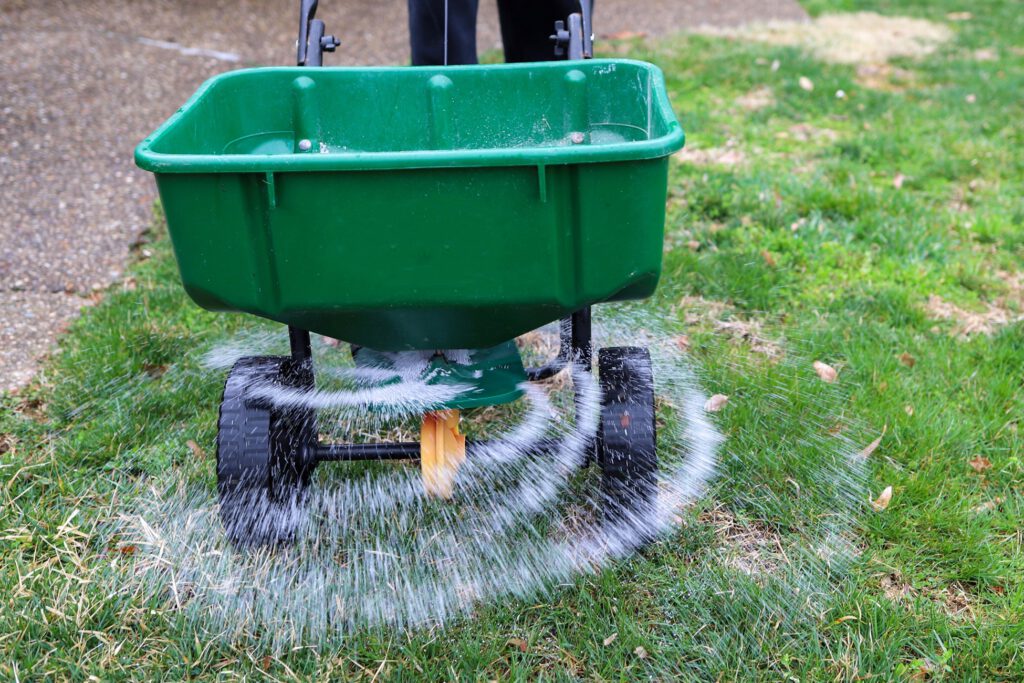
Spreader settings on the bag are a starting point. Set the spreader at half the label rate, walk the lawn in one direction, then walk it again at a right angle, closing the spreader at the end of each pass before turning. Uneven application shows up next spring as stripes.
Final Mow
Keep mowing at about two and a half to three inches until growth stops, then make a final cut slightly lower. That helps reduce matting under snow, which lowers the risk of snow mold, without scalping the crowns.
Blow Out the Sprinklers First
If your irrigation system has not been winterized yet, have it blown out before the first hard freeze. Water left in the lines can freeze and crack pipes and heads. Most homeowners schedule this around the time secondary water shuts off.
Common Mistakes
A few patterns come up often around Utah County. Waiting until December, when the ground is frozen and the grass is dormant. Applying without any moisture in the forecast and with the sprinklers already off, so the fertilizer sits on the surface for weeks. And applying a product heavy in phosphorus on soils that already have plenty.
What a Well-Timed Feeding Looks Like in Spring
Imagine this. It is early April. The snow on the benches is retreating, and the valley lawns are waking up. Yours is greening evenly across the whole yard, ahead of most of the street, with fewer thin spots than last year. You got the late-season feeding down in early November, just ahead of a storm, and the lawn is showing it.
What to Do Next
If you are feeding your own lawn, plan for late October into mid November, earlier on the benches, once mowing slows but the grass is green and the ground is unfrozen. Clear leaves first, choose a nitrogen-focused product with little or no phosphorus, time it just ahead of forecast rain or snow, or water it in by hose if your secondary water is off, and sweep granules off pavement.
If you would rather have someone else handle the timing decisions, product selection, and application for your Utah County lawn, we are here for that. Lawn Squad of Utah County serves homeowners across Utah County. Visit lawnsquad.com to request a free quote. Our VitaminLawn program is built for the grass types, soils, and weather patterns we deal with here.
Here is what to expect. We will look at your grass, talk through how your lawn handled this year, and explain what we would apply before winter and why. If your lawn does not need a late-season application, we will tell you that honestly.
