Salt, Sand, and Wind: What Oceanfront Myrtle Beach Lawns Need This Fall
Short Answer: Lawns within a few blocks of the ocean face three conditions that inland lawns do not: salt spray carried on the wind, soil that is essentially pure sand with almost no nutrient holding capacity, and constant air movement that dries turf quickly. Fertilizer leaches through beach sand faster than anywhere else in our area, so lighter and more frequent applications with slow release nitrogen are the only efficient approach. Salt accumulation in soil is best managed with thorough irrigation that flushes it downward, which sandy soil actually does well.
If your lawn is within a few blocks of the ocean, you already know it behaves differently from your friend’s place out past the highway. The grass browns faster, fertilizer seems to vanish, and there are spots along the windward side that never look quite right no matter what you do.
None of that is your imagination and none of it is a failure of care. Oceanfront and near beach lawns face a genuinely harder set of conditions, and a few adjustments make a substantial difference. Here is what is actually happening and what to do about it this fall.
Beach Sand Holds Almost Nothing
All of our area is sandy, but proximity to the beach takes it further. Soil close to the ocean is frequently near pure sand with very little organic matter and almost no clay content at all.
Soil holds nutrients through a property called cation exchange capacity, which is essentially its ability to grip nutrient ions where roots can reach them. Clay and organic matter have high capacity. Beach sand has close to none, because the particles are large, round, and chemically inactive.
The practical result is that nitrogen applied here does not stay put at all. It dissolves, moves downward with rain and irrigation, and a large share passes below the root zone within days. This is the reason a heavy application produces two weeks of color and then nothing, and it is more pronounced here than a mile inland.
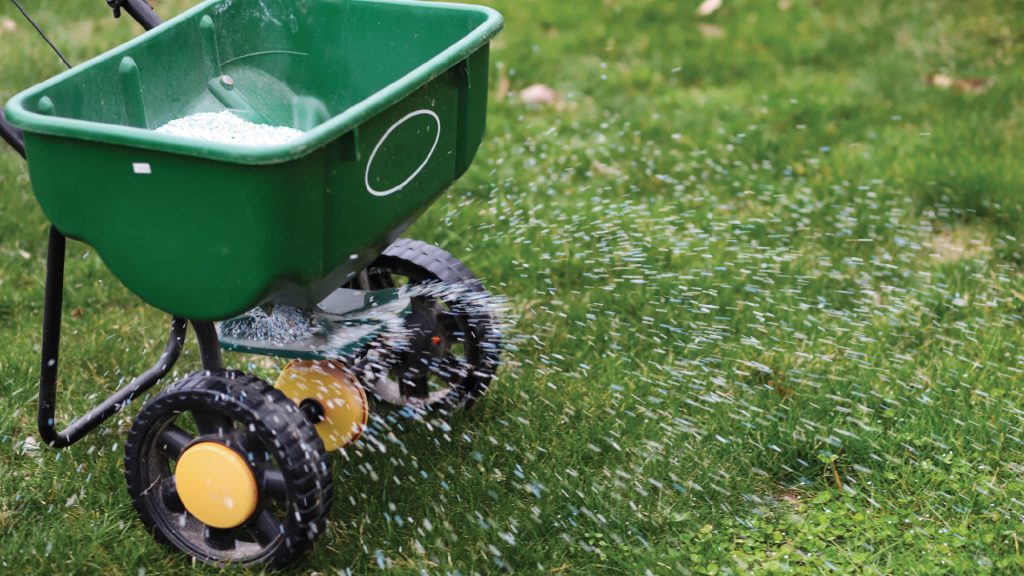
The response that works is lighter applications more often, using slow release nitrogen that dissolves gradually over weeks rather than all at once. Less is dissolved at any given moment, so less leaches, and far more of what you buy reaches the plant.
Salt Spray and What It Does
Onshore wind carries fine salt spray inland, and on a windy stretch it reaches well past the first row of houses. Salt lands on leaf blades and accumulates in soil over time, and both cause problems.
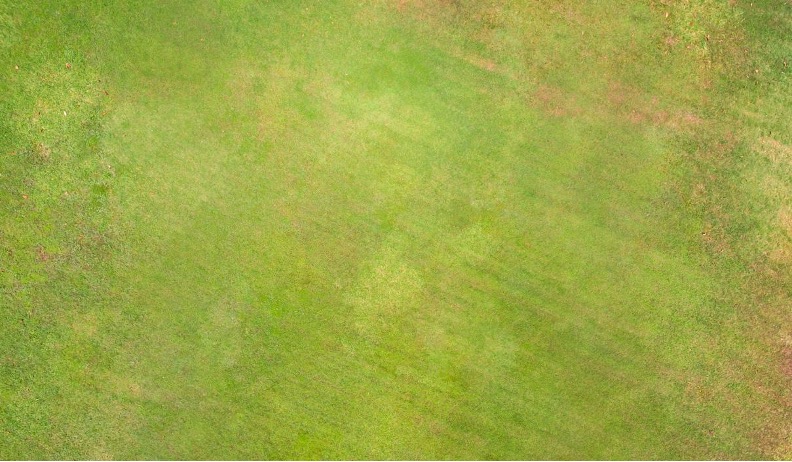
On the blade, salt draws moisture out of leaf tissue, producing tip burn and browning that looks remarkably like drought stress or fertilizer burn. It shows up worst on the windward side of a property and on anything exposed above a fence line or dune, which is why damage on these lots often has an obvious directional pattern.
In soil, accumulated salt makes it harder for roots to take up water even when water is present, because the dissolved salt holds onto it. A lawn can be irrigated adequately and still show stress if soil salinity has climbed. That is the version of the problem that builds quietly over seasons rather than appearing after a single windy week.
The useful news is that sandy soil is good at one thing here. Salt flushes downward readily with thorough watering, so periodic deep irrigation genuinely moves it out of the root zone. That is one case where a heavier watering serves a purpose, though it will move some nutrients along with it, which is another argument for slow release products.
Grass Choice Matters More Here
Salt tolerance varies considerably among the grasses common in our area, and on an exposed oceanfront lot it is one of the more important factors.
St. Augustine is the most salt tolerant of the common warm season lawn grasses and it performs noticeably better on exposed coastal sites than the alternatives. Bermuda has reasonable tolerance as well. Zoysia varies by cultivar.
Centipede is the weak point, and it matters because centipede is so common across the Grand Strand. It has relatively poor salt tolerance, so a centipede lawn on an exposed oceanfront lot is fighting a condition it is not equipped for. If you have centipede close to the water and have struggled with it for years, that mismatch may be the underlying explanation rather than anything you have done.
We would rather say that plainly than sell a program into a situation the grass cannot win. On a very exposed lot, a grass change is sometimes the honest recommendation.
Wind Dries Everything Faster
The third factor is constant air movement, which has both a cost and a benefit.
The cost is moisture loss. Wind increases evaporation from soil and transpiration from the plant, so a near beach lawn uses more water than an equivalent lawn inland. Combined with sand that stores almost nothing, that means these lawns show drought stress quickly, sometimes within a few days of dry weather.
The benefit is disease pressure. Large patch, which is the main fall disease on warm season grass here, needs extended leaf wetness to establish. Constant wind dries blades faster than in a sheltered inland yard, so exposed coastal lawns often see less large patch than properties a few miles back that sit in still humid air.
That trade is worth knowing, because it means the fall priorities differ. Inland, the main fall concern is managing disease. On the oceanfront, the main fall concern is moisture and salt.
What Fall Feeding Should Look Like Here
Pulling it together. The last nitrogen application of the year should already be behind you or going down now, since warm season grass needs nitrogen stopped several weeks ahead of frost, and centipede in particular wants very little to begin with.
Use slow release nitrogen at a moderate rate rather than a heavy one. On beach sand, a heavy application is largely a donation to the water table, and it is a water quality issue in a coastal environment as well as a wasted expense.
Potassium is worth including and worth repeating through the season, because it leaches readily from sand and because it supports both cold tolerance and general stress resistance. On a lot dealing with salt and wind year round, that stress resistance is not an abstraction.
Iron helps color without pushing growth, which is exactly the right combination now, and it is particularly relevant on centipede and on lawns where shell content has pushed soil pH upward.
Building Soil Is the Long Game
There is a durable improvement available and it is slow. Adding organic matter increases the sand’s ability to hold both water and nutrients, and it also improves the soil’s capacity to buffer salt.
On an established lawn the realistic methods are topdressing with a thin layer of quality compost, returning clippings with a mulching mower rather than bagging them, and core aeration to help that material work into the profile. Each is modest alone and they compound across seasons.
We want to be honest that this takes years rather than a season, and that any product promising to transform beach sand in one application is overselling. The oceanfront properties we manage with noticeably better soil got there through patience.
What to Do Next
Look at where your damage actually is. If the browning concentrates on the windward side and on anything exposed above a fence or dune, that pattern points to salt rather than to nutrition, and no fertilizer application addresses it.
Water thoroughly rather than lightly on occasion, specifically to flush accumulated salt down through the profile. Sandy soil does this well, and on an exposed lot it is worth doing deliberately rather than hoping rain handles it.
Check what grass you have and how exposed it is. Centipede close to the water is a difficult combination given its poor salt tolerance, and knowing that changes what expectations are reasonable. St. Augustine handles exposure considerably better if a replanting is ever on the table.
If you would rather have someone assess salt exposure, soil, and grass suitability on your coastal property, we are here for that. Visit lawnsquad.com to find Lawn Squad of Myrtle Beach and request a free evaluation. Our VitaminLawn program is built around the sand, salt, and wind we actually work with along the Grand Strand.