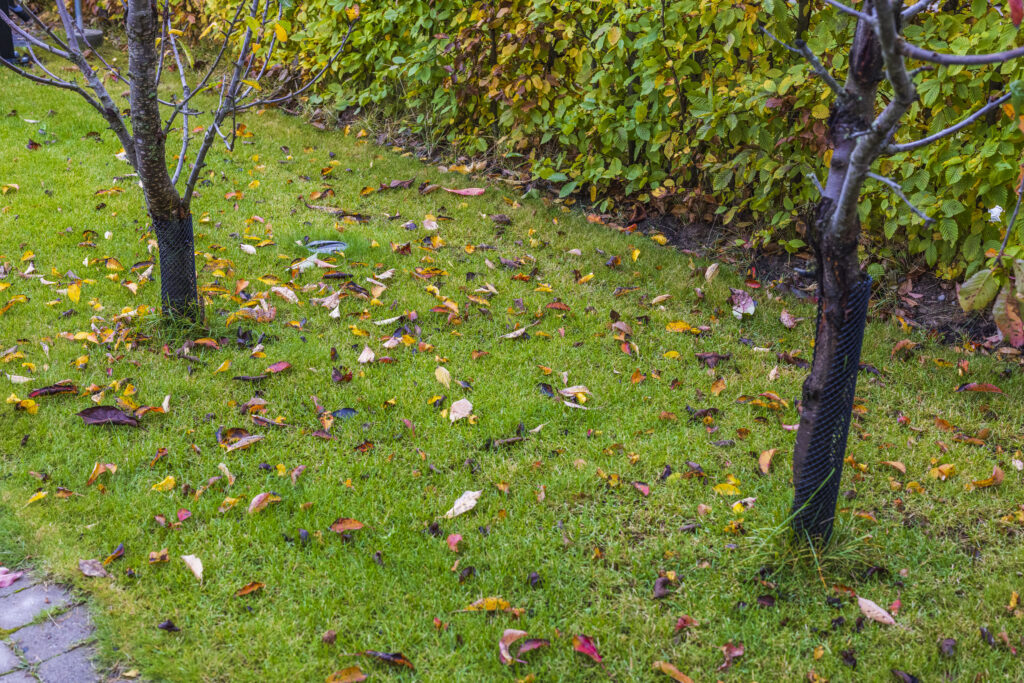
Short Answer: Those expanding circles are almost certainly large patch, a fungal disease caused by Rhizoctonia that attacks St. Augustine and zoysia once soil temperatures fall out of the summer range. It becomes active as soil settles into the seventies and below and the lawn stays wet for long periods, which describes a typical Woodlands autumn precisely. It rots the leaf sheath at the base of the blade rather than the roots, so the grass usually survives and recovers slowly. Nitrogen applied at the wrong moment and evening watering both make it dramatically worse.
What Large Patch Actually Is
Large patch is a fungal disease caused by a strain of Rhizoctonia that lives in the soil and in the thatch layer of essentially every lawn in this region. It is not something that arrives from a neighbor’s yard or blows in on the wind. It is already present, waiting for conditions that let it become aggressive.
Many people know it as brown patch, and the two names get used interchangeably on warm season lawns. The important point is that the fungus attacks the leaf sheath where the blade attaches to the runner, not the root system. That is why an affected lawn usually recovers rather than dying outright, and why the recovery is slow and frustrating.
The Trigger Is Soil Temperature Plus Leaf Wetness
The disease has a narrow set of conditions it needs, and our fall delivers all of them. Soil temperature dropping out of the summer range and settling in the seventies and below is the main switch. Add extended leaf wetness, from heavy dew that lingers into midmorning, from a wet stretch of weather, or from irrigation running in the evening, and the fungus goes to work.
That is why this shows up on a calendar you can nearly predict in The Woodlands. It is also why the same lawn often gets hit again in spring, when soil temperatures pass back through the same range on the way up.
What It Looks Like in the Yard
The classic appearance is a roughly circular patch that expands outward, starting anywhere from a couple of feet across and sometimes growing to twenty feet or more. Multiple patches often merge into irregular shapes.
The edge is the tell. Active large patch usually shows a yellow or orange band at the advancing margin where the grass is being colonized, with tan or straw colored collapsed turf behind it. Sometimes the center partially recovers and greens up while the ring keeps moving, producing a doughnut shape. The patch typically appears first in the lowest, wettest, shadiest part of the lawn and works outward from there.
The Test That Confirms It in Thirty Seconds
Grab a few blades at the edge of a patch and pull gently. With large patch the leaf separates from the runner with almost no resistance, and the base of the blade you pulled is dark brown, water soaked, and slimy, sometimes with a rotten smell.
Then tug on the runner itself. It should stay firmly anchored, because the roots are intact. That combination, a leaf that slips out easily with a rotted base and a stolon that stays put, is large patch. If the entire runner lifts up because the roots are gone, you are looking at take-all root rot instead, which is a different problem with a different management plan.
Why The Woodlands Gets Hit So Consistently
Several local conditions line up. The soils here are heavy and hold water, so the ground stays wet longer after rain than it would on sand. The tree canopy over most lots keeps sun off the turf in the morning and slows air movement, so dew sits on the blades for hours instead of burning off.
St. Augustine, the dominant lawn grass here, is highly susceptible, and zoysia is as well. Add irrigation systems still running a summer schedule into October and you have a lawn that essentially never dries at the surface during the exact window the fungus needs. Almost every yard in the area has at least one spot that meets all these conditions.
Nitrogen at the Wrong Time Feeds the Disease
This is the mistake that turns a small patch into a large one. When a homeowner sees browning grass in fall, the common reaction is to apply fertilizer to green it back up. Soluble nitrogen applied while soil temperatures are in the large patch range produces lush, tender leaf tissue, which is precisely what the fungus colonizes fastest.
The general guidance for this region is to stop pushing nitrogen once soil temperatures start dropping into the seventies. Feeding earlier in the season, while the grass is still growing strongly and the disease is not active, is how you get the density that helps the lawn resist. Feeding into the disease window works against you.
Move Your Watering to Early Morning
If you change only one thing, change the irrigation start time. Watering in the evening or overnight adds many hours of leaf wetness on top of the dew that is already coming, and that extended wet period is what the fungus needs to spread.
Set the system to finish shortly after sunrise. The blades were already wet from dew, so you have added little wetness time, and the sun then dries the canopy. Cut back frequency as well. Cooler weather and shorter days mean the lawn is using far less water in October than it was in August, and most controllers are still running the August number.
Thatch, Mowing, and Air Movement
The fungus survives in thatch, so a heavy thatch layer is both a reservoir and a moisture sponge. St. Augustine builds thatch readily, particularly in lawns that have been fertilized heavily. If you can push a finger into more than about half an inch of spongy material above the soil, that is worth addressing.
Keep mowing through the fall at the proper height, three and a half to four inches, and keep the blade sharp. Torn leaf tips are open wounds. Bag the clippings while a disease is actively running to reduce how much infected material you are redistributing, and clean the mower deck between the affected area and the rest of the yard.
Drainage and the Low Spot Problem
Notice where the patches start. In most Woodlands yards they begin in the same low areas every single year, where water collects after a storm and takes days to leave, or where a downspout dumps onto the lawn, or where a compacted area from construction refuses to drain.
You can spray those areas every fall forever, or you can fix the grade, extend the downspout, install a drain, or core aerate the compacted zone and change the outcome permanently. Heavy clay in this area makes drainage work harder than it is in sandier regions, but it also makes it more valuable, because clay holds the water that drives the disease.
Fungicides Work Before Symptoms, Not After
This is the part people find counterintuitive. Fungicides for large patch are far more effective applied preventively, before the patches appear, than curatively once the lawn is already browning. By the time you see a large circle, substantial tissue is already infected and no product reverses that damage.
Preventive timing is keyed to soil temperature falling into the susceptible range rather than to a date. On lawns with a history of large patch in the same spots every year, planning that application ahead of the window is the difference between a clean fall and another season of circles. Follow label rates and intervals, and rotate active ingredients rather than repeating one product indefinitely.
How Long Recovery Actually Takes
Set expectations now. Because the roots and crowns survive, affected turf generally does come back. But the recovery happens by the grass regrowing leaf tissue and filling in by runner, and that requires warm growing conditions. Damage that appears in October does not repair in November, because the lawn is heading into its slowest stretch of the year.
In most cases the patches sit there looking bad through winter and fill in during spring as temperatures rise, provided the spring conditions do not trigger another round. Large open areas may need plugs or sod. Patience is genuinely part of the treatment here, and applying more fertilizer to force faster recovery in cool soil usually restarts the problem.
What to Do Next
Walk the lawn this week and write down the two or three things that actually bother you about it, then work backward from the window rather than forward from today. Almost every fall mistake we see in The Woodlands comes from starting with the calendar instead of with the lawn.
If you would rather have someone look at it with you, Lawn Squad of The Woodlands offers a free quote. Call 833-816-7508 or find us at lawnsquad.com. Every Lawn Squad location is independently owned and operated, and our VitaminLawn fertilization and weed control program is built around the grass, soil, and conditions here rather than a national average.
A first visit is a walk of the property, a look at the thin areas, a check of mowing height and irrigation, and a straight conversation about what is realistic in the weeks left this season. At 30 days you should see color and density improve. At 90 days the lawn should be visibly thicker, with the root growth that carries it through winter.