
Short Answer: Those expanding brown rings and arcs on Central Georgia zoysia, centipede, and St. Augustine lawns are almost always large patch, a soil borne fungal disease that turns active when soil temperatures fall through the seventies and the canopy stays wet overnight. It is not drought and it is not chinch bugs. Late nitrogen, evening watering, and poor drainage all encourage it. A preventive fungicide applied as soil temperature drops through about seventy degrees is effective. Treating after the rings appear is slower, and the damaged turf is very slow to fill back in.
What You Are Actually Looking At
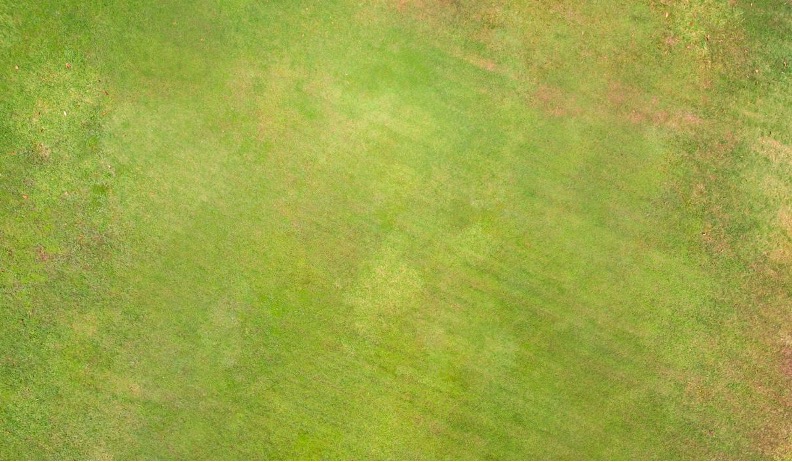
The pattern is distinctive once you have seen it. A roughly circular patch of turf turns yellow, then orange or straw brown, and over a few weeks it widens outward. Sometimes the center partially recovers and you are left with a ring or a horseshoe shape rather than a solid circle. Patches can run from a foot across to fifteen feet or more, and on a bad property several of them merge into irregular blotches.
The disease is large patch, caused by a strain of the soil fungus Rhizoctonia solani. It was formerly lumped in with brown patch, which is why older references and a lot of retail products still use that name. On warm season grasses in Central Georgia, large patch is the correct term and the timing is different from the summer brown patch that hits fescue farther north.
The fungus attacks the leaf sheath right at the base of the plant, near the soil surface. That is why an affected blade pulls out of the crown with almost no resistance and shows a dark, rotted, water soaked section at the very bottom. That pull test is the single most reliable field diagnostic a homeowner can run.
Why It Appears in Fall and Then Again in Spring
Large patch is a shoulder season disease. It becomes active when soil temperatures at the two inch depth are moving through roughly sixty five to eighty degrees with sustained leaf wetness. In Central Georgia that describes September through November, and then again March through May.
This is why many homeowners here experience it as two separate problems. Rings show up in October, the lawn goes dormant, everything turns tan and the evidence disappears. Then in April the same areas green up late or not at all and the homeowner assumes it was winter kill. It was the same fungus, active on both ends of dormancy in the same spot.
The pathogen survives in the thatch and soil year round. It is almost certainly already present in your lawn. The question is never how to eliminate it, only whether conditions let it express.
Which Central Georgia Lawns Get It
Susceptibility is not equal across grass types, and the mix here matters.
- Zoysia is the most severely affected turf in this area and produces the largest, most dramatic patches.
- Centipede, which is extremely common through Bibb, Houston, and the surrounding counties, is highly susceptible and recovers the slowest because it spreads only by stolons and grows slowly.
- St. Augustine gets it, particularly in shaded and low lying yards.
- Bermuda is the least affected of the warm season grasses. If you have bermuda and you are seeing large circular damage, look harder at other causes before assuming large patch.
Centipede deserves special mention because it is both very common and very slow to fill in. A three foot patch of damaged bermuda may close over the following summer. The same patch in centipede can still be visible a year later.
How to Rule Out the Other Suspects
Several things produce brown areas in a Central Georgia lawn in the fall, and the responses are not interchangeable.
- Drought stress appears first on high spots, near driveways and sidewalks, and in the sandiest areas, and the pattern follows irrigation coverage rather than forming circles.
- Chinch bug damage concentrates in full sun along hot edges and the grass appears dried out rather than rotted at the base.
- Armyworm and sod webworm damage shows chewed, ragged blade edges and advances as a front rather than expanding as a circle.
- Nematode damage produces general thinning and weak decline rather than defined margins.
- Large patch produces the circular expanding margin plus the easy pull with a rotted sheath at the base.
Run the pull test at the outer edge of a patch, in the yellowing transition zone, not in the dead center. The center is already past the active stage and will not tell you much.
The Conditions That Switch It On
The fungus is present continuously but it needs a specific set of conditions to cause visible disease. In Central Georgia those conditions assemble reliably in the fall.
Extended leaf wetness is the primary driver. Twelve or more hours of continuous moisture on the leaf surface is roughly what it takes, and that is easy to achieve in October when nights get long, dew forms early and burns off late, and daytime temperatures are still warm enough for the fungus to work.
Poor drainage and compacted soil hold moisture at the crown longer. The fall line runs right through this part of Georgia, so soils vary considerably from tight red Piedmont clay on the north side to sandier Coastal Plain material to the south. The clay dominated properties see more disease because water sits at the surface instead of moving through.
Shade compounds it. Any part of the lawn that does not get direct morning sun stays wet hours longer, and that is very often exactly where the first patches form.
The Late Nitrogen Connection
Excess nitrogen applied as soil temperatures are falling is one of the most reliable ways to make large patch worse. Nitrogen produces soft, thin walled leaf tissue that the fungus penetrates easily, and it does so exactly when the grass is losing its ability to outgrow the damage.
This is one more reason the fall nitrogen cutoff on warm season grass in Central Georgia should be roughly six weeks ahead of first frost, which puts it around mid September. A homeowner who sees the lawn beginning to thin in October and responds with a bag of high nitrogen fertilizer is often feeding the disease that caused the thinning.
Potassium is the nutrient that is still worth applying late. It supports cell wall strength and stress tolerance without pushing the soft growth the fungus prefers.
Watering Habits That Feed the Disease
Irrigation timing is one of the few large patch variables a homeowner controls completely and for free.
Evening and night watering is the worst possible schedule in the fall. It adds moisture at the exact hour dew is already forming and extends leaf wetness through the entire night. Shift the whole system to finish before or around sunrise. That way the sun begins drying the canopy almost immediately and total wet hours drop substantially.
Reduce total volume as well. A warm season lawn in October needs far less water than it did in July because temperatures are lower, days are shorter, and the plant is slowing down. Many of the worst disease properties we walk in the fall are simply running a July irrigation schedule in October.
Timing a Preventive Application
Large patch is one of the diseases where prevention genuinely outperforms treatment by a wide margin, and the timing trigger is soil temperature rather than a calendar date.
The target is a preventive fungicide applied as the two inch soil temperature is falling through approximately seventy degrees. In Central Georgia that usually lands somewhere in the second half of September through early October, but it moves several weeks year to year depending on how the fall arrives. Soil temperature data is publicly available from Georgia weather station networks, and it is a far better trigger than a date on a calendar.
A second application four weeks later extends protection through the remainder of the active window. Properties with a history of severe large patch, heavy shade, or poor drainage benefit most from the two application approach.
What Happens If You Wait Until You See Rings
Curative treatment after symptoms appear does work in the sense that it stops the patches from expanding further. What it does not do is repair damage that already occurred.
Because the disease kills the leaf sheath at the crown, recovery requires the grass to regrow into the area from the outside, and by October a warm season lawn in Central Georgia has almost no growing season left to do that. In practical terms, patches that appear in late October will still be visible in March. Zoysia and centipede in particular may take an entire following summer to close.
That gap between a September preventive application and an October curative one is the entire argument for treating on soil temperature instead of on symptoms.
Mowing, Thatch, and Drainage
Cultural practices will not cure large patch on their own, but they change how severe it gets.
- Keep mowing at the correct height for the grass and mow with a sharp blade. Torn leaf tips create additional entry points.
- Bag clippings while moving through an actively diseased area so you are not spreading infected material across the property.
- Address thatch above roughly a half inch, since thick thatch holds moisture at the crown and harbors the fungus. On warm season grass in this area, that work belongs in late spring and early summer when the grass is growing hard, not in the fall.
- Fix the drainage problems and correct the shade issues you actually can. A limb removal that gets morning sun onto a chronically wet corner is sometimes worth more than a fungicide.
Where This Fits in Your Fall Calendar
For a Central Georgia warm season lawn, the fall sequence is fairly compact and the order matters. Last nitrogen goes down by roughly mid September. Preventive fungicide goes down as soil temperature falls through seventy degrees. Fall pre emergent for winter annual weeds goes down in the same general soil temperature window. Irrigation gets cut back and shifted to early morning. Mowing continues at the normal height until growth stops.
What does not belong in that sequence is aeration and overseeding. That is cool season advice for fescue and bluegrass lawns, and applying it to zoysia, centipede, or St. Augustine here opens the canopy and disturbs the crown at the worst possible moment.
What to Do Next
Walk the lawn this week and write down the two or three things that actually bother you about it, then work backward from the window rather than forward from today. Almost every fall mistake we see in Central Georgia comes from starting with the calendar instead of with the lawn.
If you would rather have someone look at it with you, Lawn Squad of Central Georgia offers a free quote. Call 833-816-7508 or find us at lawnsquad.com. Every Lawn Squad location is independently owned and operated, and our VitaminLawn fertilization and weed control program is built around the grass, soil, and conditions here rather than a national average.
A first visit is a walk of the property, a look at the thin areas, a check of mowing height and irrigation, and a straight conversation about what is realistic in the weeks left this season. At 30 days you should see color and density improve. At 90 days the lawn should be visibly thicker, with the root growth that carries it through winter.