
Short Answer: Tall fescue is a cool-season grass being asked to survive an East Tennessee summer, which is genuinely difficult, and it is also a bunch grass that cannot fill its own gaps. Every plant lost to heat, drought, or brown patch leaves a hole that stays a hole. So the thinning is cumulative year over year rather than a fresh problem each August. Three things drive most of it: shallow roots from compacted clay, brown patch disease in our humidity, and mowing too short. All three are fixable, and the repair happens in fall, not in the summer when the damage is visible.
By August, a lot of Knoxville lawns look tired in a specific way. Not uniformly brown, but thin, with visible soil between plants and patches that were smaller last year. The homeowner did nothing differently, and the lawn is worse than it was.
That pattern has a structural explanation, and understanding it is what makes the fix obvious.
Fescue Cannot Repair Itself
This is the single most important fact about lawn care in the transition zone, and most homeowners have never been told it.
Tall fescue grows in bunches. It does not send out runners above ground like bermuda, and it does not spread underground by rhizomes like Kentucky bluegrass. Each plant occupies its spot and stays there.
When a fescue plant dies, nothing grows into the gap. The hole stays a hole until either a weed finds it or somebody puts seed down.
Bermuda lawns recover from summer damage on their own, which is why bermuda neighbors are often puzzled by the whole conversation. Fescue lawns do not. They accumulate losses.
So a lawn that loses five percent of its plants each summer and gets no seed is noticeably thin after three years and genuinely bad after five. Nothing changed. It just added up.
Why Summers Here Are So Hard on It
Cool-season grasses have an optimal soil temperature range for root growth that sits well below what East Tennessee soil reaches in July and August.
Past that range, root growth slows or stops entirely. The plant is not building anything. It is spending reserves to hold what it has and waiting for September.
Add our humidity, which keeps leaf surfaces wet for long stretches overnight, and you have close to ideal conditions for fungal disease at the same moment the plant has the least capacity to recover from it.
That combination, heat stress plus disease pressure plus no root growth, is what a Knoxville fescue lawn is dealing with for roughly eight to ten weeks a year.
Cause One: Shallow Roots in Compacted Clay
Root depth is what separates a lawn that rides out August from one that does not.
A lawn rooted six inches deep draws from a large volume of soil and has a real buffer. A lawn rooted in the top inch has almost nothing, and the top inch dries first.
East Tennessee clay compacts readily, and on properties built in the last couple of decades, construction equipment compacted the subsoil before a thin layer of topsoil went over it. Roots cannot grow through soil with no pore space, so they stay shallow whether the grass wants to or not.
The screwdriver test settles it. Water the lawn, wait a day, then push a long screwdriver in with hand pressure. If it stops at two inches, compaction is limiting your lawn more than anything else on this list.
Cause Two: Brown Patch
Brown patch is the dominant summer disease on tall fescue, and East Tennessee gives it everything it wants.
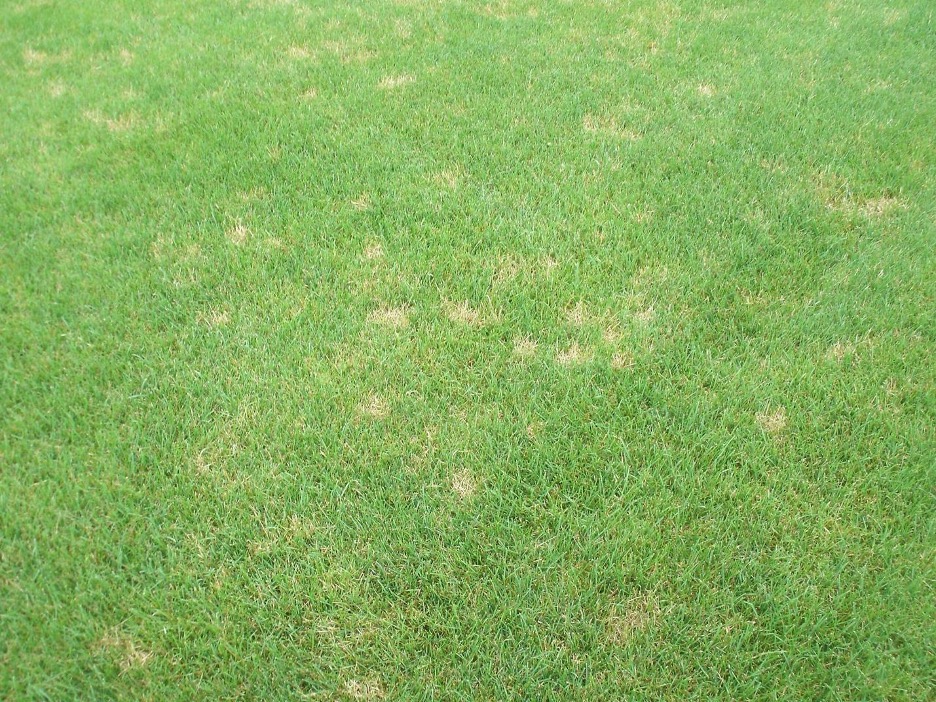
Look for roughly circular patches from a few inches to several feet across, tan or straw colored. Early in the morning while dew is still down, an active infection often shows a darker gray border at the advancing edge. That ring vanishes as the lawn dries, so morning is the only time to see it.
It is driven by warm nights, extended leaf wetness, and excess nitrogen. Three things reduce it substantially without any product: water in the early morning rather than the evening so the canopy dries in the sun, hold off on nitrogen while nights are still warm, and keep the mowing height up.
The damage matters more here than elsewhere precisely because fescue does not fill in what it loses.
Cause Three: Mowing Too Short
Cutting height and summer survival are directly connected, and this is the cheapest fix available.
Leaf area funds photosynthesis, which funds root growth. Cutting short repeatedly removes the machinery that builds roots. Taller grass also shades the soil surface, which measurably lowers root zone temperature through a Knoxville July and cuts evaporation.
Fescue here should generally be mowed in the three and a half to four inch range through summer. The lawn scalped to two inches every week in June is the one that fails first in August.
Blade sharpness is the other half. A dull blade tears rather than cuts, the torn tip loses water faster and browns within a day, and the damaged tissue is an entry point for brown patch. If your whole lawn takes on a whitish cast the day after mowing, that is a dull blade.
Why Watering More Is Not the Answer
The instinct when a lawn looks stressed in August is to water more often, and it usually makes things worse.
Frequent light watering keeps moisture in the top half inch, so roots have no reason to grow deeper. You are training the lawn to be fragile at exactly the moment it needs depth.
It also extends leaf wetness, which is the primary driver of the brown patch already working on the lawn.
Deep and infrequent is right: roughly an inch a week including rainfall, in one or two long soaks, early in the morning. That pulls moisture down and roots follow it.
The Repair Has to Happen in Fall
Here is the frustrating part. The lawn looks worst in August, and August is the worst possible time to work on it.
Seeding into summer heat fails. Aerating a heat stressed lawn opens it up when it cannot recover. Nitrogen in peak heat feeds brown patch more than it feeds grass.
September and October are when the repair happens, because soil is cooling into the range where roots grow fastest and the plant is actively building again.
For a fescue lawn in Knoxville, fall overseeding is not an optional improvement. It is the only mechanism by which the lawn ever gets thicker, and skipping it means next August starts from a thinner stand than this one did.
What the Fall Program Looks Like
- Core aerate to relieve compaction and open a seedbed.
- Overseed immediately into the holes with a quality turf type tall fescue blend, ideally mid September through mid October.
- Water short and frequent for three weeks, then transition back to deep and infrequent.
- Feed at seeding with a starter, then again in late fall once growth slows.
- Raise the mowing height for next season and sharpen the blade.
- Get a soil test so lime or amendments address what is actually short rather than what is assumed.
What to Expect, Honestly
One fall of proper work produces a visibly denser lawn going into winter and a stronger spring green up.
The real test is the following August. A lawn aerated, overseeded, and fed through fall, then watered deeply and mowed high through spring, enters that summer with a deeper root system and holds noticeably better.
Because fescue cannot self repair, though, this is not a one time fix. Annual fall overseeding is simply part of owning a fescue lawn in the transition zone, in the same way that mowing is. The lawns around here that look consistently good are the ones where that happens every year rather than the ones that got one big renovation.
What to Do Next
Walk the lawn this week and write down the two or three things that actually bother you about it, then work backward from the window rather than forward from today. Almost every fall mistake we see in Knoxville comes from starting with the calendar instead of with the lawn.
If you would rather have someone look at it with you, Lawn Squad of Knoxville offers a free quote. Call 833-816-7508 or find us at lawnsquad.com. Every Lawn Squad location is independently owned and operated, and our VitaminLawn fertilization and weed control program is built around the grass, soil, and conditions here rather than a national average.
A first visit is a walk of the property, a look at the thin areas, a check of mowing height and irrigation, and a straight conversation about what is realistic in the weeks left this season. At 30 days you should see color and density improve. At 90 days the lawn should be visibly thicker, with the root growth that carries it through winter.