How Do I Identify Late-Summer Lawn Diseases in My Climate Zone?
Short Answer: Late-summer disease looks different depending on where you live. In the cool-season North and the transition zone, tall fescue and ryegrass get brown patch, circular tan patches that are most visible in early morning dew. Across the warm-season South, zoysia and centipede get large patch as soil temperatures fall back through the low seventies. Gray leaf spot hits St. Augustine in tropical Florida and along the Gulf, and ryegrass and fescue farther north. Take-all root rot is a Gulf and Florida root disease that mimics drought. The first three respond to fungicide. Take-all is corrected mostly by changing conditions.
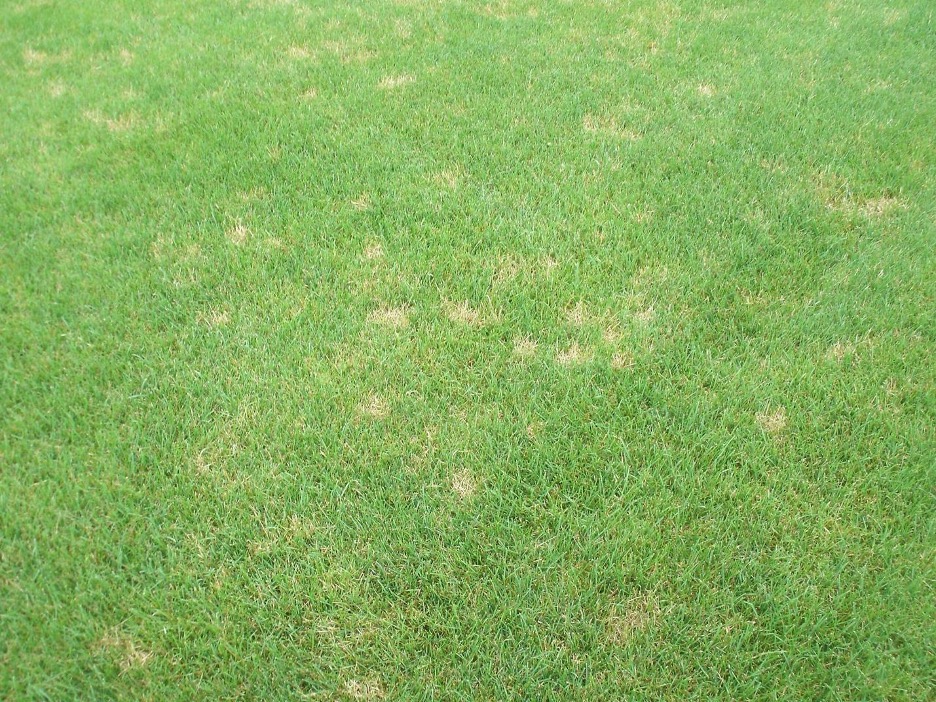
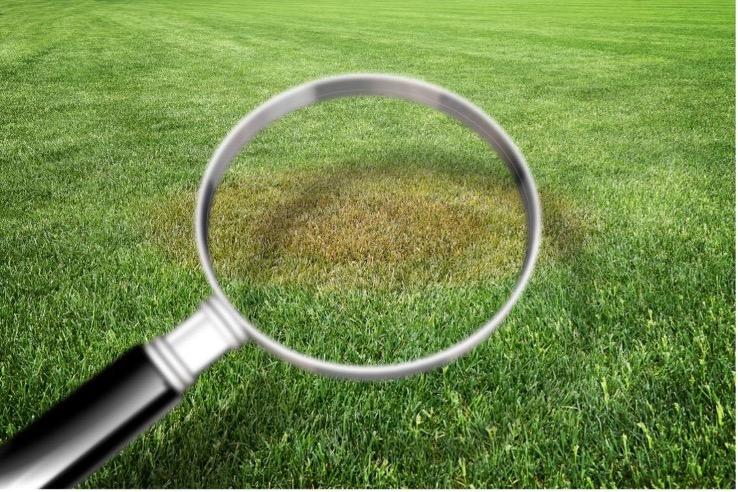
Imagine walking out the back door a little after six, coffee in hand, before the sun clears the fence line. The lawn is still soaked with dew. Last evening everything looked normal. This morning there is a ring of tan grass about four feet across near the downspout, and its outer edge carries a smoky gray-purple halo you can only see because dew is still sitting on the blades. By ten o’clock that halo is gone and the whole thing just reads as a dry spot. That is the central difficulty with late-summer disease. It shows you its fingerprints for roughly ninety minutes a day, and most people are at work for all of them.
Most homeowners we talk to in August have already watered that spot, usually more than once, which almost always makes it larger. The frustration is rarely the damage itself. It is the not knowing. Fungus, insect, or irrigation, and each wrong guess costs a week of a season that has few weeks left.
Read the Lawn Before the Dew Burns Off
Across our service areas we walk a lot of properties in August, and the most useful habit we can hand you is the early walk. Disease is a moisture organism, and the mycelium that gives you a positive identification is only visible while free water is still on the leaf, which in most of the country means before about eight in the morning. Look at the pattern from standing height first: circular, arcing, ring shaped, or scattered? Then kneel down and look at individual blades. Nearly every disease worth naming leaves a lesion, a distinct spot or band with its own color and border. Drought does not do that. Insects do not do that. If blades are uniformly tan from the tip down with no defined lesion, you are probably looking at water, grubs, or chinch bugs instead.
Brown Patch: The Cool-Season North and Transition Zone Headliner
Brown patch defines August for tall fescue and perennial ryegrass, which makes it the dominant problem across the transition zone and the humid parts of the cool-season North. It turns on when nighttime lows stop dropping below the upper sixties and the canopy stays wet for long stretches, which is exactly what a muggy August delivers.
You get roughly circular patches from a foot to several feet across, tan to light brown, often with grass at the center that looks less affected than the ring around it. In heavy dew, before sunrise, the advancing edge shows a grayish purple band of mycelium that people describe as a smoke ring. That smoke ring is the confirmation, and it is gone by mid-morning. On individual fescue blades you will find irregular tan lesions with a thin dark brown border, usually mid-blade rather than at the tip. Fescue is most susceptible, ryegrass close behind, Kentucky bluegrass considerably less so.
Large Patch: The Same Fungus, Running the Opposite Calendar
Large patch comes from a close relative of the brown patch organism, but it attacks warm-season grass and runs on the other side of the year. Zoysia is the classic host, with St. Augustine, centipede, and bermuda also vulnerable. Across the warm-season South and lower transition zone, it activates as soil temperatures fall back through roughly the low seventies, which in most of that geography starts in September.
The name is honest. These patches are big, often ten feet or more, roughly circular, and the giveaway is a bright orange or yellow-orange leading edge on actively expanding turf. Pull a blade from that edge and the leaf sheath near the crown will be rotted, dark, and slimy, and the leaf slides out of the sheath with almost no resistance. This is the disease people first notice the following spring when the lawn greens up everywhere except in large dead circles. The infection that caused it happened in fall.
Gray Leaf Spot: The Fastest Mover of the Four
Gray leaf spot can take a lawn apart in under a week. In tropical Florida and along the Gulf it is a St. Augustine disease and a serious one. Farther north, in the transition zone and cool-season North, the same pathogen group hammers perennial ryegrass and can hit tall fescue, particularly new seedings in a hot, wet stretch. Look for oval to diamond shaped lesions on the blade, gray or ash colored in the center with a dark brown or purple margin, frequently ringed by a yellow halo. On St. Augustine the lesions run along the blade and the whole leaf takes on a scorched, olive-gray cast. On ryegrass the newest leaves twist and shrivel at the tip like a burned fishhook, one of the more reliable field signs anywhere in turf. From a distance the lawn looks smoky and thin rather than patchy, and it can go from mild to severe between two mowings.
Take-All Root Rot: The Gulf and Florida Disease That Impersonates Drought
Take-all root rot is the most misdiagnosed problem on the Gulf Coast and in Florida, and the response is different from the other three. It is a root and stolon disease, not a leaf disease, on St. Augustine primarily and bermuda secondarily. Above ground you get irregular yellowing areas, not clean circles, that thin out slowly over weeks and do not respond to watering. Because the roots are the problem, the tell is underground. Grab a handful of affected turf and pull. Healthy St. Augustine resists. Take-all turf lifts away with almost no root at all, and what remains is short, dark brown to black, and brittle instead of white and springy. The disease is strongly associated with high soil pH, alkaline irrigation water, compaction, and general stress.
The Arid West Sees a Different Set Entirely
Across the arid West and Intermountain region, humidity is low enough that brown patch and gray leaf spot are minor players. The problems there are root and crown diseases on Kentucky bluegrass, and they show up as rings. Necrotic ring spot produces the classic frog-eye: a dead or straw colored ring with a tuft of apparently healthy grass surviving in the middle, most obvious on sunny slopes, south facing exposures, and shallow soil over compacted subgrade in newer subdivisions. Summer patch looks similar. Both rot the root system, both look worst under heat and water stress, and both frustrate homeowners because the lawn seems to recover in cool weather and then returns in the same rings a year later.
Tropical Florida and the Gulf get the reverse problem. Afternoon storms keep the canopy wet nearly every night, so pressure never releases and take-all and gray leaf spot often run together on one lawn.
Which Need Fungicide and Which Need a Cultural Correction
Here is the honest sorting, and it saves people real money. Brown patch, large patch, and gray leaf spot are genuine fungicide diseases. They respond to a properly timed application, and with large patch the application is preventive, going down in early fall as soil temperatures approach the trigger rather than after the circles appear. Waiting until symptoms are obvious means paying for a product to protect turf that is already damaged.
Take-all root rot, necrotic ring spot, and summer patch are different. Fungicides have a limited and inconsistent effect once you can see symptoms, because the pathogen is already inside root tissue. The durable answers are cultural: correct the pH direction, reduce compaction with core aeration, fix the irrigation cycle that keeps the canopy wet all night, raise mowing height, and with ring spot, overseed with more resistant material. We would rather tell you to change your watering clock than sell you a spray that will not hold. One correction helps in every zone and costs nothing: water deeply and early in the morning so the canopy dries fast. Evening watering in August extends leaf wetness through the entire warm night, the condition every one of these organisms needs most.
What to Do Next
Take the early walk tomorrow, before eight, and photograph anything suspicious while the dew is still down. Note the pattern, then pull a few blades. If roots come up short and dark, you have a root disease and a conditions problem. If blades carry defined lesions, you have a leaf disease and a treatment decision. Then find your local Lawn Squad at lawnsquad.com or call 833-816-7508 for a free quote. Each Lawn Squad location is independently owned and operated, and the team near you builds its VitaminLawn program around your actual grass type, soil, and climate rather than a national template, because the right August answer in the arid West is not the right answer on the Gulf. A first visit is a walk of the property, an identification, and a plan you can see. On a treatable leaf disease, expect spread to stop within one to two weeks and damage to fill in over roughly thirty days of growing weather. On a root disease, expect visible change to take a season, with real recovery arriving through fall aeration, overseeding, and a corrected watering schedule. Both are fixable. They simply run on different clocks, and August is when either one starts.