Will My North Dallas Bermuda Lawn Recover From August Drought, or Does It Need Sod?
Short Answer: Dig up a plug and look below the straw. Dormant bermuda has firm, plump crowns and rhizomes that are cream colored and slightly moist inside when you scratch them with a fingernail. Dead bermuda has crowns that crumble dry and hollow, and runners that snap like a toothpick. The confirming step is water: irrigate the questionable area deeply for two to three weeks, and in our August soil temperatures living bermuda pushes green shoots in that window. Anything still uniformly straw colored after three weeks of consistent moisture is not coming back on its own.
By the third week of August, the black clay under a Prosper yard has pulled away from itself. There are cracks running across the back lawn wide enough to lose a house key in, a visible gap between the soil and the sidewalk, and a hard tan strip along the west-facing side of the house where the brick throws heat back at the grass all afternoon. Step off the patio at six in the evening and the ground gives nothing. It feels like walking on a driveway with a rug over it.
What most people are really asking when they call us in August is not a lawn question. It is a money question. Nobody wants to spend a weekend and a water bill nursing something that is already gone, and nobody wants to pay for sod that was never necessary.
What August Does to a Blackland Prairie Lawn
The soil under most of Prosper, Frisco, Allen, and north Plano is Blackland Prairie clay, and it behaves unlike almost anything else in the country. It is genuinely fertile and holds an impressive amount of water, which is why the grass looks so good in May. The catch is what happens when it dries. This clay shrinks as it loses moisture, and it shrinks a lot, opening the vertical cracks you are looking at right now.
Those cracks are not just cosmetic. As the soil mass contracts, it shears fine roots apart underground, so your bermuda loses part of its water uptake at exactly the moment it needs all of it. Then the crack becomes a shortcut. Water applied to the surface pours straight down the fissure and out of the root zone, and the homeowner ends up running the system longer while the top four inches stay dusty. That combination is what turns an ordinary hot summer into visible loss.
Dormant or Dead: Settling the Question
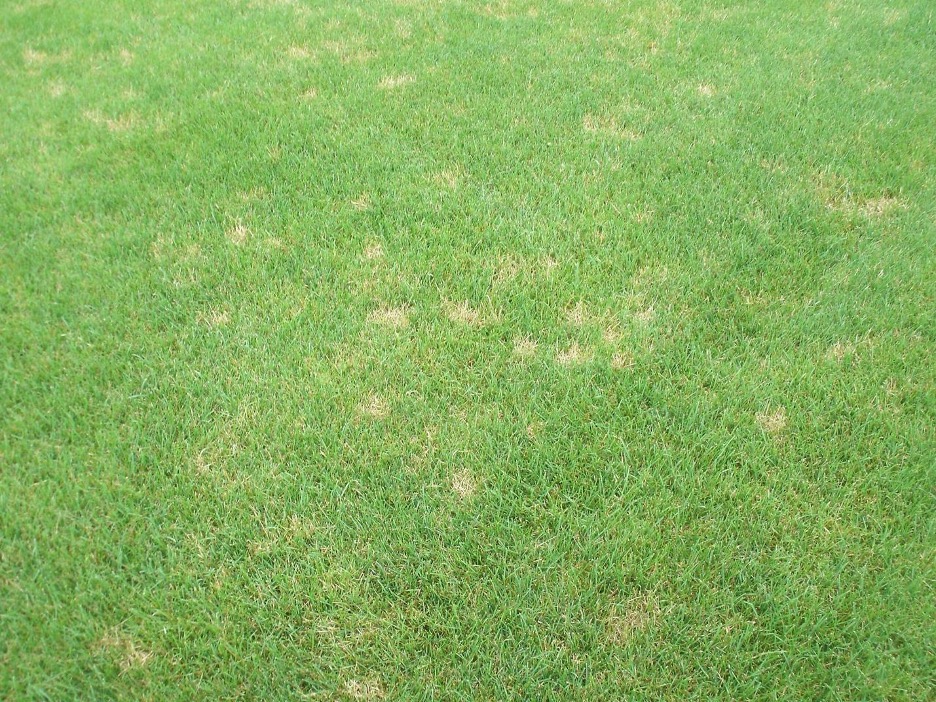
Bermuda is built for this. Drought dormancy is a deliberate survival strategy, and a healthy stand can hold in that state for weeks, dumping the leaf tissue to protect the crowns and rhizomes underground. Uniform straw color across a whole area is actually reassuring. Dormancy is usually even.
Get a spade and take a plug three or four inches deep from the worst area and another from an area you know is fine. Compare them side by side. You are looking at the crown, the compact knot where the shoot meets the roots, and at the rhizomes running through the soil. Living tissue is firm, pale cream to white, and when you scratch the outer layer with a thumbnail there is a hint of moisture and pale green underneath. Dead tissue is brittle, brownish, and hollow, and the runners break cleanly rather than bending. The tug test works too. Grab a handful of turf and pull steadily. Living turf holds on. Dead turf lifts like a piece of old carpet.
Watering Inside a Twice a Week Schedule
Most cities across our service area limit residential irrigation to a set number of days per week through the summer, and the specific day and stage vary by city, so check your own before you plan. Working within that is a technique problem, not a hardship. Two properly executed cycles beat five sloppy ones.
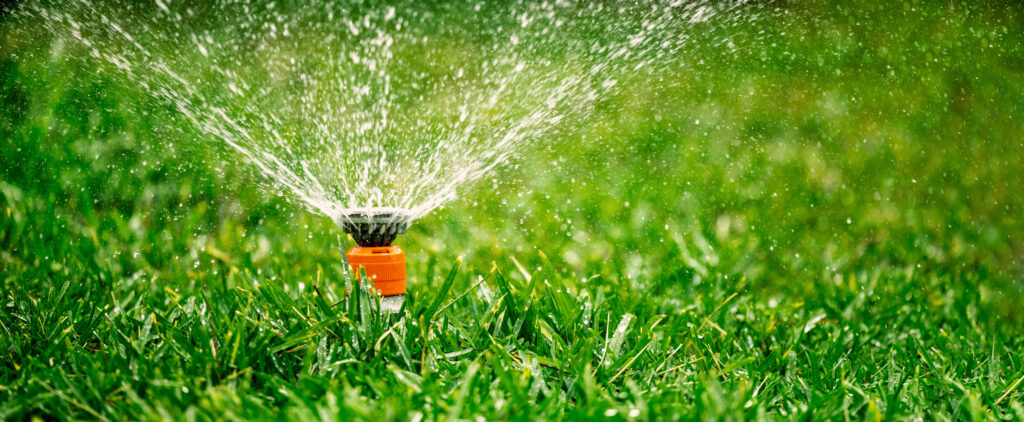
Use cycle and soak. Rather than one long run that produces water in the street within eight minutes, split each zone into two or three shorter runs an hour apart on your permitted day. The first run wets the surface and lets the clay begin to swell and close its cracks, and the later runs actually penetrate. On badly cracked ground, a very light pass the evening before your watering day makes a real difference in how much of the next morning’s water stays where you put it. The goal every time is to move moisture six inches down, not to keep the top inch damp.
Why New Construction Lawns Fail Faster
Here is the pattern we see over and over in the newer sections of Prosper and Frisco. Building a subdivision means scraping the topsoil, driving heavy equipment across the remaining subsoil for a year, and then laying sod over a thin layer of imported dirt at closing. The sod looks perfect on move-in day. It is also sitting on a compacted pan that roots cannot get through.
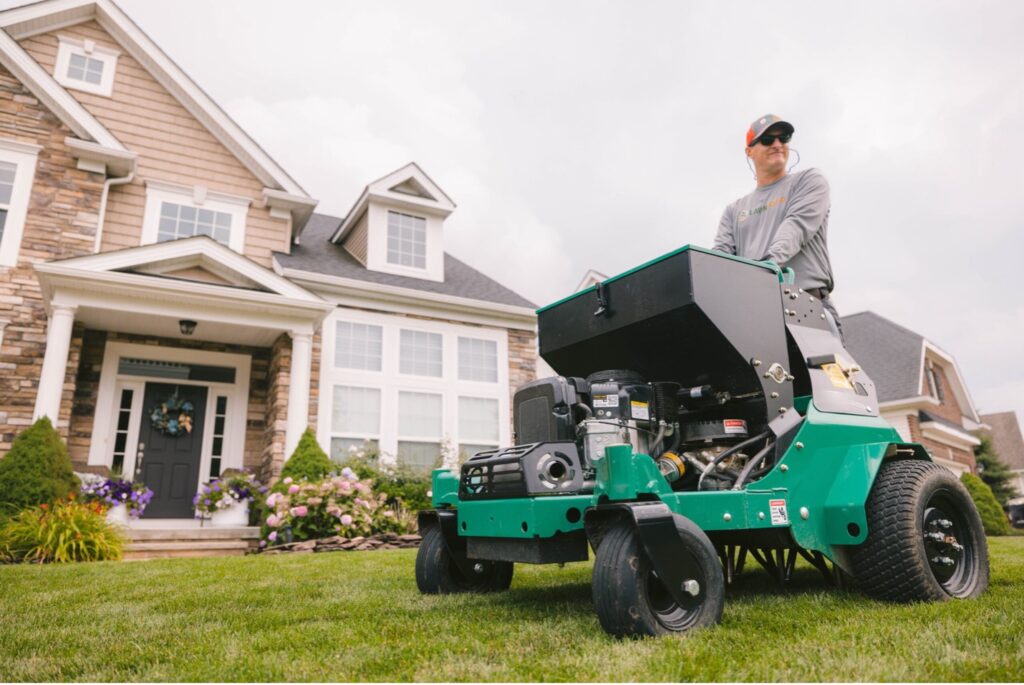
A three-year-old lawn on that profile has a root system two or three inches deep, and two or three inches of North Texas clay in August holds nothing. Those are the yards that actually die rather than go dormant, and they die in the same places every year: the hot strip by the driveway, the corner by the mailbox, the narrow side yard. If that describes your property, the important work is core aeration and organic matter over time. Replacing the grass without addressing what is under it buys about one season.
What to Leave Alone While You Wait
The instinct in a bad August is to do something, and several of the obvious somethings make the situation worse. Fertilizer is the main one. Nitrogen applied to dormant or badly stressed bermuda asks the plant to produce leaf tissue it has no water to support, and on this clay it can also concentrate salts in a root zone that is already dry. Wait for genuine green-up, then feed.
Hold off on herbicide applications during peak heat as well, since stressed turf is far more likely to take injury from a product it would shrug off in May. Raise the mowing height a notch rather than lowering it, because taller leaf shades the soil and slows evaporation, and keep the blade sharp so cuts seal instead of fraying. Keep traffic off the worst areas, including the dog run and the route to the trash cans, since foot and paw pressure on parched crowns turns dormancy into loss. Doing less right now, and doing the watering correctly, is the whole strategy.
When Sod Is Honestly the Better Spend
We would rather talk you out of sod than sell you some you did not need, so here is how we think about it. Bermuda spreads aggressively by stolons and rhizomes, and a bare area surrounded by healthy turf will close on its own at a rate of several inches per month while soil is warm and moisture is consistent. A patch a foot or two across, ringed by living grass, does not need sod. Water it, feed it lightly, and it will knit shut by October.
Sod becomes the better answer when the dead area is too large to close before the growing season ends, when it is dead all the way through rather than thinned, or when there is no healthy bermuda adjacent to grow into it. A large open area left bare all winter does not stay bare. It becomes a nursery for annual bluegrass and henbit, and next spring’s problem costs more than this fall’s sod would have. Timing matters as well: sod laid while soil is still warm roots in before winter, while a late installation goes into cold ground with no time to anchor, and waiting for spring is the smarter play at that point.
What to Do Next
Call us at 469-629-1599 or request a free quote at lawnsquad.com. On the first visit we pull plugs in the questionable areas with you standing there so you see the crowns yourself, check your irrigation coverage and run times against your city’s schedule, and probe for the compaction layer if the house is newer. You get a straight answer about which areas will recover on their own and which will not, in writing, with the honest cost of each path.
Expect the recovery to look like this. In the first two to three weeks of corrected watering, living areas begin to show green flecks at the base before the surface color changes. By thirty days those areas read as recovering rather than dead. By ninety days, with fall root growth and proper feeding, the difference between a lawn that got the right diagnosis in August and one that did not is dramatic. Our VitaminLawn program is built specifically around bermuda on this heavy clay and this climate, with aeration and soil amendments handled as part of the plan rather than as an afterthought. We serve Prosper, Frisco, Plano, Allen, and North Dallas, and this location is independently owned and operated.