Is My Central Indiana Lawn Dead or Just Dormant, and How Do I Tell in August?
Short Answer: Pull a small handful of the brown turf. If it lifts free with no white resistance, those plants are gone. If the base holds and you find a firm, pale green or cream colored crown just above the roots, the plant is dormant and will return. Kentucky bluegrass in Central Indiana is built to shut down in heat and restart when soil cools and moisture returns. Water a test patch deeply for ten to fourteen days. Dormant turf shows new green at the crown in that window. Anything still brown after a genuine watering trial needs seed this fall.
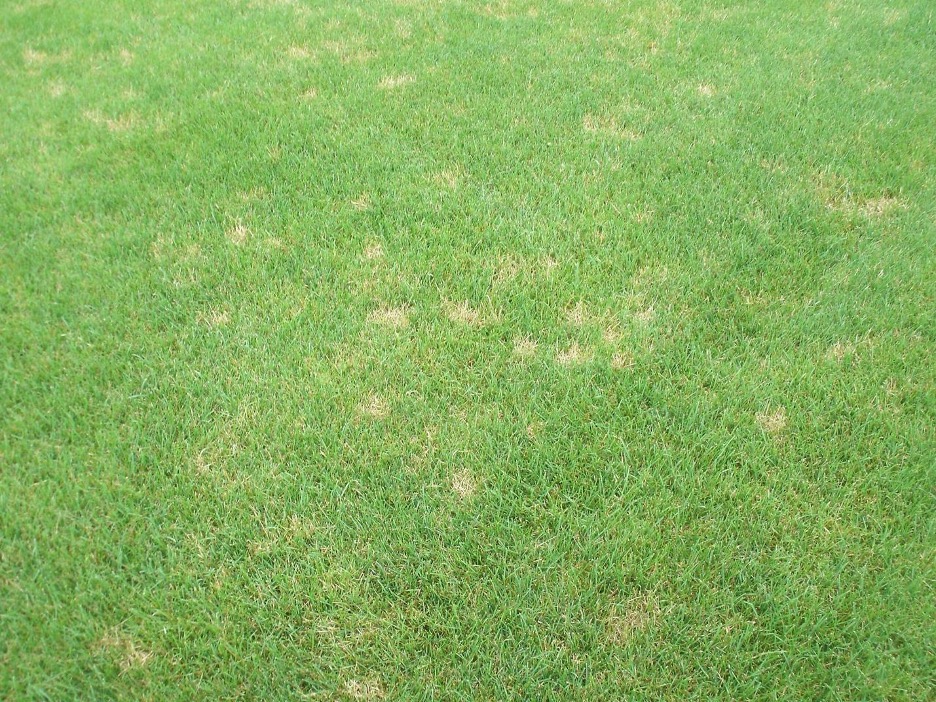
Walk out the back door in the third week of August anywhere between Lafayette and Carmel and the view is roughly the same. The lawn has gone the color of a paper grocery bag. The strip along the south side of the driveway is the worst of it, crisp enough to hear underfoot. Under the maple the grass is still green. The soil has shrunk away from the sidewalk, leaving a crack you could drop a pencil into.
Most homeowners we talk to this month are not asking an academic question. They are standing in the yard doing arithmetic in their heads about sod, and they would very much like someone to tell them honestly whether they have to spend that money. Usually they do not.
Dormancy Is a Strategy, Not a Failure
Kentucky bluegrass, the backbone of most established lawns in Boone, Hamilton, Clinton, and Tippecanoe counties, does something remarkable when soil temperatures climb and rain stops. It stops paying for leaves it cannot afford. Rather than run a water deficit, the plant pulls its resources back into the crown, the compact growing point sitting at the soil surface where the blades emerge from the roots, and it waits. The leaves it abandons turn brown. That brown is not decay. It is a closed storefront.
A healthy bluegrass crown can hold in that state for several weeks and still push new leaves once conditions turn. That is why a lawn in Zionsville can look finished on the fifteenth of August and look like a lawn again by the twentieth of September without anyone buying a single bag of seed. Turf-type tall fescue, which shows up more often in newer subdivisions around Whitestown and Westfield, behaves differently. Its deeper roots let it stay green longer, so a fescue stand that has actually browned tends to be in more genuine trouble than bluegrass at the same color.
The Crown Test Takes About Ten Minutes
Pick three spots that represent the range of what you are seeing: the worst area, an average area, and a spot that still looks decent. Grab a small tuft of turf between your thumb and fingers and tug straight up with steady pressure.
Living turf resists. The plant is anchored, and when you part the brown leaves at the base with your fingernail you will see a short, firm section just above the roots that is pale green, cream, or ivory, and it feels plump rather than papery. That is the crown, and it is alive. Dead turf comes away in your hand like the top of a worn out doormat, roots either absent or dark and brittle, and the base is the same dull brown as the leaves.
Do this in all three spots and you learn something more useful than a yes or no. You learn the percentage. Across our service area we walk a lot of properties in August, and the pattern we see most often is a lawn that is roughly eighty percent dormant and twenty percent genuinely lost, concentrated in predictable places. That is a very different conversation than a dead lawn.
Where the Damage Sits Tells You What Caused It
Geometry is diagnostic. Damage that follows straight lines along pavement, or forms a fan shape radiating from a sprinkler head, is water distribution. Damage on the crest of a slope while the bottom stays green is runoff on clay, and it is extremely common on the rolling ground out toward Delphi and Battle Ground. Damage in irregular blotches with clean edges, where the turf rolls back like carpet because there are no roots holding it at all, is grubs rather than drought, and no amount of water will bring that back.
Then there is the newer subdivision problem. A lot of homes between Lebanon and Sheridan sit on ground that grew corn and soybeans until fairly recently, and during construction the topsoil was scraped, the subsoil compacted by equipment, and a thin blanket of soil rolled back over the top before sod went down. Those lawns brown first, brown hardest, and recover slowest, because the root zone is only a few inches deep before it hits dense clay.
The Watering Trial That Settles the Argument
If the crown test leaves you unsure, run the trial. Pick a representative brown area and water it deeply, about an inch total per week delivered in one or two long sessions rather than daily sprinkles. Set a tuna can out to measure it. Do this for ten to fourteen days and watch the base of the plants, not the tips. The old brown leaves will never green up. Recovery shows as fine new blades pushing from the crown, and at first it reads as a faint green haze you can only see at a low angle in early morning light.
Give it the full two weeks. Turf dormant for a long stretch is slow off the line because it rebuilds roots before it can afford leaves. If the area is still uniformly brown at day fourteen with no green fuzz at the base, it is not coming back, and now you know how much seed you need instead of guessing.
What Recovery Actually Looks Like on the Calendar
Real recovery in Central Indiana is usually driven by weather rather than by anything you do. When nighttime lows settle into the low sixties and we get a decent soaking, dormant bluegrass wakes up on its own. That typically means the back half of September, sometimes the first week, and it looks thin and uneven at first because the crowns do not all restart on the same day.
By mid October a dormant lawn that was never actually dead is usually back to full color, though it may still be thinner than it was in May. That thinning is the real cost of a hard summer, and it is what overseeding solves. The window for that work here runs roughly from mid August through mid to late September, when seed meets warm soil and cooling air, the most favorable combination cool season grass gets all year.
When to Stop Waiting and Start Seeding
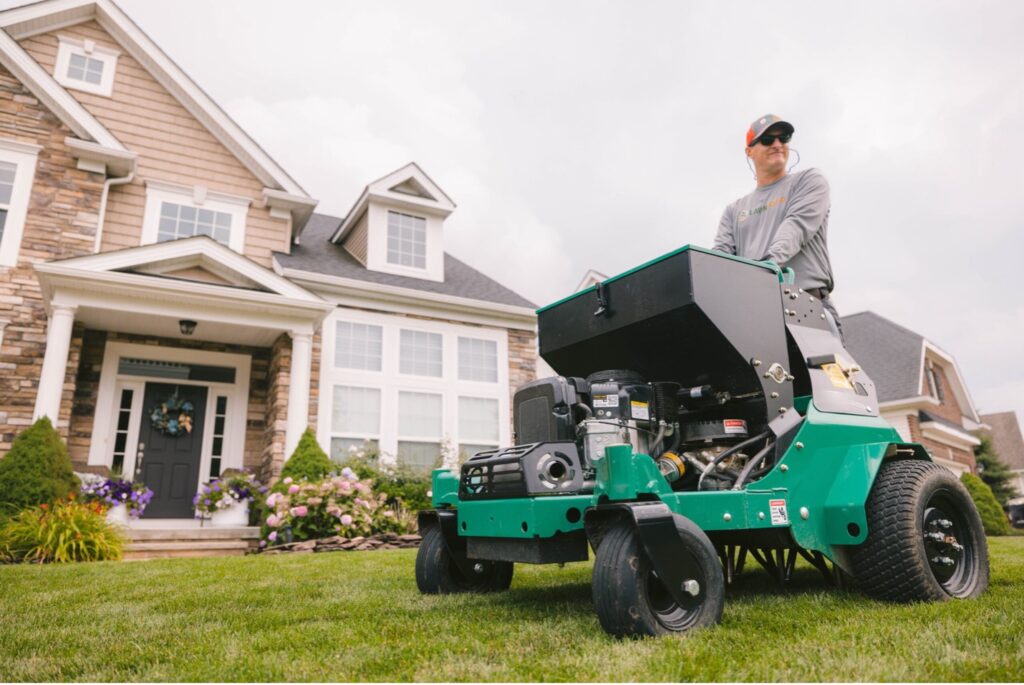
Here is the honest line we use. If more than about a third of an area failed the tug test, waiting for natural recovery will leave you with a thin stand that crabgrass and nutsedge will happily colonize next June. That area wants core aeration and overseeding, ideally in the same visit, so the seed drops into open holes and makes real contact with soil rather than sitting on top of thatch.
If the failure is under a third and scattered, dormant neighbors will fill much of it in on their own, especially with bluegrass, which spreads laterally by rhizomes. Fescue does not do that, so a fescue lawn with bare patches needs seed in those patches regardless. And if the tug test showed turf rolling up with no roots at all, treat the grubs before you seed, or you will feed the same insects a fresh crop.
What to Do Next
Run the crown test this week while there is still time to act. Write down roughly what percentage of each area failed. If the number worries you, or if what you found does not match anything described here, call us at 765-343-4785 and we will come look at it. A first visit is a walk of the property with you, a look at the soil profile and root depth, a check on irrigation coverage, and a straight answer about how much of the lawn needs seed and how much simply needs time and cooler nights. Quotes are free, and there is no charge for being told to wait.
If seeding is the call, expect germination in roughly one to three weeks depending on the seed and the weather, with bluegrass on the slow end. At thirty days you should see even, fine new grass filling the openings and a lawn that looks noticeably better but not finished. At ninety days, which lands in late fall, the new plants should be established and rooted well enough to hold through winter, with the real payoff visible next spring when those areas green up alongside everything else instead of coming back bare.
Longer term, the lawns that shrug off an August like this one are the lawns with deep roots and balanced soil nutrition going into summer. That is the whole idea behind our VitaminLawn program, which builds a fertilization and weed control plan around the grass types, the heavy clay, and the swing between our humid Julys and dry Augusts rather than a generic national schedule. We serve Carmel, Westfield, Zionsville, Lafayette, West Lafayette, Lebanon, Frankfort, Sheridan, Whitestown, Thorntown, Delphi, Monticello, Brookston, Dayton, and Battle Ground. Learn more at lawnsquad.com, or reach the local team at 765-343-4785.