Short Answer: If your Utah County Kentucky Bluegrass, Fescue, or Rye lawn is already showing brown spots and crispy edges in early July, the priority for the next seven to eight weeks is protection, not pushing recovery. Keep crowns alive with about half an inch of water every 10 to 14 days on dormant areas, raise the mower to 3.5 to 4 inches, stop fertilizing until late August, treat disease promptly, and respect any local secondary water restriction. Real recovery happens in September with aeration and overseeding. July effort spent the wrong way undermines the September comeback we are counting on.
You walk out the back door in Provo, Orem, or Lehi on a bright Tuesday morning in early July, and the lawn that looked so good on Memorial Day has changed. The south-facing slope is tan. The strip next to the driveway is straw colored. The area you forgot to adjust on the sprinkler controller is bare. Your neighbor in Spanish Fork sent you a photo of their yard and theirs looks just as rough. It is easy to start thinking about giving up on grass and converting to gravel.
Slow down. We have walked thousands of Utah County lawns through July, and we can tell you with high confidence that what you are looking at is not dead. It is doing exactly what cool-season grass is supposed to do when the Wasatch Front delivers seven straight days of 95 degree highs paired with 12 percent afternoon humidity. It is shutting down. Your job in July is not to wake it up. Your job is to keep it alive until the calendar saves you in September.
Why Utah County Lawns Hit a Wall in July
Most lawns from Lehi through Spanish Fork are Kentucky Bluegrass, Tall Fescue, Perennial Rye, or a blend of the three. These cool-season grasses thrive in the 55 to 75 degree weather of April, May, late September, and October. They tolerate the freezing temperatures of January with snow cover. What they cannot do is grow vigorously when soil temperatures push past 78 degrees and air temperatures stack day after day above 90.
Along the Wasatch Front in July, we typically see 18 to 25 days above 90 degrees, soil temperatures in the low 80s by mid-month, and afternoon humidity dropping into the teens. The combination matters more than any single number. Heat alone, Kentucky Bluegrass can manage in dormancy. Heat plus high evaporative demand from dry air drains water from the soil faster than the plant can replace it through its roots. Add in our alkaline soils with pH commonly 7.5 to 8.2, which lock up iron and other micronutrients the plant needs, and you have the perfect conditions for heat-induced dormancy.
Dormancy is not death. It is a survival mechanism baked into cool-season grass genetics. The crown of the plant at the soil line stays alive. The blades go tan to stop transpiring. The roots stop growing actively. The plant essentially holds its breath. A healthy Kentucky Bluegrass lawn can stay dormant for 4 to 6 weeks and bounce back when nights cool down. That is the bet you are making in July.
What Real Watering Looks Like When the Lawn Is Already Stressed
This is where well-meaning Utah County homeowners do the most damage. The instinct when grass looks crunchy is to water more. The reality is that light, daily watering during a heat wave is one of the worst things you can do to a stressed cool-season lawn. It wets only the top half-inch of soil, evaporates in our dry air before it can soak in, trains roots to stay shallow, and on the days when humidity does spike before a thunderstorm, sets up the leaf wetness window that triggers brown patch and dollar spot.
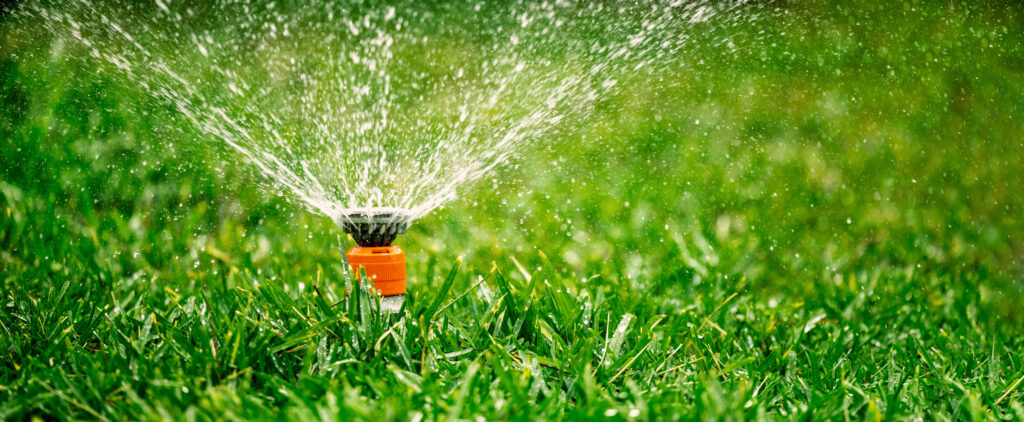
If your lawn still has color and you are trying to keep it that way, run deep cycles. Three quarters of an inch to one inch total per cycle, applied between 4 and 8 a.m., two or three times per week. On the alkaline clay loam typical across Utah County, split each cycle into two shorter runs 45 to 60 minutes apart so the water actually soaks in instead of running off. The surface crust on our soils rejects fast water and accepts slow water.
If your lawn has already gone dormant and looks straw colored, switch to a maintenance schedule. About half an inch of water every 10 to 14 days. That keeps the crown alive without coaxing the plant out of dormancy and back into stress. Pushing dormant grass to green up in mid-July and then sending it back into dormancy two weeks later when the next heat wave hits is harder on the plant than leaving it asleep.
Respect your secondary water schedule. Many neighborhoods in Provo, Orem, Pleasant Grove, Lindon, and Saratoga Springs run pressurized irrigation systems with assigned watering days. Trying to cheat the schedule is rarely worth the risk, and the systems are designed to deliver enough water for properly programmed lawns on the assigned days.
The Mowing Adjustment That Saves the Most Grass
Raise the mower. If you have been mowing at 2.5 or 3 inches all spring, move to 3.5 inches in late June and 4 inches by early July. Sharper blade. Less frequent mowing.
This matters more than people think. Every blade of grass is a solar panel and a shade structure. Taller blades shade the soil, keep root-zone temperatures lower, and reduce evaporation. They also support a deeper root system, because the plant maintains roughly a 1-to-1 ratio between blade height and root depth. A 4-inch lawn on Utah County clay loam might have roots 4 to 5 inches deep. A 2-inch lawn over the same soil might have roots only 2 inches deep, which puts the plant in chronic drought stress even when water inputs look adequate.
Mow less often during the heat. If the lawn is not growing, do not mow it. Cutting tan, dormant grass just to make the edges look clean stresses the crowns and creates entry points for disease at every cut tip. Wait for cool nights and a real rain or irrigation cycle before mowing dormant turf.
Keep blades sharp. A clean cut heals in 24 hours. A torn cut from a dull blade leaves a frayed wound that loses water rapidly in our dry air.
Disease and Pest Pressure on Utah County Properties
July in Utah County does not have the humidity-driven disease pressure of the Midwest or Northeast, but we are not pressure free either. Two issues we see most often.
Necrotic ring spot and summer patch hit Kentucky Bluegrass lawns on the alkaline soils of Utah County hard. The symptoms look similar. Circular yellow to tan patches that expand outward through summer, often with greener grass in the center, giving them a frog-eye appearance. The damage is largely already done by the time you see it on the surface. Treatment now is about suppression and setting up the recovery seed for September, not eliminating the disease this season. If you see the rings, lower the nitrogen, raise the mower, and call us to look at the underlying soil chemistry, because these diseases love high-pH soils that lock up iron and manganese.
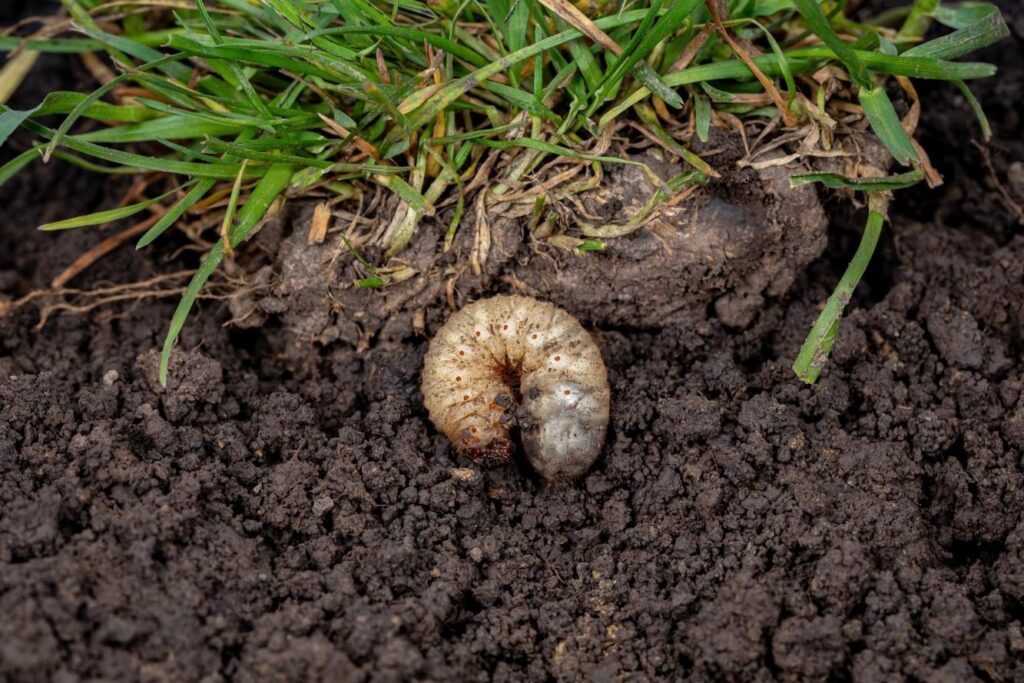
Billbug damage shows up in July as expanding dead patches that pull up easily when you tug on the brown grass. Billbug larvae feed inside the grass stems and at the crown, and the damage often looks like drought even though the lawn is being watered correctly. Roll back a piece of damaged turf. If you see small white grub-like larvae with brown head capsules, that is billbug, not drought, and the treatment plan is different.
Brown patch and dollar spot show up only when humidity spikes during monsoon thunderstorm patterns in July and August. If we get a stretch of high dew points, the rules change. Skip evening watering immediately. Get a fungicide on the area within 7 days if patches are spreading.
What Not to Do in July on a Utah County Lawn
- Do not fertilize with synthetic nitrogen on stressed cool-season grass. You are forcing top growth the roots cannot support, and you are burning crowns that are already heat stressed.
- Do not apply broadleaf herbicide in temperatures above 85 degrees. The product volatilizes in our dry air, drifts onto your tomatoes and your neighbor’s roses, and the heat amplifies any chance of turf damage.
- Do not power rake or dethatch. This is a September job.
- Do not seed bare patches in July. Seed will germinate but seedlings cannot survive the heat without daily babysitting. Wait for late August or September.
- Do not lower the mowing height. This is the surest single way to turn dormancy into actual death.
- Do not run the sprinklers at midday. Beyond the water you lose to evaporation, you risk leaf scorch on droplets sitting in full Utah sun.
How July Decisions Set Up September Recovery
Here is the part that matters most. Utah County has one true window for major lawn renovation each year. It opens around the third week of August, when overnight lows start dropping into the 50s and soil temperatures fall back into the 70s, and it closes around the third week of October when the first hard frost arrives. About eight weeks. That is the window for core aeration, overseeding, soil amendments, and the heavy fall fertilization that builds the lawn you want for next May.
Everything you do in July is in service of getting to that window with living crowns. Crowns are the bank account. If you spend them down through stress, disease, and well-intentioned mistakes in July, September has less to work with. If you protect them, September can do almost anything.
We start mapping renovation plans for our Utah County customers in mid-July. We walk the property, mark the dead zones, recommend the seed blend that fits the sun and exposure, address the alkaline soil chemistry through chelated iron and acidifying amendments, and put the aeration date on the calendar before the calendar fills up. The customers who book in July get the late August and early September slots, which is exactly when the weather window opens.
What to Do Next
If your Utah County lawn is already showing summer stress and you are not sure what to do, we are here for that conversation. We will walk the property, identify what is dormancy versus disease versus billbug damage, give you the watering and mowing plan for the next eight weeks, and map the September renovation that brings the lawn back stronger.
Lawn Squad of Utah County serves Provo, Orem, Lehi, American Fork, Pleasant Grove, Lindon, Saratoga Springs, Eagle Mountain, Springville, Spanish Fork, Mapleton, Payson, and the surrounding Utah County communities.
Call us at 385-336-6785 or request a free quote at lawnsquad.com. Our VitaminLawn program is calibrated for cool-season Kentucky Bluegrass and Fescue lawns on the alkaline high-desert soils of the Wasatch Front, and we will build the July-through-September plan that protects what you have and sets up a real fall recovery.